

Friday, February 27, 2009

Ticket for the Wind

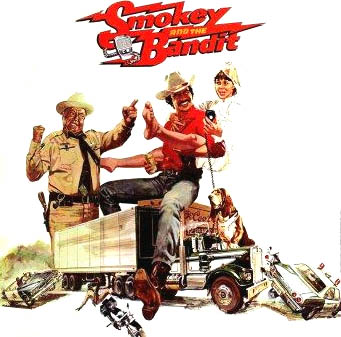
In the previous two posts, I talked about my adolescent experiences seeing both Smokey and the Bandit and Smokey and the Bandit II. For me, these movies fall into that strange category of films where they are so bad, they are good. However, I still thought they could have been better than they were. Not so much the first one, but the sequel definitely could have easily been improved with a more sensible plot and a faster tempo. I really didn't think the studio would risk a third installment after the embarrassment of the second, but the studio and Jackie Gleason were not ready to let go of the franchise just yet.

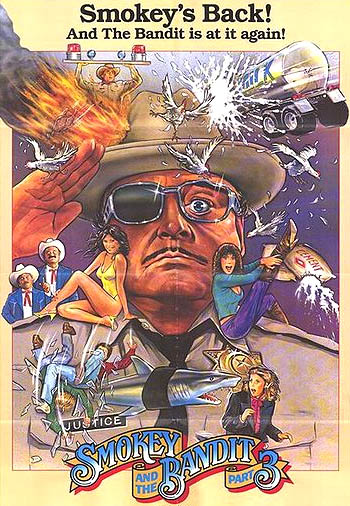
After seeing the horrible Cannonball Run in the summer of '81, I swore I would never see another one of these movies ever again. My resolve was only strengthened when I read that the third installment of the Smokey saga would feature Jackie Gleason in both roles and be called Smokey IS the Bandit. I couldn't get my mind around how this would work. Was Buford going to get knocked on the head and suddenly think he was the Bandit? If so, who would be chasing him as the sheriff? My mind boggled, but I still had no thought of seeing it, at least not in the theatre. Later, in the spring of '83, I read that the test audiences hated the dual-role idea and the studio was hastily shooting new footage to remake the movie in time for a summer release. It finally came out as Smokey and the Bandit Part 3 in late summer (why it was "Part 3" and not "III" is unclear). The bad-movie lover in me was tempted to see how they cobbled this mess together, but the only theatre showing it in my area was a dirty little dump that actually became a porn theatre later that same year. I took a pass.

The following summer, Smokey and the Bandit Part 3 popped up on cable, so I watched it. I was surprised that I didn't dislike it as much as I thought I would. At least they did remember to fill the movie with lots of high speed car stunts, and they kept the story hopping at a rapid clip (at only 85 minutes running time, they had no choice). In the revised version, a retired Buford T. Justice (Jackie Gleason) decides to take a challenge from Big Enos and Little Enos Burdette (Pat McCormick and Paul Williams) because he is bored. To hedge their bet, they enlist Cledus Snow (Jerry Reed) to pretend to be the Bandit and generally get in Buford's way. The Enos boys also create diversions of their own, including trying to blow Buford and his son to bits with explosives. Why these two would want to become murderers to protect their bet is not explained.

While watching the hijinks, I'm always distracted by the thought of how the movie looked in its original form. During the car stunts involving the Trans Am, you can see that the person in the driver's seat is made up to look like a fat, older version of the Bandit, in keeping with the original premise of Jackie Gleason playing both parts. The fact that Jerry Reed has to wear a bad fake moustache to look vaguely like the Bandit is also disconcerting. Although the movie has a disconnected feel no doubt created by the large amount of reshooting, the old and new footage meshes better than you would expect and you sometimes believe that Gleason and Reed may have actually been on the same set at the same time. Nevertheless, this movie is cringe-worthy in countless ways.

Burt Reynolds makes a cameo at the end which is utterly nonsensical, but I think the producers wanted to somehow make up for the Burt-lessness of the previous 80 or so minutes of the movie. It doesn't help. Just when you are feeling completely depressed for watching this travesty, the ending credits roll with a song from former Kingston Trio head John Stewart titled, "Ticket for the Wind." Although it's a great song, the downbeat quality is completely inappropriate for a farcical comedy. Think "Tom Dooley" with an 80s electronic beat. You can listen to it here.

I remember getting to this part of the movie and just feeling so sorry for the entire cast. They actually tried to be entertaining, but ended up embarrassing themselves. Around this time, Gleason seemed to be embarrassing himself on a regular basis with such films as The Toy and The Sting II. Somehow, his reputation remained unsullied, though. I guess people loved The Honeymooners so much, they could forgive him.

I can't leave this final segment on the Smokey and the Bandit saga without mentioning the dubbing. While in the first two installments they used character actor Henry Corden to overdub Gleason's voice in certain scenes, for the third installment, they couldn't even get his services. In Part 3, some scenes feature overdubs by someone who doesn't sound even remotely like Gleason. It's kinda like the sound engineer just went into the studio and took a crack at it. Although unintentional, it's the funniest thing in the movie.

Wednesday, February 25, 2009

Texas Bound and Flyin'

In my previous post, I talked about my adolescent memories of seeing Smokey and the Bandit. While I was growing tired of the car chase formula, the unabashed silliness and fast-paced action of Smokey sucked me in. When the sequel was announced, I wasn't so sure they could strike lightning twice, and I had no intention of seeing the movie when it came out. Things changed, however.

By the time I got my driver's license, Smokey and the Bandit II was in the theatres. In fact, on the day after I received my license, my mom let me borrow the car for the day and my friend Vince and I went out to exploit our new found freedom. We ended up at the mall where we wanted to see a movie. Unfortunately, the only film at the multiplex that was not rated R (we were both still under 17) was the new Smokey movie. Although I liked the first one, I had bad feelings about the sequel and my reservations were well founded.
Instead of a light, rapid-fire comedy, we were treated to a plodding, stupid story with a drunken, loser Bandit (Burt Reynolds) acting like an ass and generally bumming everyone out. In a nutshell, Big Enos and Little Enos Burdette (Pat McCormick and Paul Williams) resurface to make a proposition to Cledus "Snowman" Snow (Jerry Reed). They want Cledus and Bo "Bandit" Darville (Burt Reynolds) to transport a mystery package from Miami to Dallas, Texas in three days. Fairly simple, except the Bandit has disappeared. His 15 minutes of fame after the Texarkana to Altanta run had expired and Bo is now hiding in a sleazy Florida motel drinking himself to death. Meanwhile, Carrie (Sally Field) has left him and is about to once again marry the son of Sheriff Buford T. Justice. Justice (Jackie Gleason) is none too pleased with the arrangement, but when Carrie decides to run off again and save the Bandit, he holds her at gun point to stop her. After she escapes, Justice and his son (Mike Henry) are once again in "hot pursuit."

There's a lot of time wasted as Carrie and Cledus try to detoxify the Bandit. When they finally pick up the package, which turns out to be a female elephant, and get on the road, Justice has tracked them down and tries to stop them. From this point, the story plods along in fits and starts. The elephant turns out to be pregnant, so they pick up an Italian doctor (Dom Deluise) to watch after her. They have to stop frequently to accommodate the elephant's delicate condition, leaving plenty of time for Bo and Carrie to fight and for Bo to act like an insensitive jerk to the elephant. While the first movie was driven by the tight 28-hour deadline to get Coors Beer from Texarkana to Atlanta, there's no sense of urgency in the sequel and the gang spends most of the time out of their vehicles arguing with each other. Meanwhile, Buford T. Justice is supposed to be in "hot pursuit," but there is no explanation as to what he's up to while the heroes are mulling around. He just pops up conveniently when he's needed to chase them around.

Finally, in a feeble attempt to liven up the finale, Sheriff Justice enlists the help of his law officer cousins to lure the Bandit into an ambush. The ambush occurs in a desert environment where the law officers descend on the Bandit from the surrounding hills in their police cruisers. Although the visual metaphor of old-time movie Indians attacking the settlers in their stage coaches is obvious, the whole fiasco makes no sense since there are no desert areas anywhere between Miami and Dallas. Even if you are willing to suspend disbelief, dozens of cars smashing into each other like a demolition derby is not really the same as the thrill of watching high speed car stunts. It's just mindless destruction, and it gets monotonous real fast.

Since the theatre was mostly empty, Vince and I entertained ourselves by calling out remarks at the screen, mocking the whole mess while it spooled out onto the screen. The only redeeming factor was that I got to hear Buford's salty dialogue as it was meant to be heard, uttered by Jackie Gleason himself. As mentioned in the previous post, Gleason's redubbed dialogue for the TV version was voiced by character actor Henry Corden. As it would turn out, Corden would also provide the redubbed language in the TV version of the sequel. I still cringe at hearing Fred Flinstone's voice coming out of Gleason's mouth.

For days and weeks after seeing the debacle that was Smokey and the Bandit II, I kept pondering how the movie could have been so much better. By this time, I fancied myself a writer and had already scribbled out two novels, two screenplays, and numerous short stories. I knew I could come up with a better script than this horrid piece of junk.

At first, I thought the film would simply pick up where the last one left off. At the end of part one, the Enos's ask Bo, Carrie, and Cledus to run up to Boston and bring back a large quantity of baked beans. Since they only had 18 hours, perhaps they could employ airplanes or helicopters. Really open up the action. Then I thought better of that. After all, it had been three years later, and the filmmakers would want to use a new Trans Am, the iconic symbol of the series.

Fine, three years later it is. Although the Bandit could have built a celebrity status based on his stunts, he would still be facing numerous criminal charges from his behavior in the last movie. He would have to stay on the run or come to some arrangement with the law. Perhaps Carrie offers herself to Justice's son again as a way to get the sheriff to leave Bandit alone. Maybe she realizes that she can't stay with a guy like Bo long term, but she could still make a sacrifice for him out of love. That would provide some explanation for why she would try to marry Junior again, even if it was a weak one.
Okay, the Bandit is free and he is certainly no drunk, although he misses Carrie. The Enos's offer a big bet, but nothing involving cutesy elephants or kittens or koala bears. Maybe they have to bring Farrah Fawcett from Hollywood to take Little Enos's virginity? I don't know! Just keep the damn thing on the road and moving!
The feeble nature of the sequel's storyline only enhanced the unmistakeable sense that car chase movies were a thing of the past. All the CB jargon, so hip in the mid-70s, sounded tired and stupid by 1980. These characters and the whole genre was passe. When the chance to do a third movie cropped up, even Hal Needham and Burt Reynolds said, "no thanks." Jackie Gleason had other ideas though...
Monday, February 23, 2009

East Bound and Down

After hearing the news that GM's sporty division Pontiac would become a small, niche car line with only a few models, I couldn't help but become nostalgic for the days when the Pontiac Trans Am was the American muscle car for the beer pocketbook set, helped in no small part by the Smokey and the Bandit movies. These films hold a special place in my vault of so-bad-they-are-good movies. I never sought them out when they were in the theatres, but I somehow ended up seeing each one several times and find myself dissecting them with a degree of analysis normally reserved for films like Citizen Kane or Casablanca. I think it's their very slip-shot nature that makes them endlessly fascinating since there are so many continuity issues, plot holes, and inconsistencies in character, you can't help but wonder why they wrote or shot what they did. To simply say, "It's a crappy movie!" isn't sufficient in my book.

The summer of 1977 seemed like the first true movie summer. Sure, Jaws had torn up the summer box office two years prior, but '77 was the first summer where the studios actively sought to put out crowd pleasing movies for the kidsc who were home from school and the parents who were on vacation. This was the summer of Star Wars, The Spy Who Loved Me, A Bridge Too Far, and Smokey and the Bandit. In fact, Smokey was the second highest grossing movie of the year. Even still, at the time, I didn't feel any great need to rush out and see it.

To me, Smokey was the culmination of a movie trend that was on the verge of playing itself out. Numerous car chase movies, usually dealing with good ol' boys who are runnin' moonshine or generally screwin' with the law, had been cluttering up the drive-ins for years. Initially, the movies were played straight, but audiences found the outrageous car stunts to be unintentionally funny. Also, watching the anti-heroes stick it to the corrupt, redneck sheriff usually brought about hoops and hollers of joy from the anti-establishment crowds of the 70s. After awhile, the filmmakers took a more lighthearted approach to these kinds of films. Even the producers of the Bond films inserted a comic-relief sheriff in two of their 70s films (Lie and Let Die and The Man with the Golden Gun). It took director Hal Needham to finally jump in the deep end and create a car chase movie that was played for pure laughs. Burt Reynold and Jerry Reed had already taken a serious stab at such material in the movie Gator, so they were perfectly suited to lampoon the good ol' boy action film. Throw in (then) sitcom darling Sally Field and comic legend Jackie Gleason as the blustery sheriff, and you had a big budget spoof that had real potential to reach a mass audience.

The plot was fairly straightforward: Millionaire Big Enos Burdette (Pat McCormick) and his son Little Enos (Paul Williams) offer Bo "Bandit" Darville (Burt Reynolds) the princely sum (for the 1970s) of $80,000 if he can transport a truckload of Coor's Beer from Texarkana, Texas to Atlanta, Georgia in 28 hours. In those days, Coor's Beer could not be transported past the Mississippi, so this was flat-out bootlegging. Bo agrees and, to make the best possible time, he enlists the help of his friend Cledus "Snowman" Snow (Jerry Reed) to drive the truck while Bo runs interference with the police using his flashy Trans Am. All goes well on the trip to get the beer, but things go awry on the return leg when Bo picks up a pretty girl in a wedding dress. Turns out the woman, Carrie (Sally Field), is running away from marrying the son of a Texas sheriff. The sheriff, Buford T. Justice (Jackie Gleason), is not about to let her get away and soon, the Bandit has a permanent Smokey on his tail all the way to Atlanta.

Despite all the praise I was hearing about the movie, I was dubious. As I said, I had seen so many car chase movies already and even the star power of this one wasn't turning my head. It wasn't until two years later, when the movie finally popped up on broadcast television, that I gave it a chance. By this time, I was studying for my driver's license and I was becoming completely obsessed with automobiles. I studied everything I could get my hands on about how cars worked, the history and evolution of the car, the differences between the various makes and models, the whole nine yards. Suddenly, watching this flashy Trans Am do all these stunts and roar down the highway had new appeal. I liked the rapid pace of the story and the constant banter which, to a teenager, was far more clever than it would sound to me as an adult.

But I was also fascinated by the inexplicable oddities. I could chalk up the strange continuity issues to problems with matching the stunt shots with the principal photography, or the inexperience of a first-time director, but the odd dubbing of the broadcast television version was truly bizarre. When Smokey and the Bandit was originally released, it received an R rating, I assume for the harsh language. By the time it reached television, the movie had developed a huge following and I think the producers felt compelled to overdub virtually all the dialogue to wipe out any trace of foul language, lest they offend the Bible Belt viewers who were their primary audience. Burt, Sally, and Jerry all did their own overdubs, but for Jackie Gleason, it sounds like his voice was replaced with that of Henry Corden, a character actor best known for taking over the voice of Fred Flinstone after Alan Reed died. Not only does it look like Jackie Gleason is channeling the ghost of old Fred, the lines the writers came up with to replace the colorful metaphors are utterly inane and often unintelligible. All these years later, I've never been able to find a satisfactory answer as to why Gleason could not do his own overdubs.

A couple years later, cable TV invaded my neighborhood and the unedited version received regular rotation on channels like HBO and Showtime. With the original dialogue restored, I got a better understanding as to why everyone thought this movie was so funny. Still, I didn't have any burning desire to see the second entry in the series, but I did anyway...

Monday, February 16, 2009

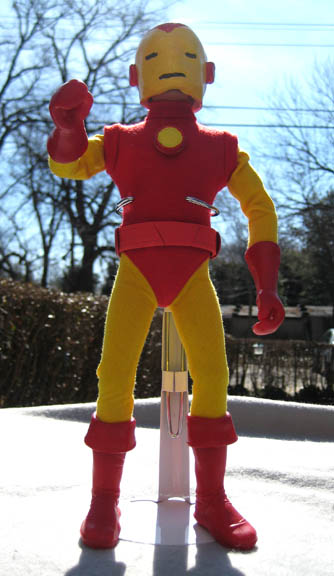
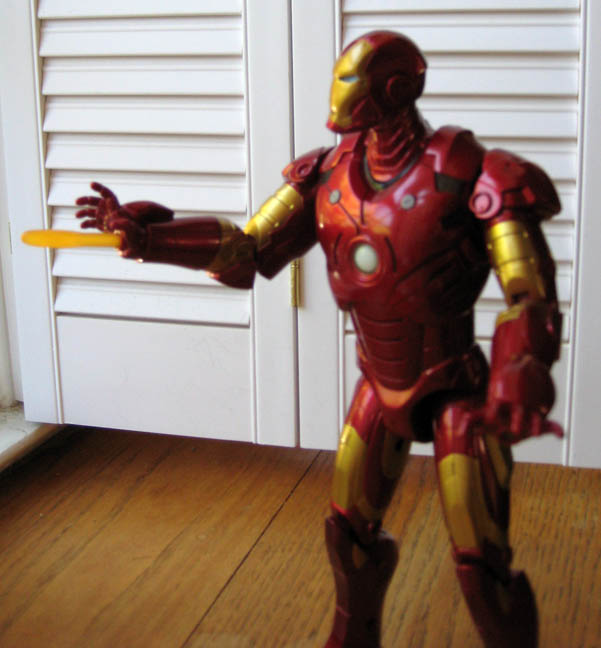
Custom Figure - Silver-Age Iron Man

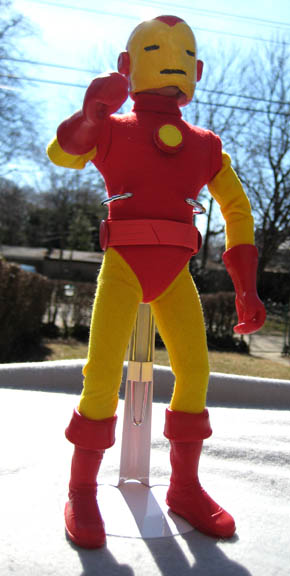
For years, I've wanted to create a custom Iron Man action figure along the lines of the Captain Action suit sets from the 60s. Although I was always more of a DC kid than a Marvel fan, Iron Man was one of the few exceptions. The tone of the stories seemed different than most of the other Marvel characters, with dashing Tony Stark fighting communists and other world dominators in his fancy, hi-tech armor. He was like Bruce Wayne and James Bond rolled into one, which was more my speed than whiny Peter Parker or those preachy X-Men. Iron Man was definitely one of the super heroes I had hoped Ideal would use for their Captain Action line of outfits. Alas, it was not so and, like the Flash and Green Lantern and so many others, I would have to do it myself. But how?

At first I toyed with the idea of creating an actual suit of armor using bits and pieces from other action figure sets, mostly relying on the armor pieces from the old Marx Noble Knights line. Unfortunately, that did not prove very feasible and it really wasn't in the spirit of the old Captain Action outfits, which were stretchy polyester leotards. Then, a couple years ago, Rauty's Toy Shop created a nifty Iron Man outfit for 1/6th scale figures sort of like the Mego figure. I'd provide a link for Rauty, but he doesn't seem to have a Web site at the moment. His stuff pops up regularly on eBay, however.

At least I knew I could get a costume, but what about the boots and gloves? Wes McCue of Classic Plastick makes all kinds of gloves and boots based on super heroes, but he didn't have anything like Iron Man's, which had little repulsor rays in the palms of the gloves and on the soles of the shoes. I was lamenting all this to my wife Kathy who, God love her, took all this in and set into action. She contacted Wes about whether or not he had such items and, while he didn't, he liked the idea of creating some. Kathy wanted to present me with these items for Christmas, but as Christmas approached, Wes had only created prototypes, so he sent her the prototypes to avoid her being empty handed. The gloves and boots were modeled on his existing stock, but with the little repulsor rays added to the palms and soles. He has since refined the design to feature rolled cuffs on the tops of the gloves and boots as well. I think the prototypes work just fine, though.


On Christmas Day, Kathy presented me with the suit, gloves, and boots. Needless to say, I was bowled over and couldn't wait to get started on my custom Iron Man. Of course, there was still the issue of the mask. Wes had suggested to my wife that I start with the back part of a vintage Phantom mask. That made a lot of sense, but I had already used my last spare Phantom mask to create a mask for my Space Ghost custom. I finally decided to mold one out of polyvinyl clay even though I knew the material would never be thin enough to have the proper proportions. It would have to do for the time being, however.

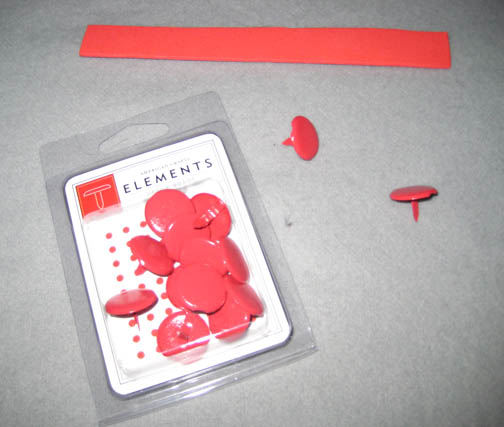
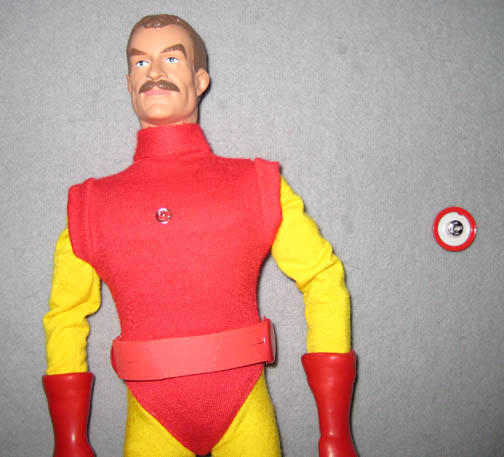
To mimic the sort of belt arrangement with the red discs on the sides of Iron Man's hips, I used a strip of red foam rubber and scored lines and a belt buckle shape into it with an X-Acto knife. For the red discs, I used some red push pins I found in the crafts store, and I secured the belt around his waist with velcro.

I was also stuck on how to fashion the round disc on Iron Man's chest, so I scoured my spare model parts until I found a wheel piece from a old car kit. After painting, I glued the female part of a snap to the back of the wheel piece, and sewed the male end of the snap to the chest of the costume. By using a snap, the disc stays securely on Iron Man's chest.


Except for the bobblehead effect of the helmet, I think the rest of the costume turned out pretty well. If I can get a vintage Phantom mask at some point, I may take another stab at the mask, or I may pursue some other approach all together.


I have to thank Rauty, Wes, and my lovely wife. I haven't had this much fun with a custom figure in a long time!

Monday, February 09, 2009

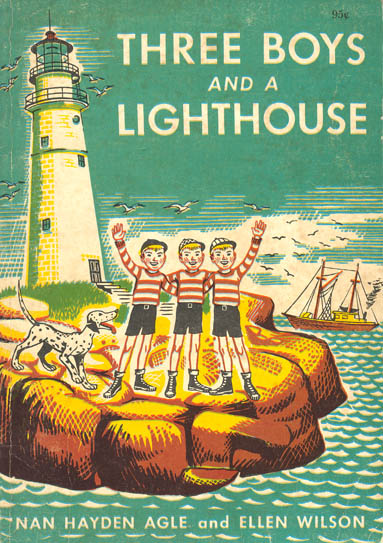
Three Boys and a Lighthouse


I've never been one of those people who romanticizes about the sea or sailing the ocean blue, but lighthouses have always held a certain appeal to me. Merely the sight of a lighthouse enthralls me, perched as it is on the edge of some rocky shore, sending out its lonely light to anyone who may or may not be out there. They're stoic and beneficent and courageous in their loneliness. At least that's what they represent, and I assume those who run them (or once ran them, I should say) had those same qualities. In some cockeyed romantic way, I could see myself living in a lighthouse. I love the idea of the solitude, and the chance to live in a cylindrical house. Of course, I'm sure at some point the job would require me to get in a boat and save somebody from the rocky coastline, and that would put me right off the job.

I think my fascination with lighthouses began with a book I read when I was 10 years old called Three Boys and a Lighthouse by Nina Hayden Agle and Ellen Wilson. I found it at my school library and, although it was aimed at a slightly younger audience, I was captivated by the illustrations by Marian Honigman. I'm not sure if they were linoleum block prints or simply drawn to look like that, but I loved the simple yet detailed illustrations. They were precise yet stylized, and perfectly evoked the idealized, boyhood notion of living in a lighthouse. In my cynical middle-agedness, I have to really flog my brain to recall how my ten-year-old self could so easily fall for such fantasies, but fall I did.

The story revolves around identical triplets named Abercrombie, Benjamin, and Christopher. Their mother is dead and their father runs a lighthouse, so they live with their grandmother. Finally, the father invites the boys to live with him at the lighthouse for the whole summer. To test the boy's meddle, he sends them off in row boats to each live on separate islands near the lighthouse. (The book was written in 1951, so no one would have screamed "child abuse" over such a plot twist back then.) When the boys show they can survive on their own, the father then sets about putting them through their paces, learning the tasks that come with running a lighthouse.

Finally, one foggy and stormy night, the lighthouse receives an SOS call and the father has to leave the boys to help the stranded seafarer. The father is gone for a day and a half and, in the era before cellphones, has no way of contacting the boys. However, the boys bravely carry on with the duties of running the lighthouse until the father eventually returns. For their bravery and devotion to duty, he gives his sons spiffy new lighthouse keeper hats with monograms on them.

Okay, not the most exciting story in the world, but I wanted so much to be one of those boys when I first read that book. It seemed like such an exciting life, and I carried the love of lighthouses with me long after I put the book down. Three years later, when I wrote my first "novel," the story was about a strange old guy who dressed like a sea captain and lived in an abandoned lighthouse. By that time, I had learned that most lighthouses were being shut down because they were unnecessary with the advent of modern navigational equipment, so the thought of living in an abandoned lighthouse seemed pretty cool. The strange old man turned out to be an alien who had a laboratory underneath the lighthouse where he built futuristic stuff, including a spaceship. Typically adolescent action yarn, and I'm not even sure if the length of it would technically put it in the category of a novel. It was about 150 handwritten pages in a composition tablet, so maybe more like a novella. Sadly, it got lost somewhere along the way, so I can't refer back to it.

The following Christmas, my brother gave me a framed print of a lighthouse. It was mostly blue, bathed in the night glow of a full moon as the waves crashed on the shoreline. Also sadly, the frame was broken and the print torn, so I had to throw it out. Such is the way with childhood memories. I still like lighthouses, though.

Friday, January 30, 2009

The Rally Series


Sixth grade was the last year I would spend in Bear Creek Elementary School. Nowadays, sixth, seventh, and eighth grades are lumped together as middle school, which makes a whole lot more sense to me. Back in the 70s, prepubescents shared the halls with kindergartners before finally moving on the junior high school. It makes an 11 year old feel kinda lost: am I still a kid or am I a teenager? The answer is, you are neither. It's a strange netherworld made all the more bizarre by the finger-paint-and-building-blocks surroundings of an elementary school.

As an avid reader, I was confused about what I should be reading at that age as well. Most of the books in the school library were aimed at those who were either beginning readers (Cat in the Hat, Where the Wild Things Are) or slightly more mature readers (Encyclopedia Brown, Nancy Drew). None of this material felt quite right at age 11. The summer before, when the whole world went crazy over the movie Jaws, I had read the novel. Once you've read an adult bestseller with a foul-mouthed sea captain and bloody dismemberment, the Hardy Boys didn't quite cut it.

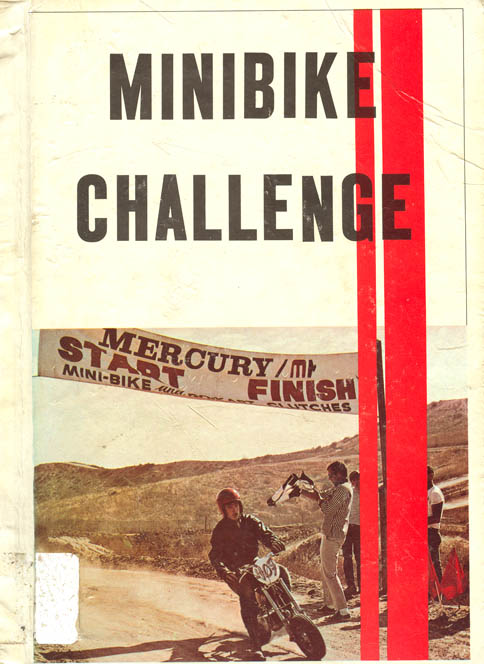
Then I noticed several of my male classmates were checking out these books with the word "challenge" in the title. There was Minibike Challenge and Motorcycle Challenge and Go Kart Challenge. If it had wheels, it had the word "challenge" after it. Known as The Rally Series, the books were all written by Edward Radlauer who illustrated the books with photographs rather than drawings. All the boys at school were wild about these books, and it was difficult to find a chance when the books weren't already checked out. Finally, one day in late fall, I managed to grab Minibike Challenge from the shelf and take it home.

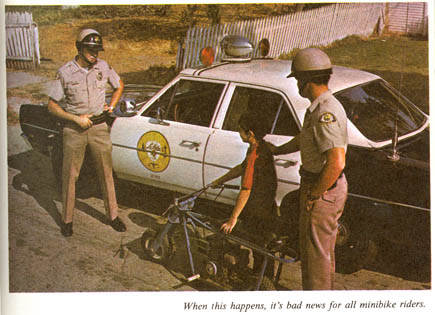
The story involved two boys, next-door-neighbors Terry Brock and Cliff Crane, who develop a passion for minibikes when Cliff's eccentric uncle gives him a minibike he picked up at a swap meet. Trouble is, they have nowhere to ride the bike and Terry is pulled over by the police when he tries to ride it in the street. Terry and Cliff read in a magazine that some communities have minibike parks where minors can ride minibikes under adult supervision, so the boys nag Terry's dad into proposing such a park to his Rotary Club. He's reluctant, but soon learns that other dad's have had similar requests from their kids, so the plan moves forward.

In typical kids book fashion, the minibike park is set up in no time flat and Terry and Cliff take Cliff's bike to the park. Sharing the bike soon becomes a nuisance and Terry talks his dad into buying him a minibike from a used car salesman dad at the park. Of course, the bike turns out to be a lemon with a cracked engine block. Without enough money to have it repaired, Terry appears to be up a creek. Then Cliff's Uncle Flum comes to the rescue with a used engine that only has a cracked piston. With the money Terry has left, he and Cliff are able to repair the bike just in time for the big race. Terry and Cliff race well, but don't win. They are, however, rewarded with good sportsmanship awards.

Although the story was pretty simple, it's really just an excuse to provide loads of information about how minibikes work and the types of things minibike enthusiasts do. I had no interest in minibikes, per se, but I loved all the technical jargon and the chance to live vicariously through these boys who were doing something decidedly male. This book felt exactly like the kind of story an 11 year old should be reading. Also, given the enthusiasm all the other boys in my class felt for the books, there was a certain fellowship surrounding these pre-teen stories.


I think the photographic illustrations also provided a unique appeal. Obviously, the author was an enthusiast for motorized sports and took his camera along to rallys and such to photograph the goings-on for his books. The real life illustrations brought a sense of immediacy to the stories and allowed a novice like me to see up close how these vehicles actually worked.

Although I was 11 and trying to read more mature books, I still had my imaginary play time and most of my activities were structured around made-up TV shows airing on my made-up TV network. The photographs in Minibike Challenge made me think that a TV series based on the book would be ideal. A budding writer even then, I decided that instead of placing the focus of the show on the two boys, the real star of the show should be Uncle Flum since he was the only person in the book who was a fully developed person rather than a stock figure. From the book, I retained certain details like the fact that he lived in a run-down house full of junk and made his makeshift living by attending swap meets and flea markets. However, I also made him a handsome young man with a motorcycle and the person who urges the Rotary Club to create the park. I thought an eccentric hippy type wooing a bunch of stuffed shirts provided more drama than Terry's dad talking his fellow Rotarians into it. I also had the Rotarians put Uncle Flum in charge of the park, so he would be an integral part of each episode. Honestly, I can't remember what the episodes were about, but they probably involved busted bikes that are repaired in the nick of time and exciting races with spin outs and crashes.

As with all my made up TV show, Minibike Challenge had a set time in the evening when I would act out the show (usually in our dining room). I did several episodes until my attention drifted to something else and I stopped acting out any more episodes (the equivalent of being cancelled in my imaginary world). During that time though, I read all the Rally Series books in my school library, including the ones mention above. I didn't particularly care for Motorcycle Challenge because the main character's parents are going through a divorce. Since my own parents were on the verge of separation at the time, the story hit too close to home, but I still enjoyed all the nuts-and-bolts talk about motorcycles.

The Rally Series books were a brief passion for me, as I was beginning to develop the next passion that I would carry into my teenage years: science fiction. A friend got me interested in Star Trek, and I began to notice all the science fiction books at my local book store. These were grown-up books, but they had lots of action and ray guns and spaceships, so they appealed to my child-like interests. Science fiction became my gateway literature into adolesence. I kinda look at the Rally Series books as a comforting friend who held my hand through the awkward transition from childhood to pre-teenhood until I could fully discover who I wanted to be.

Monday, December 15, 2008

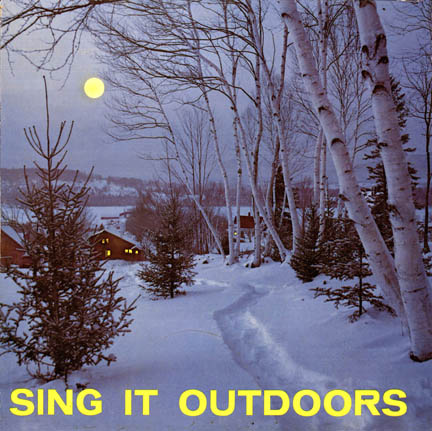
Baltimore Christmas Memory: Sing It Outdoors!

It never ceases to amaze me how much can be found on "teh internets" these days! The flotsam and jetsam of a misspent youth in front of the TV or hiding in a movie theater can be easily retrieved with only a Google search. One day, the ipod in my brain shuffled up a song that I heard every holiday season when I was a kid. The song was called "Sing It Outdoors!" and it was played during the commercials for John Donnelly & Sons Advertising. It went like this.

I believe they were mainly into billboard advertising, so the title of the song had a duel meaning. It seems like they are singing about carolers, but the implication is that you can sing the praises of your company or product outdoors through billboard advertising. Get it? I was rather proud of myself that I figured that out when I was six or so.

I don't recall Donnelly & Sons running TV ads any other time of the year but Christmas, and for an advertising firm, the ads were surprisingly chintzy. The Christmas ad consisted of the aforementioned song while we were treated to abstract representational drawings of choirs, bells, and other Christmasy images. Just before the final line was sung, a syrupy announcer voice came on and would tell us how Donnelly Advertising wanted to wish us a Merry Christmas. No Happy Holidays back then. They were putting the Christ in Christmas, baby! It was fun not to be PC.

During the week between Christmas and New Year's, Donnelly & Sons ran a slightly different TV ad. As I recall, it would start off with a similar song and some more poorly rendered images of streamers and champagne bottles popping, and then the announcer would jump in with, "Rrrring out the old, rrring in the new, with all our best wishes! We at Donnelly Advertising wish you..." When he would say, "rrrring out the old," a graphic with the current year would appear, and when the announcer said, "rrrring in the new," a graphic with the next year would appear. For example, it might show "1972," and then jump to "1973." I remember one year - I think it was 1973 or 1974 - and they mistakenly put up one of the old commercials because it showed "1965" and "1966." I got a chill because I suddenly thought I had been transported back in time.

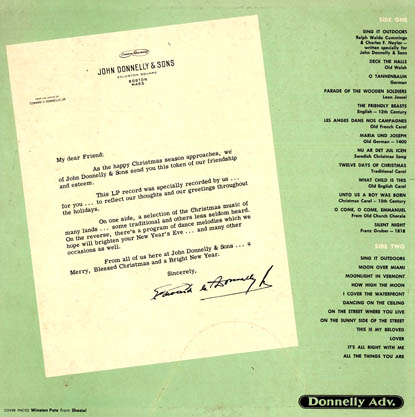
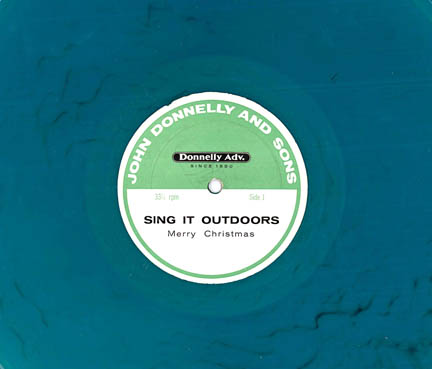
Those commercials disappeared around the mid-70s and became yet more fond holiday memories to put on the brain pile. God knows why the song popped back into my head on a warm spring day more than 30 years after I had last heard it, but my mind tends to work like that. Just for fun, I did a Google search using the song title and found this blog site. Apparently, the song on the commercial was part of a complimentary record album that Donnelly & Sons gave away to clients at Christmas time. One side had music for Christmas, the other side featured dance tunes for your New Year's Eve party. The blog author, Ernie, provides a link where you can download the Christmas songs along with some photos of the album, which I've used here, with his kind permission.


One of the coolest aspects of this album is the fact that the record itself was made out of green vinyl. Take a look:


Be sure to check out www.ernienotbert.blogspot.com for more great, obscure Christmas music. He's currently running a 27 Days of Christmas series with a new Christmas album featured each day.

Thursday, December 11, 2008

The 1/6th Scale Sushi Bar - 2008

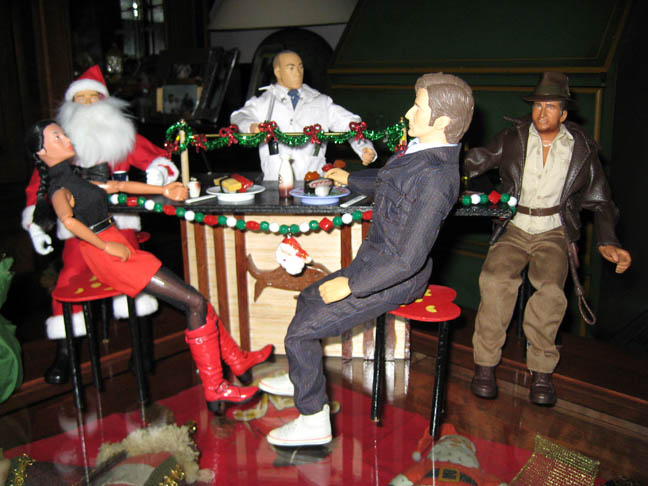
Awhile back, I related the story of how I built a 1/6th scale sushi bar as a Christmas present to my wife. For the uninitiated, 1/6th scale refers to the size of action figures who are usually between 11 1/2- and 12-inches tall. We're talking old G.I. Joes and Barbies. Anyway, every year I add miniature Christmas decorations to the bar and, while I'm at it, I usually change the customers at the bar. In years past, we've had Christopher Lee, Dr. Evil (from Captain Action fame, not Austin Powers fame), Man of Action G.I. Joe, African-American G.I. Joe, Barbie, Pierce Brosnan, Diane Farr, Captain Jack Sparrow, and, of course, Santa Claus. Here is the new line-up for Christmas 2008:


Santa Claus has popped in again for a sushi snack before finishing his rounds. At the front of the bar, the current Doctor Who, David Tennant, is talking an Asian woman into becoming his next companion, and on the side, Indiana Jones is kicking back with a cold brewski after taking on the Lair of Witchiepoo or something.

The sushi bar sits on our living room coffee table year round, but it seems particularly festive during the holidays. It's also a great conversation piece when the plumber or the exterminator drop by.

Tuesday, December 09, 2008

The Bell Telephone Company Presents: The Spirit of Christmas

In A Child's Christmas in Wales, Dylan Thomas wrote, "One Christmas was so much like another, in those years around the sea-town corner now and out of all sound except the distant speaking of the voices I sometimes hear a moment before sleep, that I can never remember whether it snowed for six days and six nights when I was twelve or whether it snowed for twelve days and twelve nights when I was six"

As I get older, I'm beginning to have the same feelings about my own Christmas memories. Twenty years ago, I would amaze family and friends with my blow-by-blow accounts of everything that happened on this Christmas or that Christmas. My mom would sarcastically ask, "What was the weather like that year?" and I could tell her. Now, however, there have been too many holidays and the traditions are so faithfully followed each year that they start to blur together. One such tradition I could always look forward to (at least in elementary school) was the annual showing of the old 1950s television special The Spirit of Christmas.

This holiday special, first aired in 1953 and sponsored by Ma Bell, was produced by puppeteer Mabel Beaton. Ms. Beaton started out performing marionette shows for her community in a make-shift theater during the 1930s and 40s. By the late 40s, her small group of fellow puppeteers, mostly neighborhood friends, dwindled away and she decided to elevate her puppeteering career by creating filmed marionette programs. She got lucky with her first try out of the gate when she presented her half-hour Christmas special, The Spirit of Christmas, to The Bell Telephone Company. The president enthusiastically green-lit the show as their 1953 Christmas special, and it became their holiday show for the next several years during the 50s.

The special is split into two segments, the first being a presentation of Clement C. Moore's poem, 'Twas the Night Before Christmas. The second segment portrays the story of the birth of Christ. Ms. Beaton maintained that her forte was with serious material, but the Santa Claus story at the beginning of the show was her concession to the commercial appeal of secular Christmas stories. Watching the special recently with an adult set of eyes, I can understand her point. The marionettes used in the Santa Claus segment appear more crudely designed and, in the case of the children puppets, downright creepy looking as compared to the marionettes in the nativity story. Also, there seems to be more loving care put into the staging of the biblical scenes. 'Twas the Night Before Christmas relies on some physical schtick that feels clumsy and forced by comparison, but I know I enjoyed it as a child.

Before you get the wrong idea about my true age, I never saw the show when it originally aired on television. My first exposure to it was in elementary school in the late 60s/early 70s. Every year, on the last day before Christmas vacation, the teacher would drag out that clunky 16 mm projector and put on the threadbare film print of The Spirit of Christmas. Usually, the teacher would show it just before the end of the day. I would always get a little flutter of excitement in my stomach when that happened because I knew we would have no more school work until the beginning of next year!

There was something magical about watching this marionette show. I had the same feeling when I watched those old Gerry Anderson shows like Thunderbirds or Captain Scarlet. Most of the drawn animation available to kids in those days was of the Saturday morning variety and consistently pretty bad. Seeing three dimensional puppets manipulated in properly scaled dioramas was a real treat because you could sense the level of artistry involved. The Rankin-Bass stop-motion films had a similar quality and, like The Spirit of Christmas, I only got to see them once a year. This was way before the home video/on-demand world of today. You got one shot at all the Christmas shows and if you missed any one of them for some reason, you had to wait for next year. And one year to a kid may as well be a decade. That's why an impromptu shopping trip with your mom on the night The Year Without a Santa Claus aired was cause for true childhood trauma.

I can't remember exactly when they stopped showing The Spirit of Christmas at school. Maybe around the time I was 9 or 10. As I said, it's a blur. But I never forgot that program, and I thought for sure I'd never see it again. Just some vague, foggy memory shelved in the attic of my mind. Of course, with the magic of DVDs and the Internet, few things from the past are lost anymore. Last year, I discovered that The Spirit of Christmas was on DVD, complete with another Mabel Beaton film, Santa's Space Ship, and a one hour interview with Ms. Beaton videotaped in 1984. It's a wonderful package, even though the print of the film used on the DVD doesn't look much better than the print we had at Bear Creek Elementary. At least a DVD player doesn't skip and make that weird audio sound like someone wiggling his forefinger between his lips (anyone under 25 probably won't get that reference).

I'm so thrilled to have this Christmas memory back. When I watched the DVD recently, I could feel that little tingle in my tummy I used to have knowing that soon I would be out of school for 10 whole days and Santa was coming with lots of plastic goodies and my grandmother would be serving her delicious stuffing and noodle casserole and my Aunt Mildred would have that cool Chex Mix stuff and my Uncle Henry would mistakenly call Santa Claus "Kiss Kingle" and the world would be lit with multi-colored lights and glowing Santas and reindeer and all would be warmth and happiness and fun....until January 2nd.

Monday, December 01, 2008

The Outer Space Men

Here's something that I came across on YouTube awhile back:


I have vague memories of these toys when I was four or five. Most of the characters were too weird for my taste, but I do recall having a Commander Comet action figure. Here is how he is described by their Web site: "From Olympus, largest of the great cloud cities of Venus, the mighty cloud ship Cumulus sets forth. Like a fiery comet it blazes through the blackness of outer space toward Earth. Its captain, Commander Comet, is a direct descendant of the mighty Zeus, leader of the historic first Venusian expedition to Earth, which landed near the Grecian Isles 3,000 years ago. Commander Comet's present mission is one of routine Earth surveillance, and once within the atmosphere of Earth, his ship will join the great fleet of Venusian craft that float like clouds above our planet night and day, watching undetected over our world."

I didn't quite understand all that when I was a kid, but I remember getting him because he looked like a super hero. I figured he was something like Thor; a mythological figure who traveled to Earth to help people in trouble. He was still a little strange looking, though, and I don't think I played with him for very long.

The creator of the toy line, Mel Birnkrant, says that the line was designed to compliment the then popular Major Matt Mason series. The thinking was that these Outer Space Men would give Matt Mason some buddies to pal around with in space other than his human astronaut friends. I guess they weren't aware that Mattel had already made some alien characters of their own for the Matt Mason line. Although the connection is obvious to me now, I never put it together as a kid. I never thought to play with both Matt Mason and Commander Comet at the same time. Perhaps other kids didn't either, because Colorform's space men never experienced the popularity that Matt Mason had. It didn't matter anyway, since interest in space exploration and space-related toys fizzled pretty quickly after NASA put a man on the moon. Here are some videos Mr. Birnkrant put together to explain the history of The Outer Space Men:


Apparently, Mr. Birnkrant is trying to revive the series as a collectible for all us Baby Boomers and slightly post-Baby Boomers who have fond memories of the toy. Currently, a new graphic novel has been released based on the characters. It never ceases to amaze me how these old toys keep resurfacing in new forms.

Monday, October 20, 2008

New 8 Inch Captain Action Figure

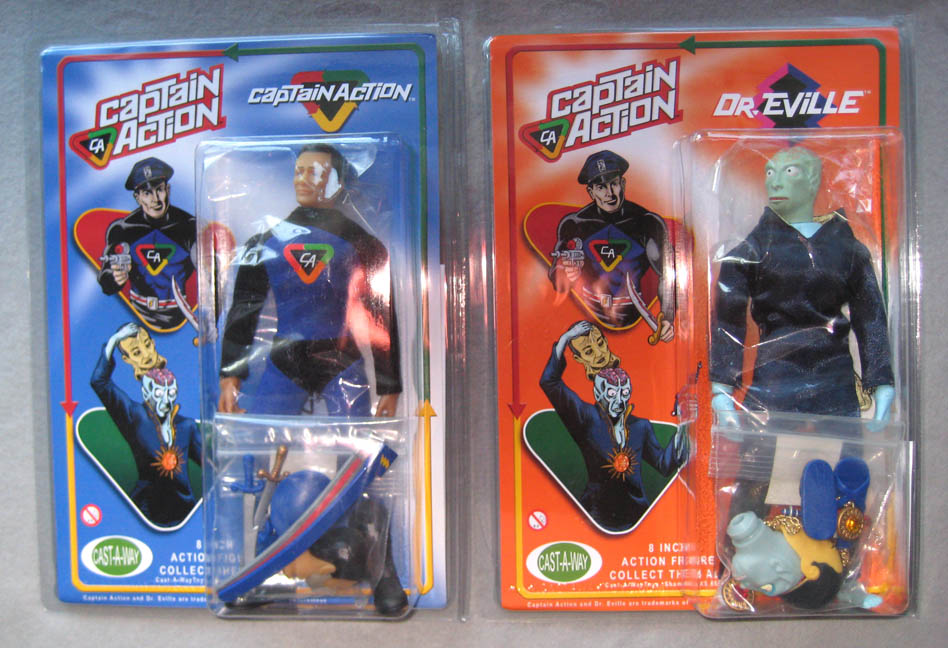
Within a few brief years, Captain Action Enterprises has launched a wide selection of Captain Action merchandise, from t-shirts to comics to models. Now they've teamed up with Castaway Toys to produce new Mego-style 8 inch Captain Action and Dr. Evil action figures (currently called "Dr. Eville" to avoid legal trouble with the Austin Powers people). Creating an all new figure in a different scale rather than producing replicas of the 11 1/2 inch figures was a smart move in my opinion. A decade ago, Playing Mantis produced 1/6th scale reproductions of the vintage Captain Action figures and costumes with mixed results. The phrase "close but no cigar" comes to mind. Since most of the Playing Mantis products are still easily obtained on eBay at reasonable prices, there really seemed no need to do yet another repro line. These new 8 inch figures will appeal to both the Captain Action collectors and the much larger Mego audience.


I pre-ordered the Early Bird Special Editions some months ago and, after numerous setbacks with the Chinese manufacturers, the figures were finally shipped. When I received my shipment on Saturday, I was immediately pleased to see that the blister packs in which the figures are packaged can be easily opened, so you can take out the figure and the accessories, then neatly return them to the package. Of course, I broke into the box right away and checked out the figure. Castaway Toys promised a body that would be superior to some of the current Mego-type bodies out there, and they delivered. The body feels quite sturdy for its size and mimics the shape and articulation of the vintage figure pretty effectively. I don't know if it's the vinyl they use nowadays or what, but the headsculpt bears a stronger resemblance to the Playing Mantis version than the vintage one, primarily because the new vinyl seems less opaque. Also, the tone gives Cap a darker, more olivey complexion.

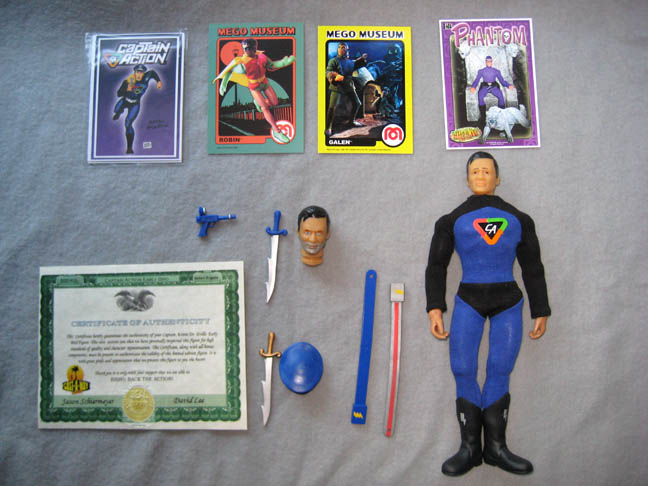
While the standard figures come with the basic accessories, these special editions offer a few extras. In the case of the Captain Action figure, you get the blue belt and blue-hilted sword like the one the vintage toy came with as well as a silver-and-red belt and gold-hilted sword like the ones pictured in the vintage box artwork. While the figure comes with a head modeled on the original doll, the special edition provide an alternative headsculpt which looks a bit like the alternative Playing Mantis head covered in Fred Flinstone beard stubble. There's also a few Captain Action and Mego Museum trading cards thrown in. Not a bad deal for five extra bucks.


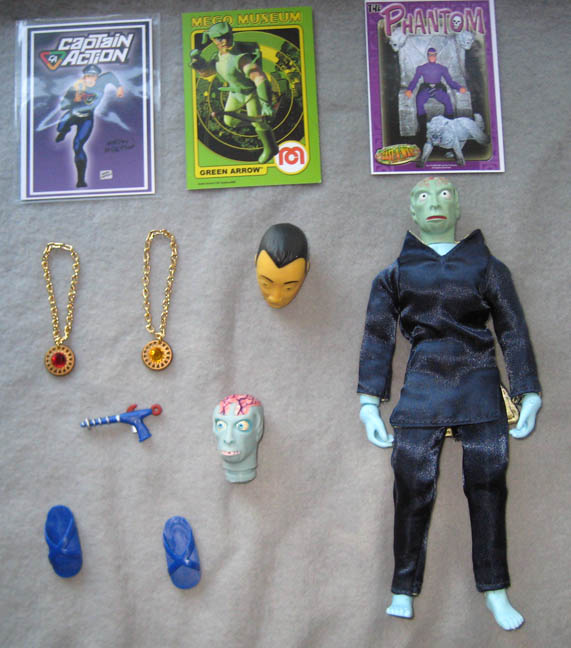
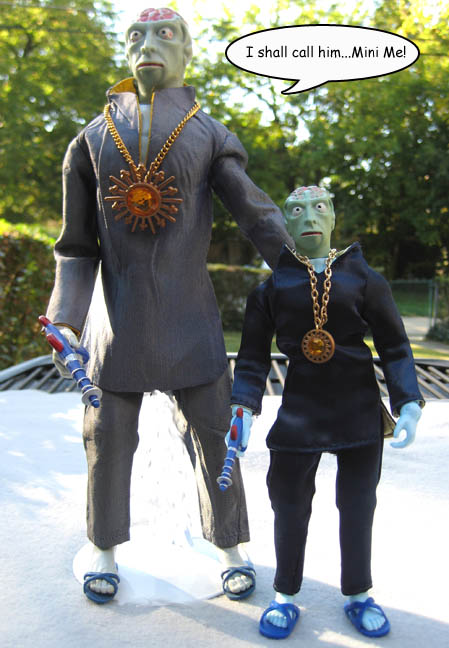
The Dr. Eville special edition also offers some extra goodies. The standard figure looks very much like the vintage doll. Castaway Toys has even mimicked the greenish-blue tinge on the head that didn't quite match the bright blue on the body. For the early bird package, I received an alternative headsculpt that looks like the Playing Mantis alternative head, complete with the matching skin color and more horrific paint details. I also got two versions of Dr. Eville's necklace: one with an amber stone like the vintage figure, and one with a ruby stone. The ray gun, sandals, and Dr. Ling mask are remarkably accurate reproductions of the vintage toys even though the pieces are shrunk down to smaller scale. The bad doctor's Nehru suit, however, is a much darker shade of blue than the one offered on the vintage figure and the jacket is a bit too small around the neck and shoulders. I suspect that since Playing Mantis made their suit way too baggy that perhaps Castaway Toys overcompensated and made their suit too tight. Overall, though, it's a high calibre product.

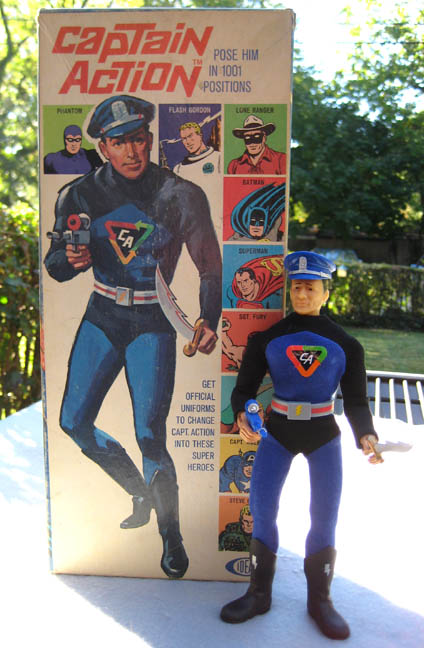
I took some pictures of the Mego-style figures next to their vintage counterparts. I also wanted to show how the alternate Captain Action accessories matched up with the box artwork:


If they had also included a silver ray gun, the match would've been perfect. I would've taken photos with the alternative headsculpts, but the instructions for swapping the heads is rather elaborate and I didn't want to risk damaging the figures. Anyway, here's Mego-style Cap next to his grandfather:


And finally, Dr. Evil meets Dr. Eville:


I know, but someone had to make the joke.

In summary, Castaway Toys hit a home run with their new Captain Action and Dr. Eville figures. They are currently offering the standard versions online, and I can't wait for their version of The Phantom based on the old Captain Action costume. Since Castaway Toys already offers accessories to customize Mego figures, I'm hoping they may come up with new costumes and parts specifically designed for customizing Cap and the Doc. I'm so glad there are people out there who won't let this old soldier fade away!

Monday, October 06, 2008

The Tornados Doin' The Robot!

This looks like one of my childhood nightmares!


For a little context, go here.

Tuesday, September 23, 2008

Latitude Zero

A couple of months ago, I was trolling the Netflix site looking for movies to add to my queue when I came across a film I'd never heard of but thought for sure I should have known of it. The movie was Latitude Zero, a Toho production from 1969 directed by Ishiro Honda. Honda directed a truckload of Japanese monster movies, most of which I watched on Saturday or Sunday afternoons as a kid, so I was surprised that I had never heard of this one. I put it in my Netflix queue and it arrived last Friday, just in time for my weekend viewing.

The movie starts with a couple of marine biologists and an American photojournalist (Richard Jaekel) exploring the South Pacific ocean in a bathosphere. An eruption from a shaky faultline sends the bathosphere tumbling into an abyss. The men are rescued by scuba divers and taken to a futuristic submarine with jet engines. On board, they meet the mysterious Captain McKenzie, played by the ruggedly macho Joseph Cotton. Now, Mr. Cotton was always a bit effeminate, but here he comes off like a contestant from Project Runway with his open-chested, poofy shirt with gold lame' trim and striking green ascot.

Captain McKenzie explains that he is over 200 years old and that he built his submarine, The Alpha, 164 years ago, making improvements over the years. Before the dazed rescuees can process this information, the Alpha is attacked by a vicious looking sub complete with shark fins. This is the attack sub of McKenzie's arch-rival, Malick (Cesar Romero). Fresh off his turn as the Joker in the Batman TV show, Romero plays the evil Malick with gutteral laughs and an impatient swagger denoting a true sociopath. This guy would run over a box of kittens because he was late for a seal bashing contest.


McKenzie and Malick were once boyhood friends, but Makick had dreams of conquering the world, so he built a small island fortress where he plots evil with a middle-aged floosie named Lucretia, who looks like a cross between Della Street and Mrs. Roper. Also assisting him is an army of extras in furry brown costumes with bat masks and ungainly wings. With a staff like that, I can't imagine why he hasn't conquered the world by now.

Anyway, the Alpha manages to outfox the shark sub and returns to the domed city where McKenzie lives, 15 miles below the surface. The city is populated by scientists from all over the world who were plucked from their ordinary lives on the surface to build a scientific utopia under water. After showing his new friends the World's Fair-type wonders of the city, McKenzie takes them to their new living quarters in an apartment building gaily decorated with spotches of pink and lavender (McKenzie's personal design, I would imagine).

Forty-five minutes in, the story finally gets moving when Malick kidnaps a Japanese scientist who is on his way to the domed city. He apparently has invented an anti-radiation serum, and he is seeking asylum from all the nuclear-powered nations who want the serum so they can unleash atomic war while keeping their own people safe from radiation poisoning. Malick wants that serum for his own purposes, and demonstrates his evilness by subjecting the scientist and his lovely daughter to displays of grotesque organ transplants. Romero really relishes his performance as he takes the brain out of his attack sub commander's head and places it in the body of a lion, then cuts the wings off a huge bird and attaches those to the lion as well. Finally, he grabs a syringe with his blood-soaked hands and injects the beast with a growth serum, creating a do-it-yourself griffin. Yes, the whole sequence is as bizarre as it sounds! And it begs the question, if you can come up with a growth serum, why can't you also invent your own anti-radiation serum? Oh, that's right, then we wouldn't have a story!

Meanwhile, McKenzie gets wind of the kidnapping and prepares a commando crew to rescue the Japanese scientist. Along with his new pals, he enlists for the mission his sub pilot Kroiga and Dr. Anne Barton (Linda Haynes, who's clearly a student of the Ricky Nelson method of acting). After dressing his crew is stylish gold lame' jump suits and matching skullcaps, they voyage to Malick's island hideout where an all-out battle is launched. Boulders tumble, lasers fire, bat wings flutter, and griffin fur flies! I guess you can imagine who wins. Afterward, McKenzie takes his pals on a long ocean voyage to Fire Island (just kidding). Actually, they try to work in a strange "maybe it was a dream, maybe it wasn't" twist that doesn't quite work, IMO.

Still, I love crazy Japanese camp like this and can't believe I've never heard or seen this movie before. According to imdb.com, "When the television syndication contracts had expired this film became unavailable, reportedly due to a dispute over the rights." So I guess it's been hiding for many years and only recently made it to DVD. It's a shame it was off the radar for so long because it is definitely one of the better made movies from the Toho studios. Best of all, even though it's a Japanese production with a half-Japanese/half-American cast, the whole film is in English. No goofy dubbing with bad lip synch. An extremely fun and watchable movie... if you're in to bat people and flying griffins.

Friday, September 05, 2008

Saturday Morning Preview Shows

I know I babbled on about this last year, but I can't help but start to feel nostalgic when we reach the first Friday after Labor Day. I'm speaking about those Saturday Morning Preview shows each network (there were only three back then) would air on the first Friday evening after Labor Day. The shows were designed to promote the new Saturday morning line up premiering the next day and would usually feature stars popular with the kiddie/pre-teen crowd. In our 24/7 cartoon world of today, where kids can watch cartoons or youth-oriented programs whenever they get near a TV, such programs are alien concepts. The few cartoons shown on Saturday morning now are merely reruns of programs already aired on cable channels like Nickelodeon or Disney. Back in the 70s, though, the only new programming kids had available to them was on Saturday morning, and the Saturday after Labor Day was always the launch date for the new season. Since I went back to school that week, it was always nice to know that I had the Friday night preview show to look forward to after those stomach churning first few days of new teachers, new classmates, and new classes.

When I made my post last year, I couldn't find any video examples of the preview shows I watched when I was a kid. There are a few examples of the shows from the 80s when VCRs became available, but I wasn't watching cartoons any longer by that time, so I get no nostalgic kick from them. Today, though, I found a clip from the 1978 ABC preview show featuring Kristy and Jimmy MacNichol. The clip showcases Donny Osmond mostly, but it gives you an idea of what these Friday preview shows were like:


I know, it seems pretty lame now, but to a kid in the 70s, it was fun to see the networks put this much effort into kids shows. I remember this episode in particular because, afterward, ABC aired At the Earth's Core. This is one of my guilty pleasures and at the time, I was reading every Edgar Rice Burroughs book I could get my hands on, so I was in hog heaven that night. Here's a little taste of the movie:


Come to think of it, if I had to watch these two programs in one night now, I'd probably consider it torture. Ah, to be young and without taste!

Tuesday, September 02, 2008

Where Did the Summer Go?!!

Another summer is winding down and once again I'm wondering where the time went. I seldom wonder where the winter goes; I'm just glad it's going. With summer, though, there is a child-like sense of anticipation as Memorial Day approaches and a sense of melancholy as Labor Day disappears (although my wife would disagree with that). Anyway, the sunny, sweaty months have past and I've barely touched this blog. Frankly, I just haven't been much into the past-times that I usually discuss here: action figures, childhood toys, and model building. My preoccupation with various writing projects have left me with little interest in customizing, and my limited resources have not allowed me to indulge in frantic eBay bidding. I did pick up a few things during the summer that I guess I should mention.

After being completely knocked over by the Iron Man movie, I picked up a 12" Iron Man action figure during a trip to Target. This is not the really cool one with the removable mask, but it still has some nice features like the variety of jet exhaust noises it makes as you pretend to fly him through the air and the orange plastic blobs that he can shoot from a rocket launcher in his sleeve. The figure is also really sturdy and a nice rendering of the movie version of the suit. Once upon a time, I plotted to make a Captain Action-style costume of a 60s version Iron Man, but I could never get around how to construct a proper mask. I've made masks from Poly-vinyl clay before, like my Hawkman and Dr. Fate customs, but I was intimidated by Iron Man for some reason. I may get around to it sometime.

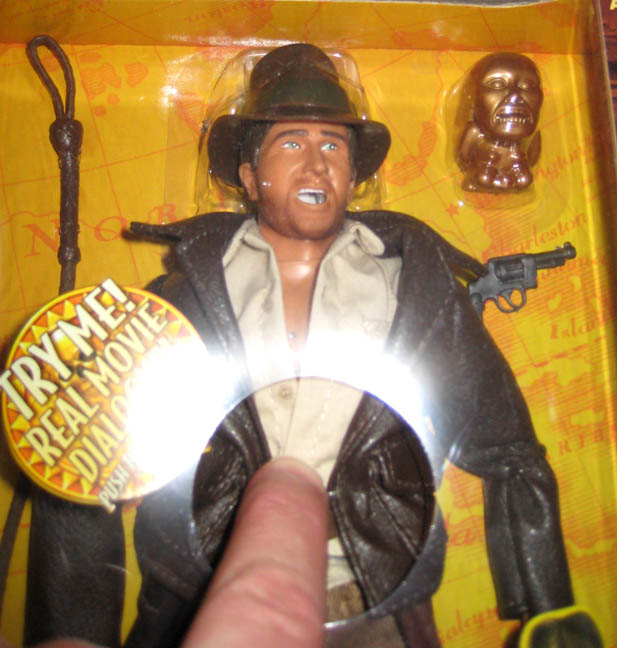
Another action figure I picked up during that same Target trip was a talking Indiana Jones. Indy was another character I long hoped to make a custom figure of, but other projects took precedence. Since the latest movie initiated a series of 12" figures, I decided to just buy one of the ready made dolls and scratch that character off my list. I bought the talking version mainly because I liked the head sculpt better than the non-talking version, and the talking one came with more accessories. It still doesn't look much Harrison Ford, however, and the talking feature is a bit creepy.


When you stick your finger in his stomach, his mouth opens in an expression of sheer agony. Then the recorded sayings are played, all lifted from previous Indiana Jones movies (e.g., "Snakes! Why did it have to be snakes?"). If the mouth moved up and down like a ventriloquist dummy, the effect might work, but because the mouth just hangs open in that painful look of indigestion, Indy appears to be possessed by some ancient Mayan god who is talking through him.


"Burritos! Why did it have to be burritos?!!"


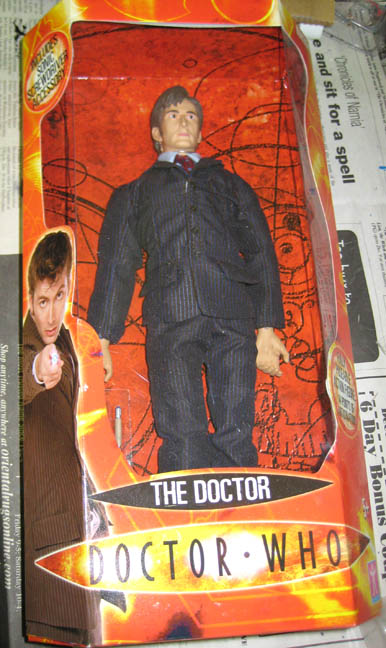
My wife Kathy and I have become hooked on the new Dr. Who series, especially since David Tennant took over the role. One day, Kathy surprised me with a David Tennant-version Dr. Who action figure. I had seen the smaller, molded plastic versions on eBay, but this is a 12" figure with cloth clothing. The accessories are pretty skimpy with just the sonic screwdriver, but the tight-fitting suit is spot on. I'm in the process of designing a 1/6th scale TARDIS to go with the figure, but I have to find some time to use my brother's workshop to put it together.

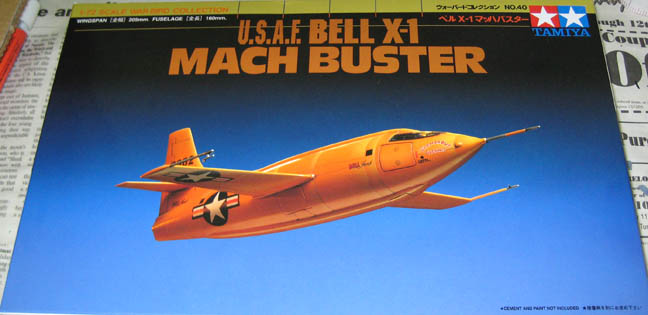
Finally, I was sad to see that my local hobby shop closed this summer. When I was single and living in Dundalk, one of the few advantages of living in my neighborhood was being able to walk to this nifty hobby shop to pick up models and model-building supplies whenever I needed them. Just before I got married, I moved to a house in Towson and was relieved to discover a similar hobby shop within walking distance. If I happened to be working on a model or action figure and discovered I needed glue or a particular color of paint, I could just wander down to the hobby shop and pick it up. Well, the owners decided to retire and I will now have to get in the car and expel carbon gases into the atmosphere to get to my nearest hobby store. Before the store closed, I went in to see what they had on sale. Sadly, all the model kits I was interested in had already been sold, so I settled for a kit of the U.S.A.F. Bell X-1 Rocket. I'm not really interested in building it as a complete model, but I thought I would use it for parts on some other custom project (whatever that may be).

As I bought the kit, I had hoped to find some pithy thing to say to the owners on my final visit to the store. The woman at the register thanked me for my years of patronage, and I thanked them as well and left. No big speech or teary farewell. I wish I wasn't so afraid of expressing my feelings in such moments. I always let them slip away and regret it later. I will miss that little shop, though.

Well, that was my summer. I hope to get more into the swing of things in the coming months and post more frequently. The crisp Fall weather always gives me a jolt of adrenalin, so I'm eager to make use of it.

Thursday, July 24, 2008

My First Time With James Bond

With the new James Bond movie Quantum of Solace about to be released in the fall, I decided to read some of the old James Bond novels that I didn’t get around to reading during my James Bond obsession in college. Back then, I was more interested in the action, so I started in the middle of the series with Dr. No and worked my way through Goldfinger, Thunderball, On Her Majesty’s Secret Service, You Only Live Twice, and Man with the Golden Gun. Later on I read Casino Royale (the first Bond novel), For Your Eyes Only, The Spy Who Loved Me, and Moonraker. Now, I feel the need to complete the series, so I started this summer with From Russia With Love and then Live and Let Die.


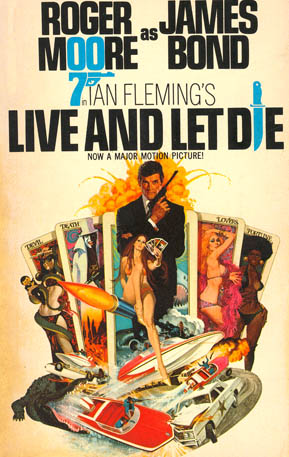
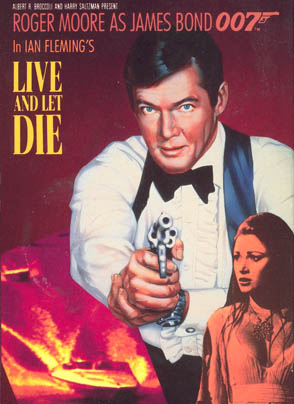
Mind you, I bought all the Ian Fleming Bond books back in college, picking up different editions from various second-hand bookstores. The copy of Live and Let Die that I have is a movie tie-in from 1973. When I dusted off the old paperback and looked at that cover with the movie poster artwork, I was immediately transported to a summer 35 years earlier and my heart ached a bit from a sharp twinge of nostalgia. You see, Live and Let Die was the first James Bond movie I ever saw.

My family and I were in Wildwood, NJ that summer, as we had been for so many summers before and for several summers afterward. Ocean City, MD was closer to our home, but Wildwood, NJ had so much more to offer. I haven’t been there for many years, but the boardwalk in Wildwood seemed like a city unto itself when I was a kid. It went on for miles and featured pier after pier of rides and arcades. The boardwalk itself was studded with all manner of attractions, including nice sit-down restaurants and grand old one-screen movie theatres with giant marquees outside. It was in one of these theatres that I saw Live and Let Die.

This was a big moment for me because, not only was this the first James Bond film I had ever seen, this was the first grown-up action movie I had ever seen. For years, my brother Craig had been coming home from really cool movies like Bonnie and Clyde and The French Connection and telling me how exciting they were, describing in careful detail all the action set pieces. Deep down I knew that this sort of action was so much better than the feeble, low-budget fare I got to watch on television. And in the days before cable and home video, you had to wait at least two years before a theatrical film hit television, and even then it was heavily edited. I really cursed the fact that I was too young to see these films.

But now it was the summer of 1973 and I was only one month away from turning nine years old. The glowing marquee on the boardwalk called out to me. I was well aware of James Bond, having listened the summer before as Craig described the exploits of the suave James Bond in Diamonds Are Forever. I also remembered seeing the Corgi version of that Moon Buggy from the film and knew that it had to have been one exciting flick. Now there was this new Bond film and I was determined to talk my parents into letting me see it. I knew my brother would help in the cajoling department, and the fact that we were on vacation in Wildwood always had a softening effect on my parents’ resolve. They decided it wasn’t such a bad way to spend the evening.

I can’t emphasize enough how much better the movie-going experience was back when you had large single-screen theatres as compared to the multiplexes of today. Since they only had one movie to show, the theatre made every effort to create an aura of excitement about the movie you were about to see. The multiplexes have every movie available in one place, so they put no effort into promoting anything. The lobbies all look the same and rather rinky-dink at that. Movie posters and standees are scattered haphazardly around where there is space. Their main interest is funneling you to the refreshment counter. Not so in the old days.

I remember standing in front of the theatre as my father stood in line to buy tickets. Not only did the flashing marquee scream that this was “the best Bond ever,” two huge, beautifully painted movie posters stood on either side of the box office. We’re talking boats crashing into cars, cars crashing into boats, boats crashing into boats, an alligator regurgitating a boat, guns, explosions, voodoo priests, sexy women in bikinis, and standing in the midst of all the mayhem was 007 himself, holding a really big gun! Of course, my brother made a point of lamenting the fact that Sean Connery was not playing James Bond anymore. It was now that prissy Saint guy, Roger Moore. This made no never mind to me, since I had never seen Sean Connery before. I liked The Saint. I even liked his show with Tony Curtis: The Persuaders. Roger Moore was okay with me. Plus, I liked how the poster artist incorporated the two “O’s” in Roger Moore’s name to spell out “007.” I thought perhaps the producers had hired Mr. Moore solely for that reason.

After getting the tickets, we walked inside and down a long hallway plastered with Bond posters and lobby cards. Seeing this hall of stills from the movie really got me jazzed. I was bursting at the seams before the movie started. Right away I was amazed at the fast-paced teaser, followed by the Paul McCartney theme song. Then we finally see Roger Moore himself in bed with a hot Italian chick. Cool! When he checked his digital watch (a very new invention in 1973), there was an audible gasp in the crowd. Little did we know that within one year we would all be wearing one (including me).

By this time, the Bond films had developed a formula of their own very different from the formula of the novels. The movies had to have at least two Bond girls (the novels usually only had one), there had to be a plethora of chrome-shiny gadgets (the novels had few if any), and there had to be a long series of superfluous action set pieces to keep the audience entertained until Bond finally ended up at the villains hideout and commenced to blowing the place up. Because the producers were so compelled to stick with a proven formula, there’s very little in these later movies that relate to the books other than some characters, locales, and maybe a few actual scenes. In the case of Live and Let Die, the similarities include a Harlem crime boss named Mr. Big who uses his Haitian roots and voodoo as a weapon of intimidation, a smuggling pipeline running from Harlem to a state in the Deep South to a Caribbean island, and an exotic fortune teller named Solitaire. Other than that, the movie is a completely different story and one that is unnecessarily more complicated, in my opinion.

I was surprised to discover that the scene in the movie where Bond is in a Harlem nightclub and his table sinks through a trapdoor in the floor into Mr. Big’s office was taken directly from the book. It seemed like the kind of cheesy thing that would only happen in a movie, but Ian Fleming always liked to push the credulity envelope (remember Pussy Galore?).

Anyway, the movie was a real thrill ride for an eight-year-old. I was surprised at how familiar the situations felt, since by this time the silliness of the action set pieces in Bond films were not far from similar scenes in Disney movies. Also, the use of a Black Mafia felt similar to the Black Exploitation movies of the day, like Shaft and Superfly. As a white kid in the ‘burbs, I was fascinated by the previews for those films shown during episodes of Soul Train. They had the exotic allure of the forbidden. I could never go downtown to see movies like that, but with Live and Let Die, I felt like I was getting a taste of them.

The rest of the summer, I was obsessed with James Bond. The theme song was a hit on AM radio all through those summer months. I ran around the neighborhood playing James Bond. I even wrote secret agent stories about my own made up spy whose name escapes me. My brother and I stayed up at night debating who was a better Bond, Connery or Moore. I was arguing for Moore simply because he was the only Bond I knew. Craig felt that Live and Let Die was a big step down from Diamonds are Forever. Looking at those movies today, I would have to say they are pretty similar since they both follow the rigid formula of 70s Bond movies. Actually, I would give Live and Let Die the edge if only because Moore’s performance seems more energetic than Connery’s, who was weary of the role at that point.

I’ve had an on-again, off-again relationship with James Bond ever since. My disappointment with Man with the Golden Gun caused me to miss The Spy Who Loved Me. I gave Bond another shot with Moonraker, and had my heart broken. For Your Eyes Only restored my faith in him, and even the goofy Octopussy hooked me on a reading spree of the old novels. I’ve seen every Bond movie in the theatre ever since, but their quality has been generally mediocre and, by the 90s, I wondered if there was any place for a character like Bond in our modern pop culture. Casino Royale proved to me that Bond could be revamped for the 21st century, and I’m back to reading Bond books again.

Wednesday, June 25, 2008

The Project Pegasus Saga

Last summer, as I sat through the interminably long and overdone Spider-Man 3, I couldn't help but think that these Marvel blockbusters had gone horribly far afield from what made Marvel Comics great. I'm primarily a DC guy, but I did read quite a few Marvel titles in the late 70s and early 80s, and I read plenty of back issues to familiarize myself with the Marvel Universe. I couldn't understand why the movies placed so much emphasis on the name brand of a single character rather than delving into the mythology of old Marvel story arcs. After all, the second Fantastic Four movie based its story line on the original Silver Surfer story arc, leading to what I thought was a fun, action-packed film in keeping with the Fantastic Four style.

As my wife and I were driving home from the theater after Spider-Man 3, I related my feelings to her. "These sequels all fall flat because, after they've told the origin in the first movie, they don't seem to have anywhere to go. Why don't they use some of the old stories like Project Pegasus?"

Since my wife read a lot of Marvel comics in her youth, I assumed I could speak in such short-hand and she would immediately know what I was talking about. I forgot she didn't get int
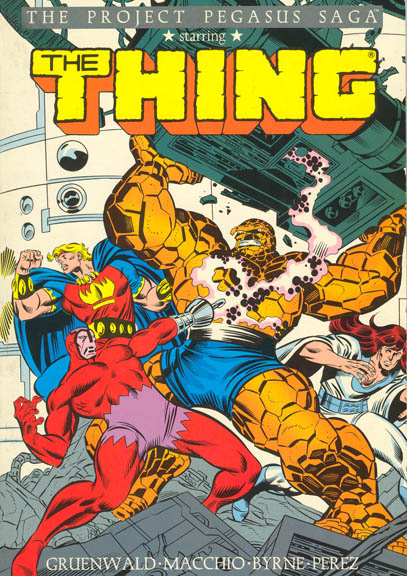
o comics until the 80s and missed The Project Pegasus Saga by a couple of years. When she questioned me about it, I had to admit I didn't remember too much about it myself. I only recalled that it took place in Marvel Two-In-One, which was The Thing's version of Batman's The Brave and the Bold, and that it had to do with a top secret, underground project to investigate alternative fuel sources. The premise alone could be timely once again.

Fast forward one year and I suddenly find myself giddy over the terrific Iron Man movie and the big plans Marvel Studios have to get their movie projects on track again. With the tantalizing prospects of having Iron Man and the Hulk come together in an Avengers movie, I started thinking about the old Project Pegasus story again and sought to find the old comics on eBay (Marvel Two-In-One issues #53-58). As luck would have it, Marvel put out the whole story in a trade paperback about 20 years ago and I found a slightly beat up copy on eBay for cheap, so I snagged it.

In a nutshell, Pegasus stands for Potential Energy
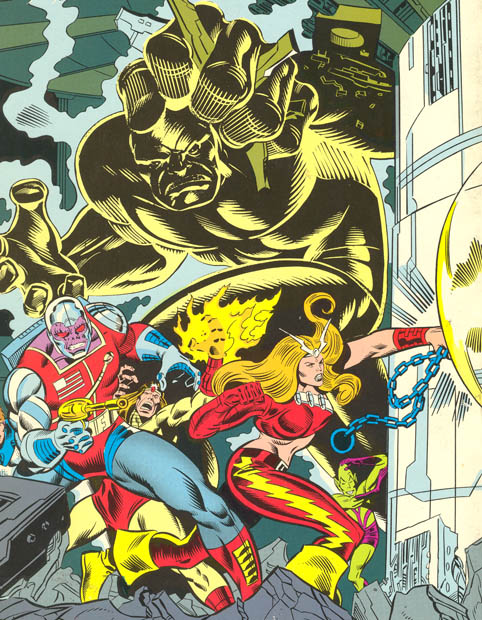
Group/Alternate Sources/United States. It was a "mammoth research facility of the U.S. Department of Energy located in Mount Athena in upstate New York." The Thing is called in to help with security in the facility, which is headed by an eager young superhero named Quasar. Turns out, Pegasus is investigating every possible new source of energy including the energy produced by strange supervillains and aliens. One of the beings under study is Thing's old friend, Wundarr. Wundarr has some kind of energy-absorbing abilities, but a recent experiment has put him into a coma. Meanwhile, one of the scientists on staff, Dr. Lightner, is up to no good, and the cyborg villain Deathlok shows up to do some sabotage.


More super people show up, including Thundarr and Giant Man, and the radioactive villain Nuklo is unleashed from his cage to wreak havoc. In usual Marvel fashion, there's lots of fighting and destruction over the six-issue story line, but it basically comes down to Dr. Lightner getting hold of a device called the Nth Projector which turns him into a human black hole, sucking in everything around him. Along the way, Wundarr comes out of his coma as a much stronger being known as Aquarian. Fortunately, he arrives just in time to help confront the mutated Dr. Lightner, who is now calling himself the Nth Man. Giant Man is the first to confront the human black hole and gets sucked into another dimension. Aquarian decides he's the only one powerful enough to take on the creature, so he allows himself to be sucked in. Once he finds Giant Man, Aquarian expands his entropy enducing field, causing Nth Man to collapse in on himself like a dying star. Once destroyed, Aquarian and Giant Man are returned to reality.

Of course, I'm condensing this story a great deal. There's a whole lot more that goes on, but I wanted to give you a sense of the action. When I read this series in 1978, I was completely overwhelmed by the suspense and excitement this story generated. I became a regular reader of Marvel Two-In-One after that, but none of the stories lived up to the scope of Project Pegasus.

I think Marvel Studios should seriously consider doing an updated, live action version of this story. Get Michael Chiklis back as The Thing and bring in an ensemble cast of not-so-well-known actors to play the various third-string superheroes and villains. What you lack in big name superhero recognition you make up for in number and variety. Also, the focus should be on the story rather than the character. As the Batman movies from the 90s proved, having a recognizable superhero in the film doesn't mean much if you don't have anything meaningful for him to do. With Project Pegasus, there's enough action for a team of superheroes, and the mystery of Dr. Lightner's mission is pretty intriguing.

Using memorable stories from Marvel's mythology is the only way I can see Marvel Studios succeeding with a new generation who love the characters but aren't much into reading comic books. I mean, we're already down to the second-stringers with Iron Man and Captain America, and there were even plans to do a movie based on Ant-Man, for God's sake! Stick with what you do best, Marvel, and go with team ups!