Showing posts with label DC Comics. Show all posts

Wednesday, July 01, 2009

Wonder Woman


Since comic book readership has traditionally been predominantly male, female super heroes were often a tough sell. Not that there weren't several attempts made, but characters like Lady Luck are largely forgotten today. As the median age of comic book readers began to rise in the 1970s, it was easier for the comic book companies to cultivate popular female superheroes since adolescent boys were only too happy to see a curvy, buxom woman in spandex kicking butt. The one female who beat the odds and remained popular from the golden age to modern day was Wonder Woman.

As a kid, I was aware of her name, but I didn't really know anything about Wonder Woman until I read her origin story reprinted in Jules Feiffer's wonderful book on comic history, The Great Comic Book Heroes. In a sense, I was experiencing Wonder Woman for the first time the same way the rest of America experienced her for the first time in 1941. The origin takes place just before the beginning of World War II when Army Intelligence officer Steve Trevor uncovers the leaders of a spy ring and goes on a dangerous mission to capture them. Along the way, his plane runs out of fuel and crash lands on Paradise Island, home of the Amazons. While Trevor is nursed back to health, Princess Diana falls in love with the man and fights to win the honor of taking Trevor back to America so he can finish the job he started. Her mother, Queen Hippolyte, fashions a special costume for her that incorporates elements of the U.S. flag and the golden eagle. Thus, Princess Diana adopts the U.S. as her new home and fights to protect her.

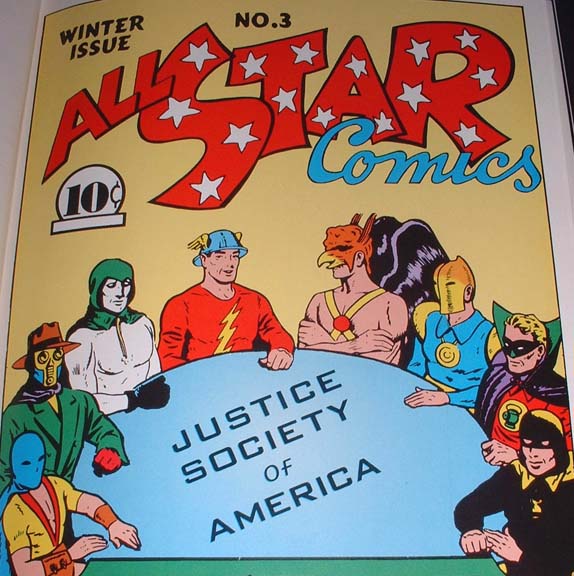
Plenty has been written about what Wonder Woman represents to young girls and to American society in general. I think her biggest contribution was to bring a female perspective and influence to the male dominated machismo of the super hero world. Shortly after her introduction, she was given membership into the all-boys club Justice Society of America. By the time the Justice League of America was formed in the Silver Age, Wonder Woman was part of DC's top three heroes (Superman and Batman being the other two, of course) who had run uninterrupted in comics up to that time. She also established the precedent of there being at least one female in every comic hero team.

Other than that origin story, I have to say I never read a Wonder Woman comic. I only saw her as part of the Justice League, or in the Super Friends cartoon show. There was also this bizarre TV movie from the early 70s:


Gotta love the wakka-cha wakka-cha theme songs back then!

I also watched the Lynda Carter version, at least for a season or so. As much as I liked Wonder Woman, I couldn't bring myself to read a comic featuring a woman. My guess is that most boys had the same reaction, which is why action figures based on female heroes were not as popular in those days. Ideal put out a line of female hero dolls in the 60s to compliment their Captain Action line, but they sold poorly and are quite rare today. Called the Super Queens, the four dolls were Batgirl, Supergirl, Aquaman's wife Mera, and Wonder Woman. I never tried to collect them because, in addition to being expensive, I didn't think they looked all that good. While Captain Action was muscled and articulated to look and pose like a hero, the Super Queens were slight and had limited articulation. They also possessed extremely girly faces not befitting of a super hero.
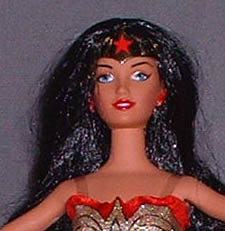
Still, I wanted a Wonder Woman doll to put amongst my other DC figures. Several years back, Mattel put out a series of Barbie dolls dressed like DC's female heroes. The costumes were great, but I've never been a fan of the Barbie doll in general. Again, it's too slight, the articulation is wonky, and the faces are way too soft and pretty. They are dolls for girls, after all. I bought a Wonder Woman Barbie and slipped it in with my Superman and Batman and Aquaman, but I wasn't happy about it.

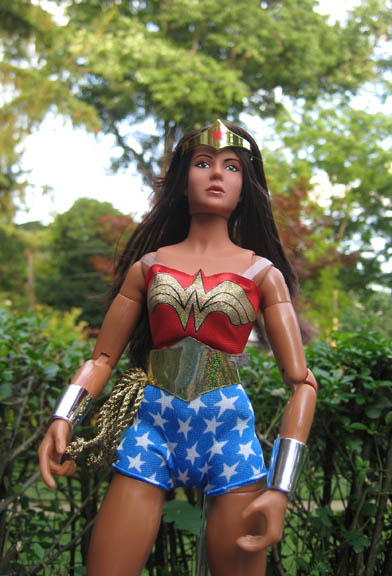
Then, last Christmas, my wonder woman wife bought me some Cy Girl action figures for customizing purposes. These female figures are articulated like male action figures and are more curvacious than Barbies, looking very much like the way women are drawn in comic books. They are also provided with two different chest pieces, one featuring smallish breasts and one with larger breasts, depending on what type of effect you want to create. Although my brunette Cy Girl had bigger hips than the Barbie, I figured she could probably slip into the Wonder Woman costume with some encouragement. Happily, I was correct. Of course, I had to use the smaller chest piece since the big boobs simply would not fit in the costume, but I think a smaller chest is better suited to an athletic woman anyhow.
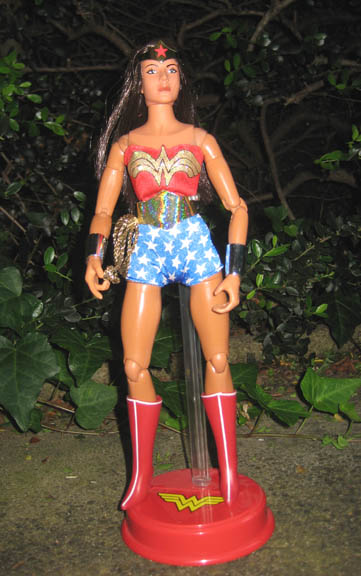


The finished product appears to me as a modern, realistic interpretation of Wonder Woman rather than her iconic image, but I like it. She's also much easier to pose.
Sunday, June 28, 2009

Golden Age and Silver Age Green Lantern


Just like the Silver Age Flash, I first discovered Silver Age Green Lantern not in comic books but on the Aquaman cartoon show where he appeared in both his own solo back-up stories and as part of the Justice League of America. The thing that fascinated me about Green Lantern was that he belonged to a larger intergalactic organization designed to police all the planets in space. That imbued him with a greater calling than these other super heroes who simply got hit by radiation or fell into a pile of chemicals and gained super powers. Hal Jordan was blessed with his powers, or at least given a ring and lantern that contained powers, by a far superior group of aliens. If Superman was a veiled representation of Jesus Christ, the Green Lantern was something like a prophet.

I first learned Green Lantern's origin in one of the cartoon installments. Test pilot Hal Jordan is suddenly transported to a desert area where a UFO has crash landed. The alien belongs to the Guardians of the Universe and, now that the alien is dying, he has chosen Jordan to pass on his membership to because he is a good man without fear. The alien gives Jordan a green ring and a green device that looks like a lantern. The lantern charges the ring every 24 hours and, whitgh the ring, he can create just about anything he wishes. Its only weakness is that the ring is powerless against the color yellow. This was one of those bullshit twists that I always hated in comic books, like Superman's kryptonite. These guardians are so powerful, but all you have to do is paint your gun yellow and they're screwed. Oh well...

I discovered that there had been a Golden Age Green Lantern when DC Comics started publishing old reprints in the back pages of their comics in the early 70s. While Silver Age Green Lantern's origin was pure atomic age sci-fi, the Golden Age version had an origin borrowing more from magic, which was pretty common with those early super heroes. Alan Scott stumbles across a magic lantern made of green metal which has mysterious powers. Scott creates a ring that, when he touches it to the lantern every 24 hours, gives him great powers. While Hal Jordan's ring could not affect anything yellow, Scott's ring was defenseless against items made of wood. I think Hal Jordan had the better advantage here.

Like The Flash, Green Lantern was one of the top five super heroes of DC's powerful stable who had his own magazine in addition to appearing regularly in an anthology title (All-American) and as part of the Justice Society of America in All-Star Comics. Also like The Flash, Green Lantern faded away in the early 50s as super hero comics fell out of favor. Once The Flash was successfully resurrected in a new form in 1956, Green Lantern got his aforementioned face lift in 1959 and the Silver Age was off and running.

I wasn't a regular reader of the Green Lantern comics, but he was always a big part of my childhood through his appearances on the Aquaman show and, of course, the Super Friends. When I renewed my interest in the old Captain Action toy during the late 90s, I found there was a lot of fans online who wished Ideal had made a Silver Age Green Lantern costume for Captain Action. Indeed, had the toy line been more successful, I have no doubt that The Flash and Green Lantern would've been turned into costume sets for the trans-super hero. Of course, I had to make a costume for my own Captain Action.

The elements for the costume came from the usual suspects. The gloves and boots were courtesy of Wes McCue at Classic Plastick. To simulate the green ring, I cut out a ring shape from green electrical tape and stuck it on the right glove hand. The costume was made by Rauty, which cleverly consists of a full black leotard over which you put on the green one-piece bathing suit type of garment. The chest emblem was made by finding a copy of the logo online, adjusting it to size in Photoshop, and then printing the logo on sitcker paper.

The mask went through two versions. First, I used the mask that came with Playing Mantis's second generation Green Hornet costume over which I placed a green mask cut out of electrical tape. I had cut out the eye holes because Green Lantern was sometimes drawn with his eyes exposed. However, the Green Hornet face mask had bug eyes similar in look to Eagle Eye G.I Joe, and the hair style was all wrong. The finished mask didn't look anything like Hal Jordan.

After awhile, it occurred to me that Hal Jordan had a pile of curly hair similar to Aquaman. Since Ideal had made an Aquaman costume set for Captain Action, maybe I could repaint an Aquaman mask. One finally came on eBay for a price I was willing to pay, and I repainted Aquaman's golden locks brown. I used the same electrical tape technique for the green mask, but decided to paint the eye holes plain white. With this new face mask, I was reasonably pleased with my Silver Age Green Lantern.


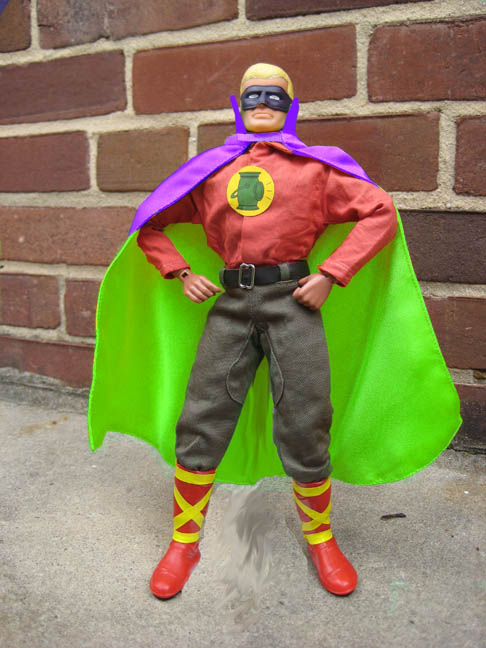
A few years later, when I was making custom figures of all the Justice Society of America characters, I took on the daunting task of recreating Golden Age Green Lantern. His was one of the more audacious costumes from the era, featuring a red shirt, green pants, red boots with yellow criss-cross striping, a purple mask, and a high-collared cape with purple on the outside and chartreuse on the inner lining. In today's vernacular, he was a hot tranny mess!

Although I was no longer making costumes specifically for Captain Action figures, I decided to repaint a spare Lone Ranger face mask to use for Alan Scott's head because of the similarity. His hair went from black to yellow and his mask went from black to purple. To mitigate the extreme color pallate, I dyed a white shirt in a soft red tone and I used some olive drab pants instead of bright green tights. The chest emblem was created in the same process mentioned above. On the red boots, courtesy of Wes McCue, I created the striping pattern with yellow electrical tape. I wanted to make the cape, but I could never find the material in the right colors. For the sake of this post, I mocked up a cape with a little photoshoppery. This is a reasonable representation of what I want my finished Green Lantern to look like when I get the right cape material.


The Flash and Green Lantern survived through the 20th century by going through radical makeovers, but DC's other three big stars, Superman, Batman, and Wonder Woman, remained relatively unchanged throughout their careers. I'll talk about my Wonder Woman action figure next time.

Friday, June 19, 2009

A Tale of Two Flashes

Going through my old posts, I realized that I neglected to talk about some of my earliest custom action figures. Although they lack some of the attention to detail that I brought to my later customs, I'm still pretty happy with them and thought it might be fun to share them. The Flash seems to be the best place to start since he was the first super hero to cross over from the Golden Age of Comics to the Silver Age in a completely new incarnation. Also, I just so happen to have created custom versions of each character.

Like many people born in the 60s, my first exposure to The Flash came not from the comics but from the Aquaman TV show where The Flash was featured in solo back-up stories as well as in The Justice League of America adventures. The Flash was the first "unitasker" hero I had ever seen. Unlike Superman who could do anything, or Batman who had no superpowers and relied mainly on his belt full of gadgets and gizmos, The Flash could do one thing well which was run like crazy. As a result, all his adventures were tailored to showcase his particular talent. The budding writer in me was fascinated by the contrived nature of these stories. I would think, "Boy, it's a good thing he doesn't have to lift up a train or set something on fire with laser vision. He just has to run across the country in time to defuse a bomb."

A few years later, I was able to read about The Flash's origin in the reprint comic title Secret Origins #1. In the story, police scientist Barry Allen leaves some jars of chemicals near an open window during a thunderstorm (why the window is open during a storm is not explained). Lightning jumps through the window, strikes the apparently conductive chemicals, and the resulting mixture splashes all over Barry Allen. Soon he discovers that he can move at super fast speed like a comic book character he remembered from his youth, the one we now refer to as Golden Age Flash. Since he already works for the police, Allen decides to become a new version of his comic book hero, fashioning a bright red costume for himself and fighting crime as The Flash.

I loved that story, not only because of the great Carmine Infantino artwork, but because the origin referenced an earlier DC creation. Barry Allen was inspired by a comic character who actually existed years earlier. This was the first time I learned of Golden Age Flash, but I was soon able to read his early stories thanks to DC's habit at the time of filling the back pages of its comics with Golden Age stories. Of course, this Flash was a completely different character. In this version, college student Jay Garrick has a lab accident (like Barry Allen) and he inhales fumes that make him super fast. Immediately, he puts together a costume modeled after the Greek god Hermes and starts fighting crime. His motivation for fighting crime is less clear than Allen's, but the stories were still a lot of fun.

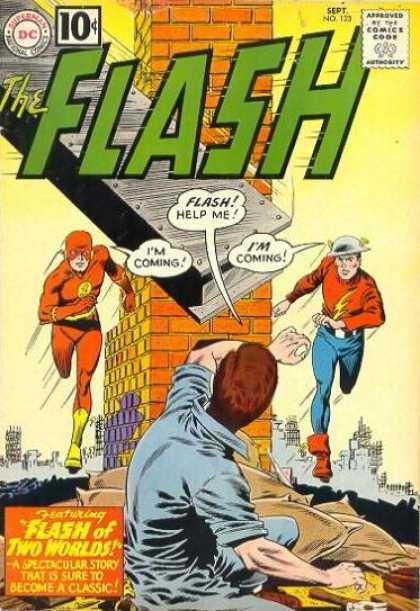
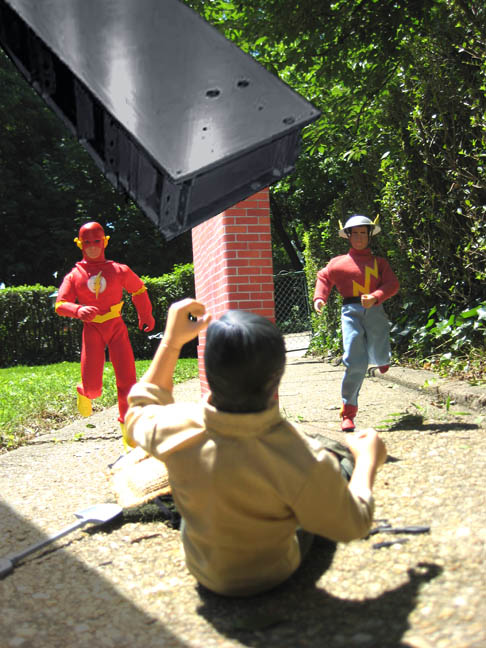
As I grew older and became a full-fledged comic book geek, I learned that the creation of two versions of The Flash led to a major change in the DC universe. In 1961, The Flash #123 featured a story where the old and new Flash meet. It seems Golden Age Flash was not merely a comic book character, but a flesh and blood hero on an alternate world known as Earth 2. In fact, all the Golden Age super heroes lived there including older versions of Superman and Batman. This opened up a long series of cross over stories featuring the old and new characters.

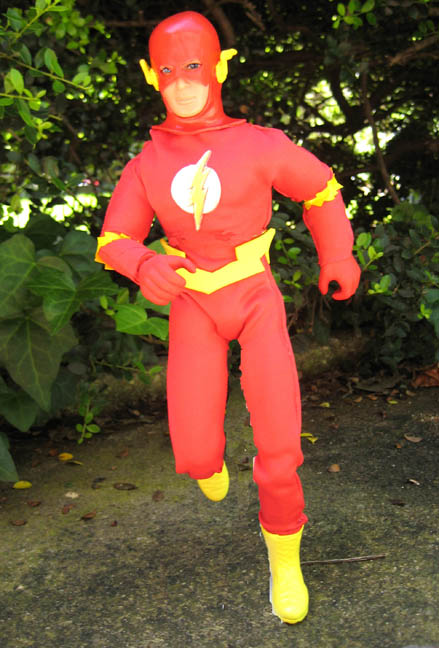
Jumping ahead to the 12st century, I found myself increasingly fascinated with the idea of creating 12" custom action figures based on the super heroes I loved as a kid. More specifically, I was inspired by the old Captain Action line where you could dress Captain Action up in various super hero costumes. Unfortunately, the short run of the toy line prevented Ideal from creating certain super hero costumes that were no brainers, like The Flash and Green Lantern. I decided to create a Flash costume when I found a great Flash mask on eBay, created by Dale Van Slyke. I then purchased a red unitard from the Dr. Mego Web site. I have to admit that, although Dr. Mego makes great Mego parts, the unitard was of really poor quality. However, I liked that it was slightly baggy the way Carmine Infantino used to draw The Flash's costume, so I made some repairs and used it. I made the yellow lightning bolts around the elbows with electrical tape, and for the chest emblem, I took an emblem from the Internet, photoshopped it to size, and printed it on sticker paper. Once cut out and applied to the chest, the unitard was complete.


Since The Flash's boots had tread, I used a pair of army boots that I painted yellow. My original figure also wore red gloves which I bought from Classic Plastick, but I didn't like the way the mask fit on the figure, so I used a beefier action figure with a bigger head. Problem was, the gloves didn't fit his beefy hands, so I just painted his hands red. The yellow belt came from a uniform set sold by a Captain Action fan known as Rauty. His red unitard was better than the Dr. Mego one, but I used his for a different custom project.


The Golden Age Flash figure was created later when I got it into my head to make my own version of the Justice Society of America. I discussed the creation of this figure in an earlier post. Unlike my Silver Age Flash, which was originally devised to be a costume I could put on a Captain Action figure, the Golden Age figure was devised as a stand alone custom. After awhile, I liked the idea of just having figures on display that were meant to be solely one thing rather than making costume sets that could work on different action figures. That's why I chose a figure from ERTL's Fisherman set. I thought the headsculpt closely resembled Golden Age Flash's face.


After creating a Silver Age Flash action figure, my next logical project had to be the other super hero who got a Silver Age makeover: Green Lantern. A look at Silver Age and Golden Age Green Lantern next time!

Tuesday, May 15, 2007

JSA SERIES - HAWKMAN

As a child, I never liked Hawkman. I think it was because of the hawk mask and the ultra-realistic wings. I couldn’t tell whether he was man or bird or both. The whole costume was just a little too creepy for me. That probably explains why he was never a big mover of comic books: kids were just creeped out by him. As an adult, however, I was impressed with his elaborate garb.

Physically, Golden Age Hawkman and Silver Age Hawkman looked pretty much the same. Of course, as was the case with the reintroduction of these old characters in the 50s and 60s, their origins were quite different. While the Silver Age origin is pure science fiction, Hawkman’s Golden Age origin is rooted in ancient mythology. Carter Hall believes himself to be the reincarnation of Egyptian Prince Khufu. His girlfriend Shiera Sanders also thinks she has an Egyptian soul in her, and the two become Hawkman and Hawkgirl to defeat the reincarnation of ancient priest Hath-Set. Using something called “Ninth Metal,” they make anti-gravity costumes with cool hawk wings. The ensuing stories take on an unusual air of romance and ancient mysticism.

Like his colleague the Flash, Hawkman did his regular duty in Flash Comics as well as functioning as a member of the Justice Society of America. Somewhere along the way, for reasons I’ve never been able to uncover, Hawkman’s giant hawk mask was replaced with a simple yellow cowl which made him look like a Mexican wrestler. Although he was less scary looking with the cowl, he lost a great deal of his mystique. The issue was moot, since all the old super heroes got the boot in the early 50s. When Hawkman was resurrected during the Silver Age, his big hawk mask was brought back.

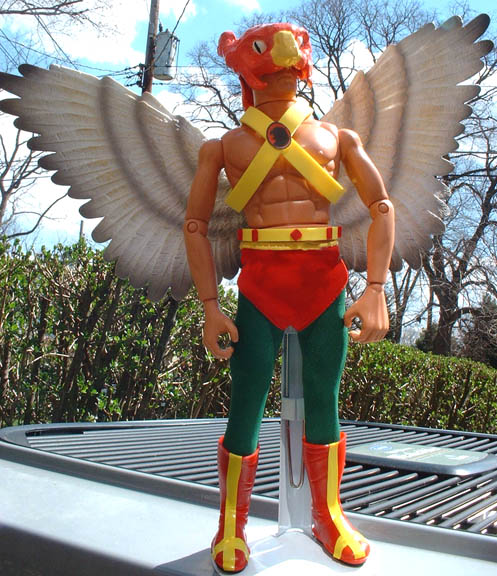
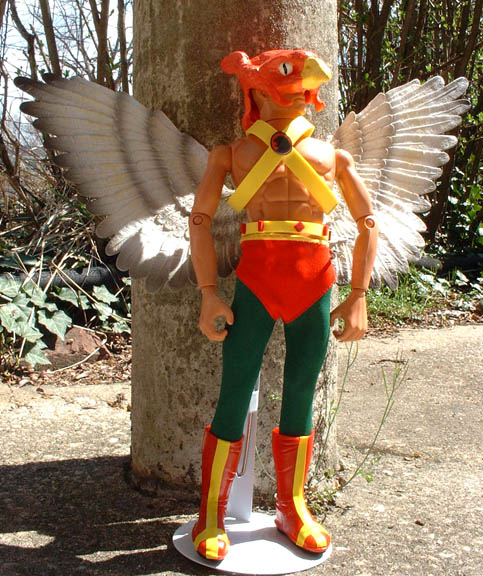
My custom Hawkman took a re-eeaa-lly long time to put together. Rauty’s Toy Store offered the basic Hawkman costume, which consisted of the tights, belt, and criss-cross chest thingee. The big issue was the hawk mask and the wings. I bought the costume years earlier, but it took a long time to figure out how to make the wings. Finally, I read in the Yahoo! Captain Action forum that a fellow customizer used the wings from an X-Men Angel figure. Although the Angel figure was several inches smaller than my 12-inch figures, the wings were oversized and, therefore, worked perfectly for my Hawkman. After snagging an Angel figure on eBay, I chopped off the wings and the back attachment from the Angel figure and re-attached the whole assembly on a standard G.I. Joe figure with screws and model glue. It’s not very pretty from the back, but the effect is great from the front.

The next big issue was the mask. Dale Van Slyke once sold a rubber Hawkman mask on eBay, but I didn’t think it was quite what I was looking for. I swallowed hard and attempted to create a mask with Sculpey. To my surprise, my clay modeling skills weren’t too bad and the mask did look something like a hawk head. Unfortunately, the Sculpey was too thick and the mask looked way oversized on poor Joe’s head. The second attempt looked better, although I had to give the wings on the sides of the helmet a swept-back look so that the mask would not be so unwieldy. Now that I’ve become more proficient with Sculpey, I may take another shot at the mask with wings that stand up on top more. The boots were standard red boots sold by Classic Plastick, but I used yellow electrical tape to fashion the talon-like stripes.

Anyway, here is the final product. Probably one of my most difficult custom jobs, but highly satisfying.


Wednesday, May 02, 2007

JSA SERIES - GOLDEN AGE FLASH

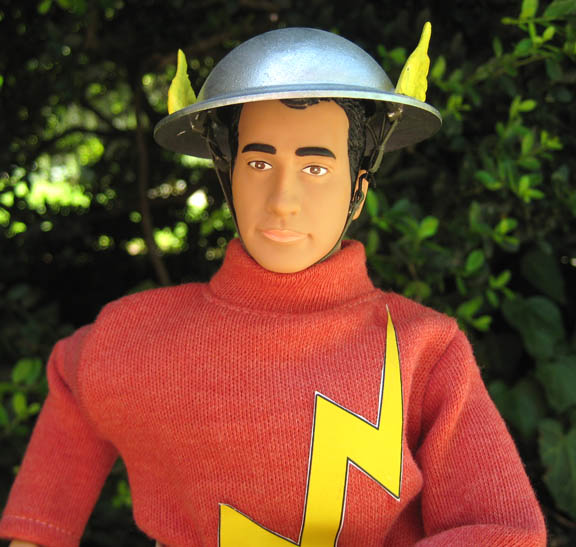
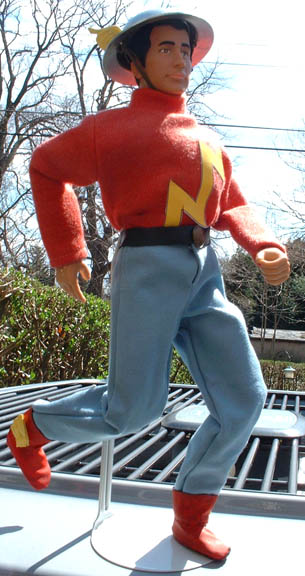
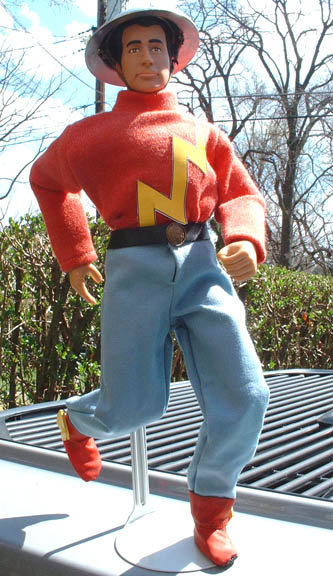
When I first laid eyes on the Golden Age version of the Flash, I could understand why DC Comics made such a radical upgrade for the Silver Age incarnation. Instead of the unitard, which was standard apparel for Silver Age heroes, Golden Age Flash wore light-blue chinos and a red, long-sleeved t-shirt with a yellow lightning bolt racing out of his trousers. Footwear consisted of red, ankle-high booties with little yellow wings on the sides. But the worst fashion choice was the helmet. Capes may be cumbersome for a super hero, but hats and helmets are downright silly (sorry Magneto, but it had to be said). In an attempt to suggest the mythological god Mercury, Golden Age Flash wore a silver head covering which resembled a World War I doughboy helmet, adorned with yellow wings similar to those on his feet. The whole effect was to suggest an utterly fabulous utility worker rather than a courageous crimefighter.


This older version of Flash had an origin about as silly as his outfit. College chemistry major Jay Garrick has one of those chemical accidents so common in comic books. He inhales the fumes of his concoction and develops the ability to run at super fast speeds. Instead of entering the Olympics, Jay decides that his powers are best served fighting crime, so he throws together the aforementioned costume and sets out to be a super hero.

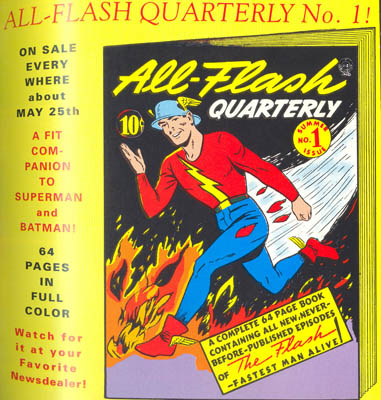
The Flash followed the career path of many similar Golden Age heroes, making his debut in late 1939 in Flash Comics (not named after the character, but perhaps the character was named after the book title). He joined the Justice Society of America, then left the group once he got his own comic (called All-Flash to distinguish it from the regular Flash title). After World War II, his popularity, like those of his costumed colleagues, faded and the comic titles he appeared in were systematically dropped. Once he lost his own title, he returned to the Justice Society, but that group would also fade from existence in the early 50s with the cancellation of All-Star Comics. In 1956, a new version of The Flash was introduced, with a better costume, better origin, and better artwork. This is when many comic fans say the Silver Age began, and I won’t argue that assessment.

It took me a long time to figure out how to create a custom action figure based on Golden Age Flash. I couldn’t find a long-sleeved t-shirt in 1/6th scale, so I took one of my many white turtlenecks and dyed it red. The light-blue pants and belt were courtesy of a Civil War uniform. For the helmet, I started with a World War I helmet which I painted silver. By carefully cutting out sections of wing from a rubber eagle I bought at a crafts store, I had the wings for the sides, which I simply painted yellow and glued to the helmet.

The odd booties took some thinking. I ended up using the boots from an Aladdin action figure, which I painted red. For the wings, I cut yellow pieces of foam rubber into wing shapes. Not my best work, but fairly effective. For the figure itself, I needed one with a headsculpt that would suggest the way Jay Garrick was drawn in the comic since he didn’t wear a mask to disguise his face. I settled on a figure that came in ERTL’s Outdoor Fisherman set.

Keep ‘em flying, Flash!

Monday, April 23, 2007

JSA SERIES - THE SPECTRE

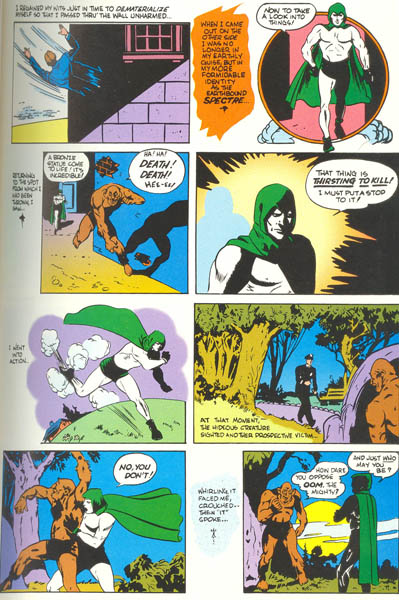
Now this was a super hero with a difference! Here was a crime fighter who was a ghostly spirit sent down by The Almighty to thwart evil. Actually, in the hands of Golden Age comic writers, the premise is presented in a more mundane way than it sounds. Detective Jim Corrigan is killed in the line of duty, but the Big Guy won’t let him into heaven because there’s too much crime on Earth to be dealt with, so he brings Jim back to life with a spirit inside him which periodically escapes to capture bad guys. Pretty quirky stuff, but that’s what made the Golden Age so great!

I was familiar with The Spectre long before I had heard of the JSA because the character had been resurrected (he’s a spirit after all) in the Silver Age with his own comic. However, it was the Golden Age stories which really interested me more since they were usually handled with a lighter touch than the later incarnation.

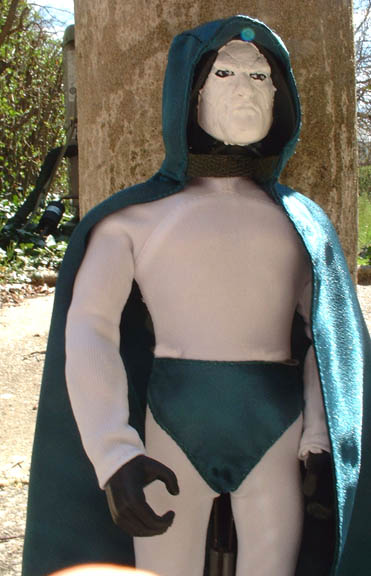
My custom action figure of The Spectre once again starts with a costume from Rauty’s Toy Shop. I wanted a face that would capture the haunted, grim expression of the ghostly crime fighter, but I couldn’t find a 12” figure that quite fit the bill. Then Hasbro came out with a G.I. Joe character called Faces, whose gimmick was that he could disguise himself as Cobra villains. Therefore, the figure came with had a set of masks as accessories. One mask for a character called Zartan exhibited just the right expression, so I painted the mask white and affixed it to an action figure. The short boots were courtesy of a Civil War costume that I had purchased around the same time. The figure already had molded gloves, so the whole figure came together pretty quickly.


Tuesday, April 10, 2007

JSA SERIES - HOURMAN

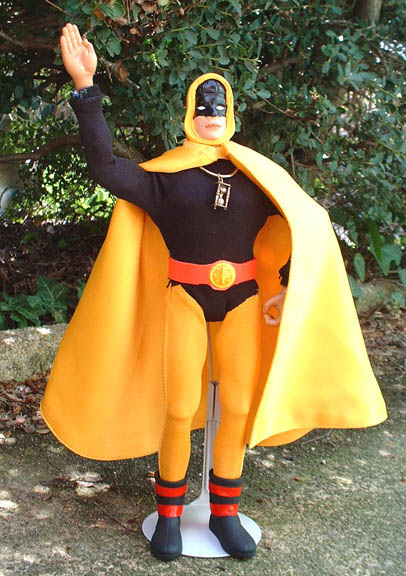
Hourman was one of DC’s earliest super heroes, rushed into duty shortly after Superman made a big splash with the reading public. His gimmick was fairly straightforward – by taking the drug Miraclo, he could have super powers for exactly one hour. Not the most exciting hero, Hourman was bumped from the Justice Society of America fairly early on, though he did return as a member in the 60s during the JLA/JSA crossover stories.


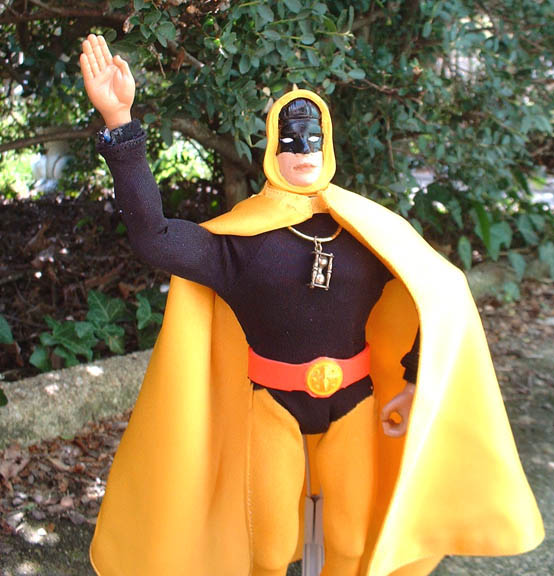
I attempted a custom figure of Hourman simply because I thought he would be a relatively easy project. For his leotard, I took a black body suit from a G.I. Joe figure (Snake Eyes) and cut out the legs. I then took the legs from a white body suit belonging to another G.I. Joe (Storm Shadow) and dyed them golden yellow. After I sewed the yellow legs onto the black suit, I had the basic costume. The gold cape came from Rauty’s Toy Shop (what can I say, his suits are amazing).

For the head and body, I used the Storm Shadow G.I. Joe and cut the face out at the point where it protruded from the hood. I replaced the face with the face from a Playing Mantis Kato mask. After gluing the two pieces together, I painted Kato’s face to look like a black mask and I painted Storm Shadow’s white hood golden yellow to match the suit and cape.

The boots were standard black boots from a generic figure. I wrapped red electrical tape around them to create stripes. The hourglass necklace was created with some gold cord and a sterling silver hourglass charm I purchased on eBay. Just to make him a little different, I swapped out the bulky G.I. Joe hands for some 21st Century Toys hands which I bought in an accessories pack. The belt was made from red foam rubber and the clock face in the center I cobbled together from various bits of plastic I had on hand.

One of the easier customs, but fairly effective, I think.


Wednesday, April 04, 2007

JSA SERIES - DR. FATE

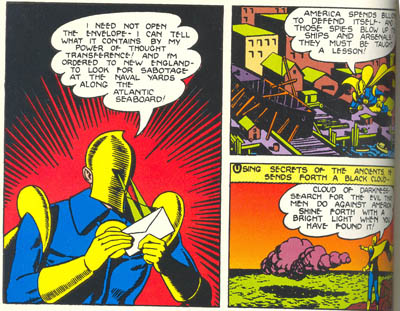
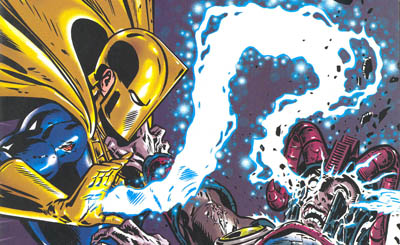
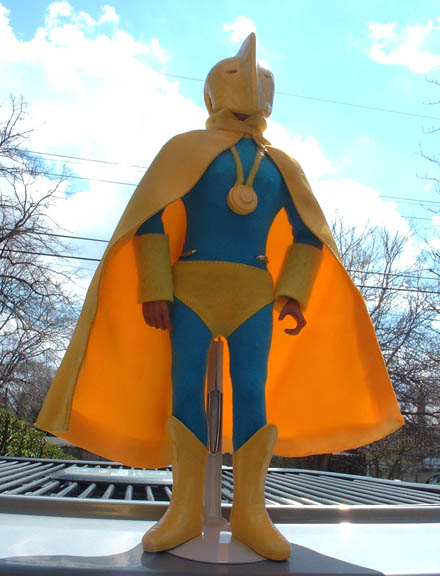
Dr. Fate was one of those Golden Age characters whom I never fully understood, mainly because I never saw an origin story and the old comics weren’t prone to repeating origins like they did in the Silver and Bronze Age. His powers (and nifty costume) were drawn from some ancient Middle-Eastern mystic named Nabu, but other than that, he was just another hero with cool duds as far as I was concerned.

My custom action figure of Dr. Fate started years earlier when my wife bought me a Dr. Fate costume from Rauty’s Toy Shop. I loved the costume, but I had no idea how I was going to make the helmet. My first attempt involved taking the back piece of a helmet from the Marx Silver Knight set and gluing the face shield from a G.I. Joe Cobra Commander figure onto the front. The seams where the two pieces joined looked pretty crude and never really glued together properly. Also, I couldn’t find a paint that would adhere properly to the slick vinyl pieces. I knew I would have to resort to Sculpey.

To create a mask out of Sculpey, I first needed a 1/6th scale head to build the clay around. I chose to use one of the busts that came with Captain Action costume sets. I positioned the bust in a coffee mug stuffed with newspaper so it wouldn’t move around. Then, to keep the clay from sticking to the head, I wrapped it in plastic wrap, secured the wrap to the head with a rubber band around the neck, and greased the whole thing with petroleum jelly. Although it looked like something from a G.I. Joe S&M party, the rig was perfect for sculp
ting the mask to its proper size and shape.

Next I had to determine how I wanted the mask to look since Dr. Fate’s helmet evolved over the years. I definitely was not going with the “half-mask” version used in later JSA stories where his grinning teeth could be seen. I always preferred the menacing nature of the early full-mask design, as do the modern comic book artists. I was never crazy, however, for the odd, soft-serve ice cream curl the early masks had on top. I chose to go with the design used in a Dr. Fate mini-series put out a few years ago where the front of the mask has a sharp, axe-like point. I know it’s not strictly Golden Age, but it’s my figure and I like it this way.

It took two attempts to create a mask that looked right and was sturdy enough to not collapse while I transferred it from bust to baking tray. As you may know, after modeling something in polyvinyl clay, you must bake it in an oven to firm up the piece. Once it was baked and solid, I painted it with yellow acrylic paint and coated the whole thing with a clear varnish made specifically for Sculpey. After it dried, the helmet was pretty similar to a solid plastic mask.

The Golden Age Dr. Fate comics showed the hero both with and without gloves. I may invest in some yellow gloves for my figure from Classic Plastick. The yellow boots are Captain Action boots which I repainted yellow (don’t worry, I used newer Playing Mantis boots and not vintage ones). The necklace is a hubcap from a car model, painted yellow and attached to some yellow yarn.


Wednesday, March 28, 2007

THE BLACK CANARY

The Black Canary raised a question mark in my childhood mind because she functioned as both a member of the Justice Society of America and Justice League of America. DC Comics had gone to the trouble to explain that the Justice Society existed in another dimension on the planet Earth-2 and those old heroes were closing in on Social Security when they would occasionally meet up with the Justice League members. When I was reading JLA in the early 70s, The Black Canary was a youthful member of the team, but I had also read that she had been a youthful member of the JSA back in the 40s.

Actually, it was explained in the late 60s, before I started reading Justice League, that The Black Canary had been with the JSA, then swapped dimensions to work with the JLA. Somehow in the dimensional move, Canary stopped aging. Later on, DC came up with some more of their b.s. to say that the current Black Canary was actually the daughter of the original Black Canary. Whatever guys.

The Black Canary was one of only two female members of the Justice Society, Wonder Woman being the other. Canary came along later in the JSA run, replacing the usually annoying and always useless Johnny Lightning. Ironically, Black Canary got her start in Johnny Lightning’s feature in Flash Comics, then took over his feature. I guess DC realized that a hot, butt-kicking female superhero would bring in more sales than a nebbishy boob with a red, sentient lightning bolt for a friend.

She also benefited by joining the JSA later, when the writers seemed more open to having a female who was an equal partner with the men. The first female member, Wonder Woman, was made “secretary” and spent most of her time back at headquarters typing up minutes and making coffee. The Black Canary would have none of that, and was always up front with the guys fighting crime.

Since most of my memories of Black Canary are rooted in her later incarnations as JLA member and Green Arrow’s wife, I decided to give my custom action figure version a more modern interpretation. Besides, I couldn’t find a female figure with a Betty Grable hairdo. I was really taken with the headsculpt on the action figure based on Abbey Chase from the Danger Girl comic, so I used her as the main figure. The black leotard and fishnet stockings were purchased from the FemBasix line at Old Joe Infirmary. The leather vest with lapels was also part of that line. The purple, pirate-style boots are courtesy of Classic Plastick, and the purple collar I made from fabric that I painted purple and applied a Velcro fastener on the back. Since Abbey Chase’s hands were already molded with black gloves, I painted them purple to match the boots and collar.

All in all, a pretty simple custom, but quite effective, in my opinion. Next time, I’ll show you a more complicated project involving Dr. Fate.

Tuesday, March 20, 2007

Golden Age Sandman


When DC Comics started putting out 100-page comics in the early 70s, I was truly thrilled. Granted I had to do some extra begging with my mom or dad to get them to shell out the 60 cents cover price versus the 20 cents for a regular-sized comic, but I would carefully explain that the added reading value provided by these jumbo size magazines outweighed the added expense. I think my dad was an easier mark than my mom because he recognized that these books were padded out with reprints of Golden Age comic stories from when he was a child. Seeing these old characters reproduced triggered a sense of nostalgia and the latest issue of Detective Comics or Adventure Comics was all mine.


I loved reading these stories from the infancy of comicdom. While the artwork was generally much cruder than what was being produced in the 70s, the stories had a certain simplicity and sense of fun that was missing from the more socially aware comics of the day. To me, comics in the 70s were being written for baby boomers who were already in their teens or 20s. Like much of the entertainment back then which catered to that demographic, I always felt a little lost and forced to catch up in order to understand what was being presented. Comics from the 40s were written for kids, so they spoke to me in a direct way.

I also enjoyed how the characters seemed completely human and frequently fallible, although they always saved the day in the end. Golden Age writers like Gardner Fox and John Broome understood how to blend comedy with suspense, and their stories had a light, breezy quality painfully absent from post-Silver Age comics. These superheroes operated by the seat of their pants and their costumes looked like some hastily assembled Halloween outfit. The most curious of these early superheroes was The Sandman.

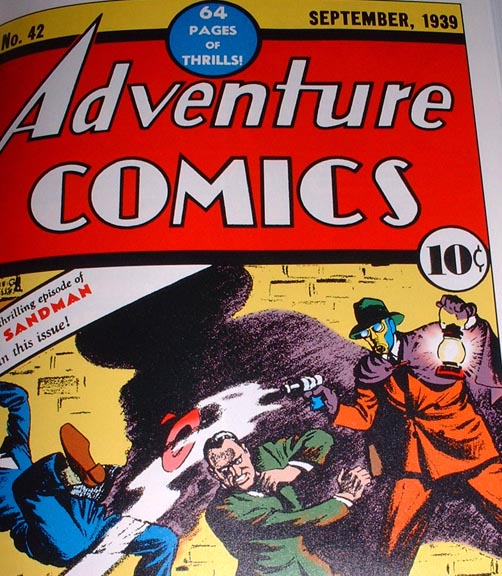
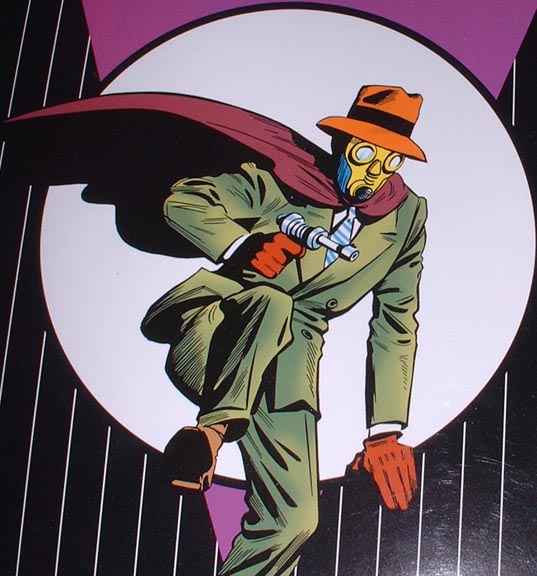
Years later, it became clear to me that The Sandman was a knock-off of The Green Hornet, with his green suit, fedora, mask, cape, and gas-gun. He even had a trusty sidekick who knew his identity like Kato, only Sandman’s accomplice was his girlfriend Dian Belmont. I didn’t make any of these connections as a child; I was just fascinated by his creepy mask. To protect himself from the knock-out gas that he sprayed from his gas gun on unsuspecting bad guys, he wore a stylized gas mask which gave him a sinister air. At first glance, I thought he was a villain, but soon realized that, not only was he a good guy, he had an easy-going, average guy humor about him that I found entertaining. I also liked that he had a cool girlfriend for a partner rather than some smart-alecky kid sidekick. And he was a member of the Justice Society of America to boot. That’s why, when I set out to make an action figure collection based on the JSA, I started with The Sandman.

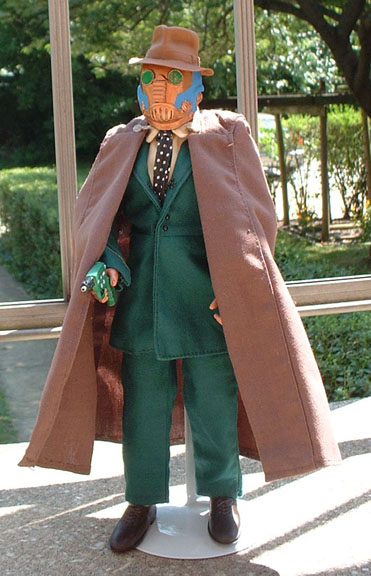
Of course, the mask was going to be the trickiest part of the exercise, so I saved that task for last. The first piece I found was his cape, which I took from a Star Wars Count Dooku figure. In most renderings of Sandman, his cape is purple, but that just seemed too garish to me, and in some of the early comics, the cape was a more realistic brown. Therefore, I felt fine with using a brown cape. The fedora was a Dale Van Slyke creation I bought on eBay, and the brown shoes I got from Old Joe Infirmary, along with the cream colored shirt and polka-dot tie.

The green suit was a real problem. At first, I sought out a white suit that I could dye green, but I came across this curious Civil War outfit on the Cotswold Collectibles Web site. Apparently, there was a Confederate unit that wore a green uniform. I bought it and was able to adapt it into a 40s style suit by simply turning out the lapels in a different way. I equipped him with a gas gun which was simply the gun used for the Playing Mantis Green Hornet costume created for Captain Action.

The Sandman was coming together nicely, except for that main piece: the mask. I attempted to create a mask using Sculpy, but the results were not pleasing. Then, as luck would have it, Sideshow Collectibles put out a series of 12” figures based on characters from the movie Hellboy. One of the characters, Kroenen I believe, had a mask similar to Sandman’s, so I bought the figure and quickly set about modifying it to look like The Sandman. While the Kroenen mask was completely smooth on the front, Sandman had a strange looking breathing apparatus which I needed to fabricate. I ended up using pieces I cut from a 1/6th scale assault rifle. When you buy as many action figures as I have over the years, you always have a pile of tiny weaponry on hand for customization. Anyway, after affixing my make-shift breathing piece, I painted the mask to match the colors from the comic. Here is the end result:

During the 40s, as The Sandman’s popularity waned, he underwent a makeover which put him in a more conventional yellow-and-purple unitard. Dian was killed off and her nephew became Sandman’s new sidekick. Joe Simon and Jack Kirby took over the artwork, and the character suddenly bore a striking resemblance to Kirby and Simon’s other creation, Captain America and Bucky. Although this boosted the character’s popularity at the time, the original, mysterious looking Sandman was the image that was used when the character was revived in the 70s. You can’t beat something as unique as the Golden Age Sandman.

Thursday, March 15, 2007

JUSTICE SOCIETY OF AMERICA

I promised in my first blog post that I would discuss my ongoing project of creating custom action figures based on the original Justice Society of America. I guess it’s long overdue for me to get started.

As most comic fan knows, the JSA appeared from 1940 to the early 50’s in All-Star Comics and featured an ensemble of second-stringer super heroes banding together to tackle a major threat. Although Superman and Batman were listed as honorary members, they never actually participated in any of the stories. The JSA was designed to showcase the lesser known heroes on DC’s roster. In fact, once a character, such as The Flash, became popular enough to have his own title, he left the JSA. All the JSA members were languishing in back-up features, and their participation in each JSA story was essentially as a back-up player.

You see, the early comics were 64 pages in length with about 54 pages devoted to actual comic content. In All-Star Comics, the JSA would have a story which would span all 54 pages, but the story was cleverly divided into chapters (6 or 8 pages in length) in which each member of the JSA completed a solo task contributing to the overall completion of the mission. Each chapter was drawn by the artist who normally drew the character in his/her other features, so there was no visual continuity at all. You would go from the highly detailed artwork on a Hawkman chapter into the amateurish artwork on a Dr. Midnite chapter. An opening and closing chapter, which set up and concluded the story, was drawn by one artist who had to render all the heroes. These were the oddest looking chapters in each comic, especially if the artist couldn’t quite capture the proper look of certain heroes.

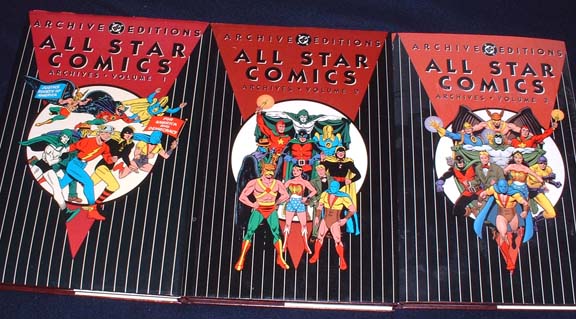
Anyway, I never got to see any of these stories until the late 90s when DC Comics started putting out the hardcover compilations of the early All-Star issues. My first encounters with JSA were during the Justice League/Justice Society team-ups in the 70s. About once a year, Justice League of America would team up with the JSA which, in the DC Universe of the time, existed in a different dimension called Earth-2. The JSA members had aged normally since the 1940s, so they appeared in the 70s as gray-haired, wrinkled old fogies who still had rock hard bodies with which to fill out the tights. I thought the whole thing was a bit odd, but since I had enjoyed reading reprints of stories featuring the Golden Age super heroes, I found it amusing to see them as older but still active. Then I read Jim Steranko’s History of the Comics and learned about the All-Star Comics which I described earlier. I wanted desperately to see how these book-length comic stories worked, but there was no way I could afford any of those old comics even if I could get to a comic show to buy them. I didn’t even know about comic shows back then, and comic stores were rare. Twenty-five years later, I finally was able to read the stories and I got a huge kick out of them. Shortly thereafter, I got into making custom action figures, and I knew I wanted to create my own 12’’ JSA.

The thing that intrigued me the most about the Golden Age heroes was their costumes. Since super heroes were a new invention in the late 30s and early 40s, their costumes were based on any number of references from wrestlers to pirates to early literary heroes like Zorro and The Scarlet Pimpernel. Unlike the Silver Age heroes who took their cue from the big guys Superman and Batman, the Golden Age do-gooders had unique, if not a little clunky, styles. They almost looked like they put together their outfits using leftovers from the attic, which heightened the reality of the characters for me. This also made the prospect of creating custom figure versions all the more interesting. By far the oddest looking member of the team was Sandman, so I naturally had to start with him. In my next post, I will describe the creation of my Sandman action figure.