I recently read that Gordon Scott, the actor who portrayed Tarzan through the second half of the 50s, died in my hometown of Baltimore while being treated for a heart ailment at Johns Hopkins Hospital. Forget about Johnny Weismuller; Mr. Scott was the best Tarzan for my money. He was handsome, well-built, and he played Tarzan as an educated person, like in the books. None of this “You Jane, me Tarzan,” garbage. The Tarzan movies from that era were also slick productions, in full color with strong performances (catch Sean Connery as a baddie in Tarzan’s Greatest Adventure). Yessir, Gordon Scott was the Tarzan for me, and the fact that he spent his remaining years so close to where I live seemed like an interesting coincidence.
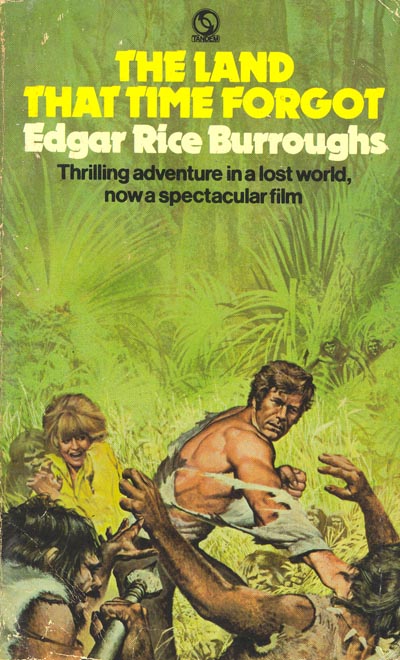
Tarzan, of course, was Edgar Rice Burroughs most well known creation, but he was the least interesting to me as a child. Tarzan movies from all eras, from the 30s to the 60s, were a ubiquitous part of weekend television when I was a child, so I watched them regularly, but I don’t think I was ever able to finish a whole Tarzan book. Jungle stories just didn’t excite me that much. I was more of a science fiction guy, and I had no idea that Burroughs wrote primarily sci-fi until I went to see The Land that Time Forgot.
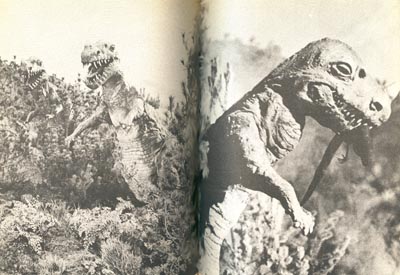
 Released in 1974, The Land that Time Forgot was a modestly budgeted movie starring aging t.v. star Doug McClure and produced by the British company Amicus Productions, known primarily for modestly budgeted horror films like The House That Dripped Blood. In a nutshell, McClure is an American traveling on an ocean liner in the Atlantic during WW I when it is torpedoed by a German U-Boat. Stranded in the water, McClure and his fellow castaways launch an improbable attack on the U-Boat and take it over. They then end up lost and find an uncharted island hidden from the world by a perpetual fog. Once ashore, the international crew discover a volatile world of volcanoes, dinosaurs, and cavemen. Since this was 1974, the dinosaurs are rubber, the caveman makeup is laughable, and the volcano special effects are crude. But for a 10-year-old in the 70s, this was really exciting stuff.

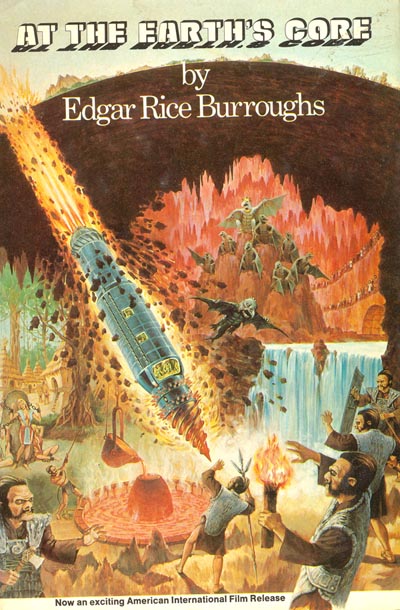
 Amicius quickly followed up with a movie based on another Burroughs book, At The Earth’s Core. Also starring Doug McClure as David Innes, this time he’s teamed with horror legend Peter Cushing as two intrepid explorers (they were all intrepid back then) who traveled to the center of the Earth in a turn-of-the-century machine which looked like a cross between a tank and a gi-normous drill. The Earth turns out to be a hollow ball with a tiny sun in the center. A whole civilization lives on the inner surface of the Earth, bathed in eternal daylight. Of course, we don’t have much time to ponder the science since the set-up is just an excuse to fight rubber dinosaurs, primitive humans, and a race of bird-like bad guys (i.e., men in rubber suits). After seeing this second movie, I was convinced there was more to this Burroughs guy than just stories about guys in loincloths.
Around this same time, I was becoming a rabid reader, and I begged my dad constantly to visit the Waldens Books at the local mall. My favorite section to browse was Science Fiction, and there I discovered shelf after shelf of Edgar Rice Burroughs books. I was stunned at the number and diversity of his work. My first purchases were the books I had seen adapted on the screen. To my surprise and pleasure, the books were much better than the movies. There’s a certain special exhilaration one feels when one discovers a writer with whom one can’t get enough of, and given Burroughs library, I knew there was plenty for me to feast on for quite awhile.
 After reading TLTTF and At the Earth’s Core, I moved on to their sequels, The People that Time Forgot and Pellucidar. The former was also made into a movie starring Patrick Wayne (John’s son). It was on par with the earlier movies and featured a cameo by perennial Doug McClure, but the movies just couldn’t live up to the source material.
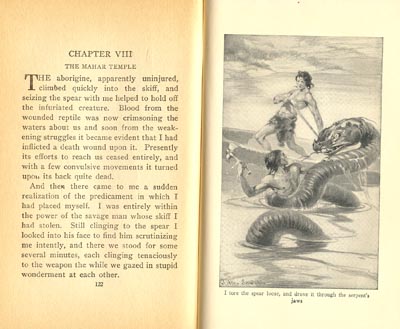
This was my pre-teen/early teen period, when I was also a big comic book collector. The cool thing about comic collecting back then was that comic people also tended to be mad science fiction buffs, so there was a cross-over of collecting comics and second-hand books. While I was buying old comics, including old comics based on Edgar Rice Burroughs stories, I also came across first editions of Burroughs books. Those musty hardcovers with the painted illustrations inside made the reading experience even more exciting, as if I were making a direct connection with the era when these stories were first written. I spent those sultry summers in the late 70s sitting on my back porch reading those books until the sun light faded from the evening sky. I would always burn a citronella candle next to me to keep away the mosquitoes. I don’t think it ever worked based on the number of bites I received, but the smell of the stuff brings me back to those days when I was alongside David Innes fighting wild creatures on Pellucidar.

For those who are avid Burroughs fans, it might surprise some that I started with these lesser known books. I actually took awhile to work my way to what is probably Burroughs’s second greatest creation next to Tarzan. That is, of course, John Carter of Mars. More on him next time…


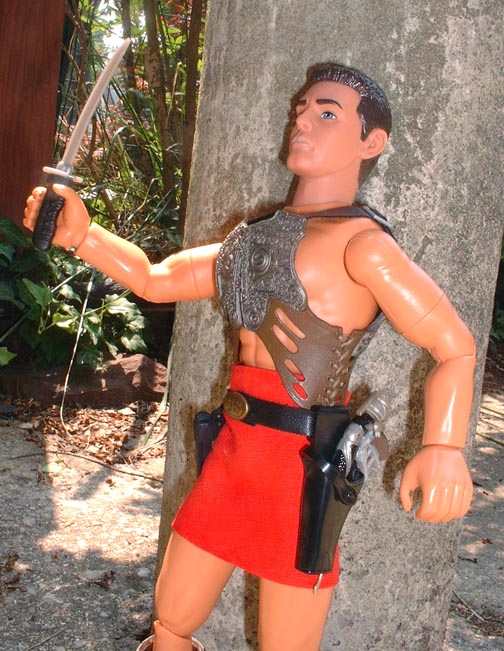
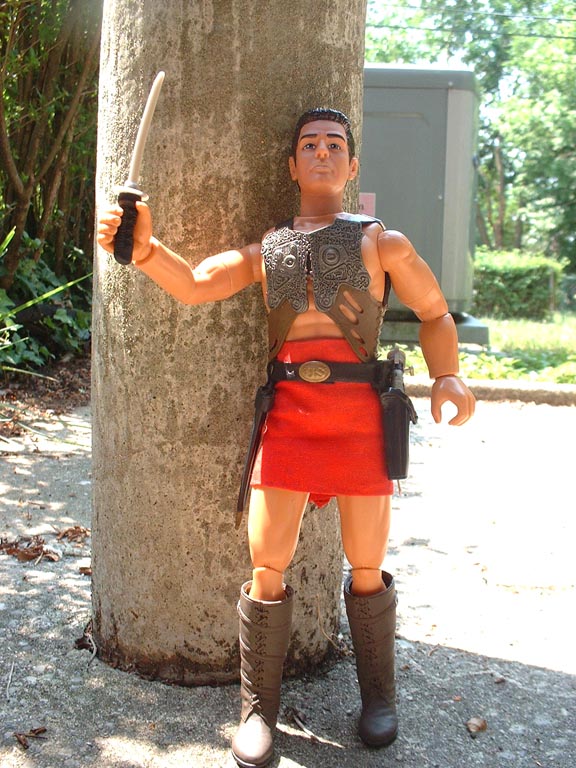
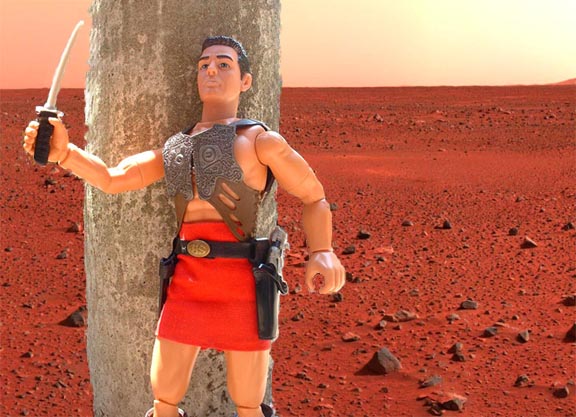
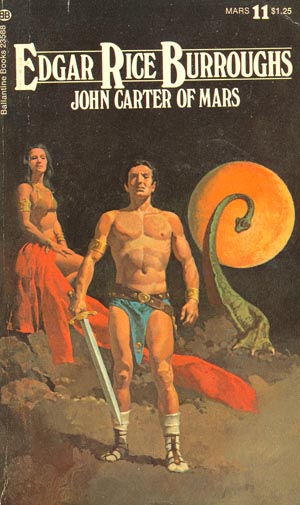
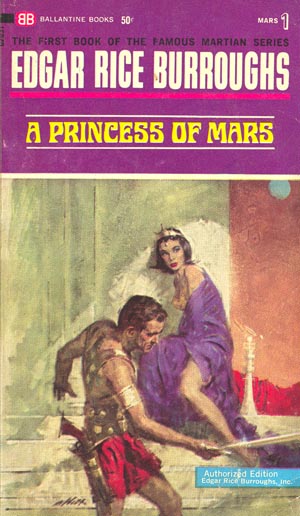 A few weeks back, I blogged about how the books of Edgar Rice Burroughs (and the related movies and comic books) had a great influence on my imagination in my early adolescence. I hesitated writing the posts since I had no toys or custom action figures to talk about, and I've tried to stick mostly to toy and action figure commentary in this blog. However, ERB was a huge part of my teenage years and still provides inspiration in my writing, so I plunged ahead and wrote what was on my mind at the time. Then I got to thinking about maybe creating a custom action figure based on the classic ERB hero, John Carter of Mars. I didn't want to go overboard and buy any new materials for the custom, but I wanted to do something that would provide at least a vague resemblance to the John Carter renderings which appeared on the old paperbacks. The artists who illustrated those covers gave John Carter a slightly gladiator look, except he carried a radium gun along with his sword. And the radium gun was usually depicted as sort of a musket/ray gun like Alex Raymond may have envisioned it. So I dug through my bins of leftover action figure accessories, old dolls, and fabric remnants. Without too much effort, I came up with what I think is a pretty serviceable figure.