Wednesday, March 28, 2007

THE BLACK CANARY

The Black Canary raised a question mark in my childhood mind because she functioned as both a member of the Justice Society of America and Justice League of America. DC Comics had gone to the trouble to explain that the Justice Society existed in another dimension on the planet Earth-2 and those old heroes were closing in on Social Security when they would occasionally meet up with the Justice League members. When I was reading JLA in the early 70s, The Black Canary was a youthful member of the team, but I had also read that she had been a youthful member of the JSA back in the 40s.

Actually, it was explained in the late 60s, before I started reading Justice League, that The Black Canary had been with the JSA, then swapped dimensions to work with the JLA. Somehow in the dimensional move, Canary stopped aging. Later on, DC came up with some more of their b.s. to say that the current Black Canary was actually the daughter of the original Black Canary. Whatever guys.

The Black Canary was one of only two female members of the Justice Society, Wonder Woman being the other. Canary came along later in the JSA run, replacing the usually annoying and always useless Johnny Lightning. Ironically, Black Canary got her start in Johnny Lightning’s feature in Flash Comics, then took over his feature. I guess DC realized that a hot, butt-kicking female superhero would bring in more sales than a nebbishy boob with a red, sentient lightning bolt for a friend.

She also benefited by joining the JSA later, when the writers seemed more open to having a female who was an equal partner with the men. The first female member, Wonder Woman, was made “secretary” and spent most of her time back at headquarters typing up minutes and making coffee. The Black Canary would have none of that, and was always up front with the guys fighting crime.

Since most of my memories of Black Canary are rooted in her later incarnations as JLA member and Green Arrow’s wife, I decided to give my custom action figure version a more modern interpretation. Besides, I couldn’t find a female figure with a Betty Grable hairdo. I was really taken with the headsculpt on the action figure based on Abbey Chase from the Danger Girl comic, so I used her as the main figure. The black leotard and fishnet stockings were purchased from the FemBasix line at Old Joe Infirmary. The leather vest with lapels was also part of that line. The purple, pirate-style boots are courtesy of Classic Plastick, and the purple collar I made from fabric that I painted purple and applied a Velcro fastener on the back. Since Abbey Chase’s hands were already molded with black gloves, I painted them purple to match the boots and collar.

All in all, a pretty simple custom, but quite effective, in my opinion. Next time, I’ll show you a more complicated project involving Dr. Fate.

Tuesday, March 20, 2007

Golden Age Sandman


When DC Comics started putting out 100-page comics in the early 70s, I was truly thrilled. Granted I had to do some extra begging with my mom or dad to get them to shell out the 60 cents cover price versus the 20 cents for a regular-sized comic, but I would carefully explain that the added reading value provided by these jumbo size magazines outweighed the added expense. I think my dad was an easier mark than my mom because he recognized that these books were padded out with reprints of Golden Age comic stories from when he was a child. Seeing these old characters reproduced triggered a sense of nostalgia and the latest issue of Detective Comics or Adventure Comics was all mine.


I loved reading these stories from the infancy of comicdom. While the artwork was generally much cruder than what was being produced in the 70s, the stories had a certain simplicity and sense of fun that was missing from the more socially aware comics of the day. To me, comics in the 70s were being written for baby boomers who were already in their teens or 20s. Like much of the entertainment back then which catered to that demographic, I always felt a little lost and forced to catch up in order to understand what was being presented. Comics from the 40s were written for kids, so they spoke to me in a direct way.

I also enjoyed how the characters seemed completely human and frequently fallible, although they always saved the day in the end. Golden Age writers like Gardner Fox and John Broome understood how to blend comedy with suspense, and their stories had a light, breezy quality painfully absent from post-Silver Age comics. These superheroes operated by the seat of their pants and their costumes looked like some hastily assembled Halloween outfit. The most curious of these early superheroes was The Sandman.

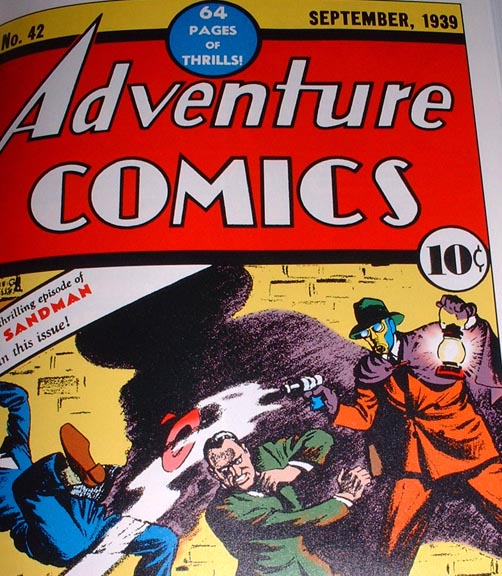
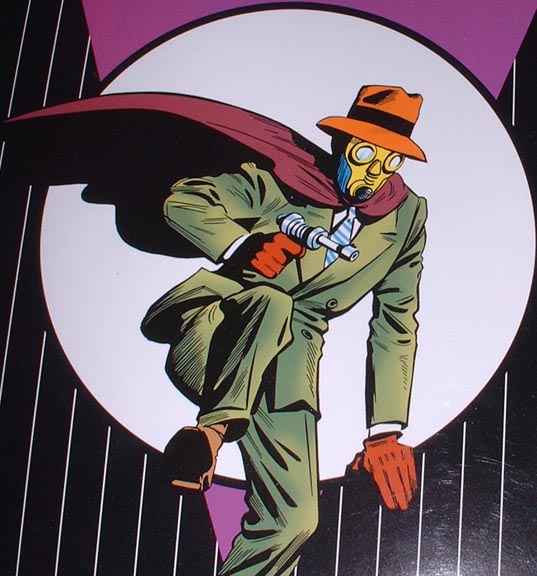
Years later, it became clear to me that The Sandman was a knock-off of The Green Hornet, with his green suit, fedora, mask, cape, and gas-gun. He even had a trusty sidekick who knew his identity like Kato, only Sandman’s accomplice was his girlfriend Dian Belmont. I didn’t make any of these connections as a child; I was just fascinated by his creepy mask. To protect himself from the knock-out gas that he sprayed from his gas gun on unsuspecting bad guys, he wore a stylized gas mask which gave him a sinister air. At first glance, I thought he was a villain, but soon realized that, not only was he a good guy, he had an easy-going, average guy humor about him that I found entertaining. I also liked that he had a cool girlfriend for a partner rather than some smart-alecky kid sidekick. And he was a member of the Justice Society of America to boot. That’s why, when I set out to make an action figure collection based on the JSA, I started with The Sandman.

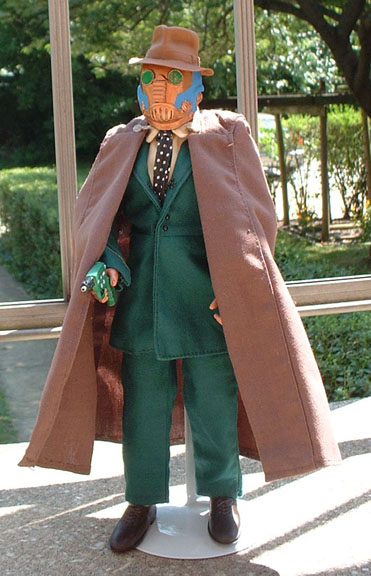
Of course, the mask was going to be the trickiest part of the exercise, so I saved that task for last. The first piece I found was his cape, which I took from a Star Wars Count Dooku figure. In most renderings of Sandman, his cape is purple, but that just seemed too garish to me, and in some of the early comics, the cape was a more realistic brown. Therefore, I felt fine with using a brown cape. The fedora was a Dale Van Slyke creation I bought on eBay, and the brown shoes I got from Old Joe Infirmary, along with the cream colored shirt and polka-dot tie.

The green suit was a real problem. At first, I sought out a white suit that I could dye green, but I came across this curious Civil War outfit on the Cotswold Collectibles Web site. Apparently, there was a Confederate unit that wore a green uniform. I bought it and was able to adapt it into a 40s style suit by simply turning out the lapels in a different way. I equipped him with a gas gun which was simply the gun used for the Playing Mantis Green Hornet costume created for Captain Action.

The Sandman was coming together nicely, except for that main piece: the mask. I attempted to create a mask using Sculpy, but the results were not pleasing. Then, as luck would have it, Sideshow Collectibles put out a series of 12” figures based on characters from the movie Hellboy. One of the characters, Kroenen I believe, had a mask similar to Sandman’s, so I bought the figure and quickly set about modifying it to look like The Sandman. While the Kroenen mask was completely smooth on the front, Sandman had a strange looking breathing apparatus which I needed to fabricate. I ended up using pieces I cut from a 1/6th scale assault rifle. When you buy as many action figures as I have over the years, you always have a pile of tiny weaponry on hand for customization. Anyway, after affixing my make-shift breathing piece, I painted the mask to match the colors from the comic. Here is the end result:

During the 40s, as The Sandman’s popularity waned, he underwent a makeover which put him in a more conventional yellow-and-purple unitard. Dian was killed off and her nephew became Sandman’s new sidekick. Joe Simon and Jack Kirby took over the artwork, and the character suddenly bore a striking resemblance to Kirby and Simon’s other creation, Captain America and Bucky. Although this boosted the character’s popularity at the time, the original, mysterious looking Sandman was the image that was used when the character was revived in the 70s. You can’t beat something as unique as the Golden Age Sandman.

Thursday, March 15, 2007

JUSTICE SOCIETY OF AMERICA

I promised in my first blog post that I would discuss my ongoing project of creating custom action figures based on the original Justice Society of America. I guess it’s long overdue for me to get started.

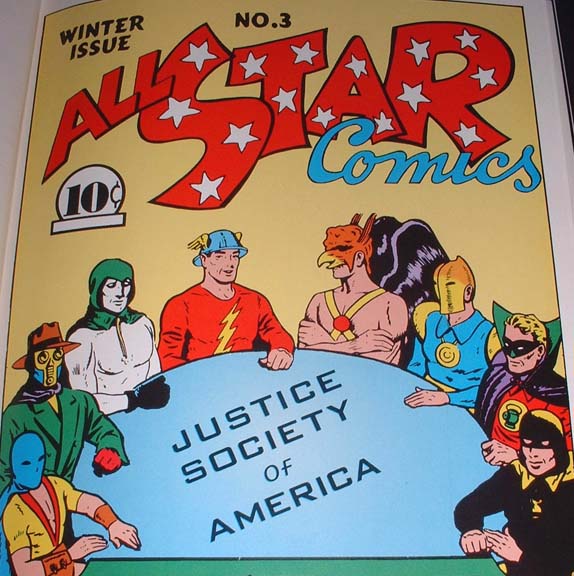
As most comic fan knows, the JSA appeared from 1940 to the early 50’s in All-Star Comics and featured an ensemble of second-stringer super heroes banding together to tackle a major threat. Although Superman and Batman were listed as honorary members, they never actually participated in any of the stories. The JSA was designed to showcase the lesser known heroes on DC’s roster. In fact, once a character, such as The Flash, became popular enough to have his own title, he left the JSA. All the JSA members were languishing in back-up features, and their participation in each JSA story was essentially as a back-up player.

You see, the early comics were 64 pages in length with about 54 pages devoted to actual comic content. In All-Star Comics, the JSA would have a story which would span all 54 pages, but the story was cleverly divided into chapters (6 or 8 pages in length) in which each member of the JSA completed a solo task contributing to the overall completion of the mission. Each chapter was drawn by the artist who normally drew the character in his/her other features, so there was no visual continuity at all. You would go from the highly detailed artwork on a Hawkman chapter into the amateurish artwork on a Dr. Midnite chapter. An opening and closing chapter, which set up and concluded the story, was drawn by one artist who had to render all the heroes. These were the oddest looking chapters in each comic, especially if the artist couldn’t quite capture the proper look of certain heroes.

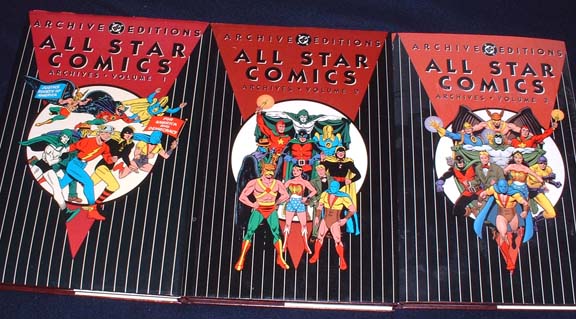
Anyway, I never got to see any of these stories until the late 90s when DC Comics started putting out the hardcover compilations of the early All-Star issues. My first encounters with JSA were during the Justice League/Justice Society team-ups in the 70s. About once a year, Justice League of America would team up with the JSA which, in the DC Universe of the time, existed in a different dimension called Earth-2. The JSA members had aged normally since the 1940s, so they appeared in the 70s as gray-haired, wrinkled old fogies who still had rock hard bodies with which to fill out the tights. I thought the whole thing was a bit odd, but since I had enjoyed reading reprints of stories featuring the Golden Age super heroes, I found it amusing to see them as older but still active. Then I read Jim Steranko’s History of the Comics and learned about the All-Star Comics which I described earlier. I wanted desperately to see how these book-length comic stories worked, but there was no way I could afford any of those old comics even if I could get to a comic show to buy them. I didn’t even know about comic shows back then, and comic stores were rare. Twenty-five years later, I finally was able to read the stories and I got a huge kick out of them. Shortly thereafter, I got into making custom action figures, and I knew I wanted to create my own 12’’ JSA.

The thing that intrigued me the most about the Golden Age heroes was their costumes. Since super heroes were a new invention in the late 30s and early 40s, their costumes were based on any number of references from wrestlers to pirates to early literary heroes like Zorro and The Scarlet Pimpernel. Unlike the Silver Age heroes who took their cue from the big guys Superman and Batman, the Golden Age do-gooders had unique, if not a little clunky, styles. They almost looked like they put together their outfits using leftovers from the attic, which heightened the reality of the characters for me. This also made the prospect of creating custom figure versions all the more interesting. By far the oddest looking member of the team was Sandman, so I naturally had to start with him. In my next post, I will describe the creation of my Sandman action figure.


Tuesday, March 06, 2007

THE RETURN OF FRANKENSTONY

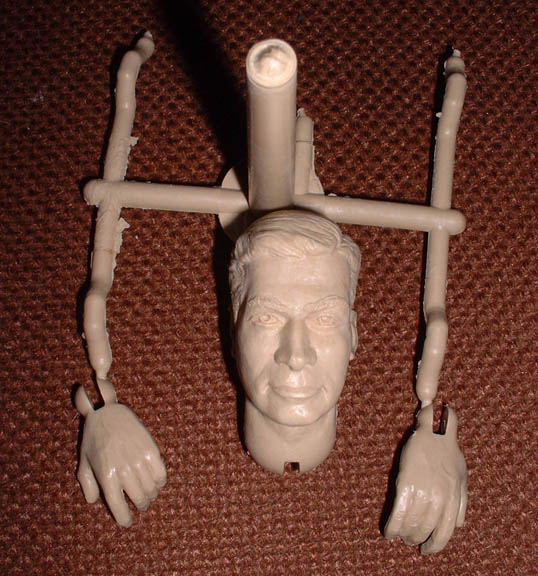
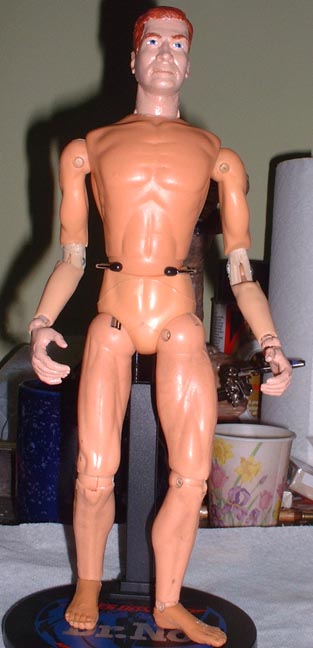
A while back, I talked about the build-it-yourself Stony Smith I bought on eBay. Apparently, in the 90s, Marx Toys went into production on a new line of Stony Smith action figures when the buyer backed out, leaving them with a bunch of unassembled pieces. They’ve now resurfaced on eBay where you can get the pieces to assemble your very own Stony Smith, provided you cannibalize rivets and bungee cords out of other Marx figures (Marxman Bros. has since begun offering the hardware to build or repair Marx figures). The other issue was that the head and hands in the kit are not for Stony Smith, but for Marx’s other army guy Buddy Charlie. Since both figures are quite different, the head and hands don’t really work with the body parts. I ended up using the head and hands off an old, beat up Marx figure to complete my makeshift Stony, but I wanted to find some use for those head and hands.


The answer came to me as I sorted through the pile of action figure odds and ends that I have compiled. You see, the tricky part about acquiring pieces you want on eBay is that you often have to purchase auction lots which also contain stuff you don’t really want. Over the years, in my passion for collecting Captain Action stuff, I’ve built up a collection of random Captain Action body parts. The weird thing is that, while there are plenty of bodies, torsos, legs, and upper arms, the heads, forearms, and hands are extremely hard to find. The Buddy Charlie head and hands could fit nicely onto a Captain Action body, but I still needed forearms.

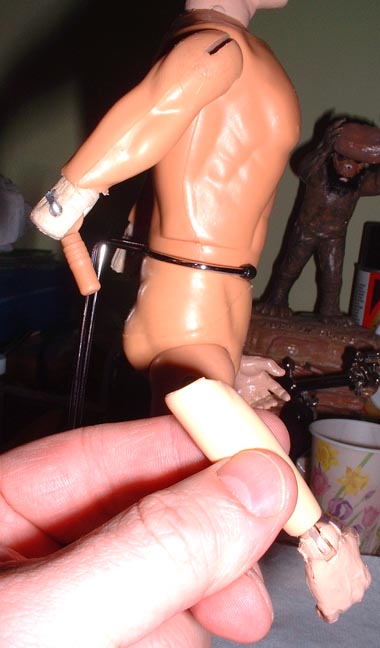
Through the Web site Cotswold Collectibles, I could purchase rivets, pegs, and bungee cords to assemble an action figure, along with body parts modeled after the vintage G.I. Joe figures. They had G.I. Joe-style forearms, but the issue was that, while G.I.Joe’s forearm was designed to receive a connecting peg from the upper arm, Captain Action’s upper arm was designed to receive a connecting peg from Captain Action’s forearm. Therefore, in order to connect a G.I. Joe forearm to a Captain Action upper arm, I needed a joint in the middle with pegs that would fit into each end.

Since I don’t have a lab in which to create plastic parts, I went to my brother who fashioned a wooden joint in his workshop. Basically, the joint was shaped like a bulbous vase, with a fixed peg that fit into the upper arm.


We then cut a slit in the rounded part of the joint which could receive a plastic peg. After drilling a hole through the joint to line up with the hole in the plastic peg, we were able to attach the peg to the joint with a rivet. This allows the plastic peg to move up and down. With the joint inserted into the upper arm, we could then attach the forearm to the plastic peg, creating a complete arm with articulation at the elbow.


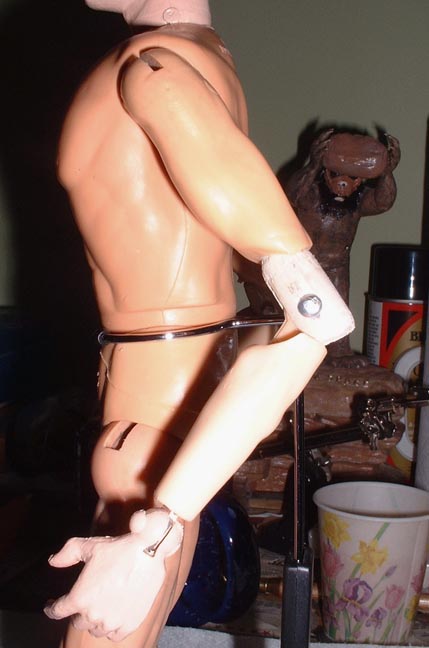
Here's how the painted head and hands look attached to a mostly Captain Action body with G.I. Joe forearms:


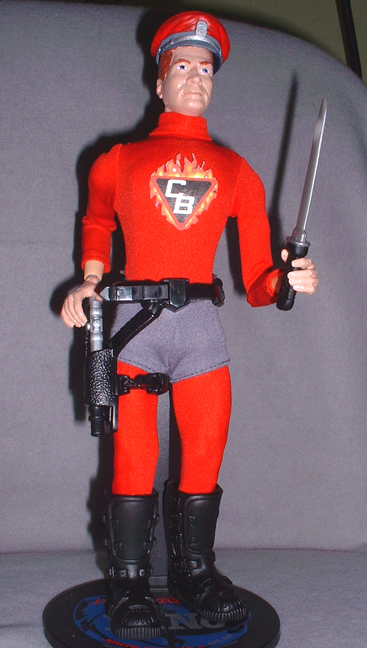
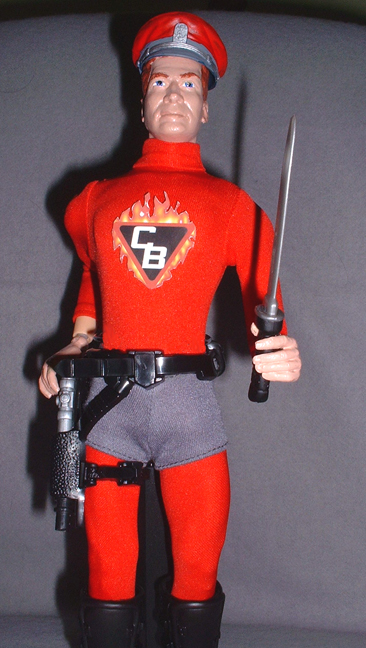
Granted, the joint looks a little rustic and makes the arms slightly longer than they normally would. However, once you cover the arms with clothing, you really don’t notice anything. After attaching all the parts into a completed body and painting the head, I was at a bit of a loss as to what to do with my new creation. I was reminded of how Army hero Sgt. Fury was transformed into the quasi-spy Nick Fury, Agent of S.H.I.E.L.D., and thought about creating Buddy Charlie, Agent of S.O.M.E.T.H.I.N.G.O.R.O.T.H.E.R.


Then I remembered that, in body anyway, he was more Captain Action than Buddy Charlie, so I decided to make him Captain Action’s red-headed step-brother, Commander Blaze!

How 'bout that?

Tuesday, February 27, 2007

CHILDHOOD ON THE PLANET OF THE APES

Once upon a time, a wildly successful science fiction movie spawned a cult phenomenon. Not only were several sequels filmed, but cartoon and television shows were produced based on the film, and a slew of merchandising was created including dolls, comic books, models, and bubble gum cards. This might sound like I’m talking about Star Wars, but I am in fact talking about Planet of the Apes. In the late 60s and early 70s, Planet of the Apes (POTA to fans) laid the ground work for how a true multi-media, pop culture blitz should be handled, and the entertainment world has never been quite the same.

I was too young to see the first POTA movie, but I was quite familiar with its iconic imagery through movie trailers, posters, and pictures in the newspaper. I was intrigued by Charlton Heston in his homo-erotic loin cloth and leather restraints, the state-of-the-art ape make-up and quasi-medieval outfits, and the ape city of stucco and wood buildings with the San-Diego-Zoo-Goes-Condo motif. Unfortunately, the first POTA movie I saw was Conquest of the Planet of the Apes, which had none of that. Instead, I was treated to Ricardo Montalban dragging Roddy McDowell on a leash through some near-future United States where man has turned apes into slave labor. I knew from pop culture osmosis that McDowell’s ape character in the other movies was Cornelius, but here he was called Caesar. The movie shows how, under Caesar’s leadership, the apes revolt and violently take over the earth (or a least a few acres of LA’s Century City) from the nasty ol’ humans. By the end, I was confused and not a little depressed. It wasn’t long, however, before the earlier movies started popping up on t.v. and I was able to understand what the original fuss was all about.

In all there were five POTA films, the first two being the only ones worth repeated viewings, in my opinion. The first took a fairly decent stab at Pierre Boulle’s novel, although budget restraints prohibited showing the book’s more modern ape world of cars and helicopters and such. The second film, Beneath the Planet of the Apes, had a more adventurous flair, showing a race of intelligent humans who have survived in the remains of New York’s subway system and worshipped a functioning atomic bomb. As a boy, I actually preferred Beneath over the first film because of the action involved. As an adult, I think I’ve shifted my vote to the more cerebral first film. The remaining three films spun off in a completely different, and obviously cheaper, direction.

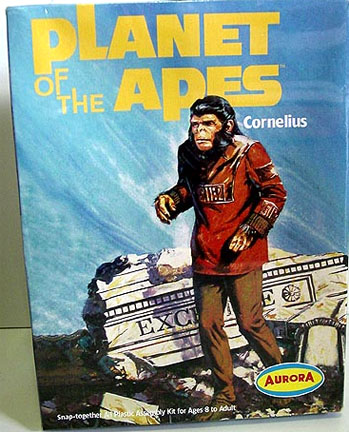
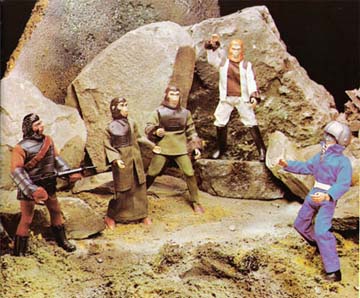
By 1974, I was completely sucked into the POTA whirlwind. My first pieces of POTA memorabilia were the Cornelius and Dr. Zaius model kits which my dad bought me while we were on vacation in Wildwood, NJ. Since the kits were snap-together, I built them on the way home in the back seat of our ’67 Chrysler Newport. Later, I was thrilled to learn that CBS was premiering a POTA television show that fall. Simultaneously, the Christmas catalogues were filled with Mego’s new POTA action figures and accessories, based on the original film. I immediately put in my begging requests for all the Mego figures and the Ape City playset. The ape figures were pretty close to the look of the actors in the movie, but Charlton Heston had not granted his permission to use his likeness on a Taylor doll, so Mego created a generic Astronaut figure wearing Action Jackson’s old jet pilot outfit. Oh well, it was still kinda cool. And the Ape City used the same cardboard forms as the Mego Batcave playset, but it was covered with vinyl material showing printed images of the Ape world (there’s even a decimated Statue of Liberty on the back). Seems like I received a Mego playset every Christmas back then, and the smell of the vinyl was so pungent, to this day if I catch a whiff of vinyl, my heart leaps from happy yuletide memories.

While I eagerly waited through the fall of ’74 for my POTA figures, I watched the new POTA t.v. show. Wisely ignoring the later feature films, the t.v. show took the basic premise from the original movie (astronauts passing through a time/space warp and landing on a future Earth inhabited by apes), and fashioned a different storyline where two astronauts are forever running away from the apes who want to suppress these thinking humans. Roddy McDowell plays an ape called Galen (still wearing his Cornelius make-up and costume), who befriends the astronauts and helps them on their escape from ape justice. Initially, I enjoyed the show, but after it became clear that this series was simply The Fugitive in fur, I lost interest. By the time Christmas rolled around, I was no longer watching the show and was happy to play out the movie version with my action figures. Mego eventually put out new POTA figures based on the t.v. show, but it may have already been cancelled by then. Once I exhausted all my POTA story lines, I reimagined my gorilla soldier figure as a super hero whom I named Commander Kong. I thought the idea was pretty nifty to have a sentient, M-16 wielding gorilla fighting crime.

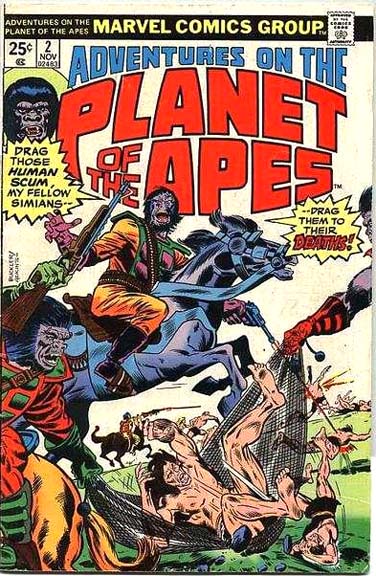
After that Christmas, I continued to have a fascination with POTA, as did much of the world, apparently. Marvel Comics, trying to move beyond the bullpen of super heroes they had unleashed, put out POTA comic books, both in the traditional format and in a magazine format with black-and-white artwork. A Saturday morning animated series was also made, which I enjoyed far more than the live-action show. Without the worries of creating sets and costumes, the animated series presented an ape world closer to Boulle’s vision, with gorilla soldiers driving jeeps and flying planes. Also, the show’s look was designed by Jonny Quest creator Doug Wildey, so it had a cool feel despite the limited animation.

My passion for POTA petered out somewhere in 1977. Once Star Wars was released, movie studios put the sci-fi machine in high gear, and there was just so much more out there to take in. Just like so many of the childhood memories I have shared in this blog, POTA had its time and place in my heart before something else turned my head. The full bore passion may have faded a long time ago, but each of these pop culture icons has left a piece of joy in my heart which has never left me.

Wednesday, February 21, 2007

SPACE: 1999 REVISITED

Around the time that Space: 1999 was ending its second season, Star Wars hit theaters. I saw Star Wars on its opening day in Baltimore (it didn’t actually reach the city until mid-June since movies didn’t open on nine million screens at once like they do now). While I enjoyed its Flash Gordon-style blend of sword-and-sorcery with spaceships and ray guns, I had no idea the world would build Star Wars up into the mega-phenomenon it became. To me, it wasn’t real science fiction like Star Trek or Space: 1999, and I laughed at how seriously so many people took all this Jedi, Force, Dark Side hooey. Nevertheless, science fiction nuts like myself did benefit as Hollywood sought out all kinds of sci-fi properties to cash in on. Without Star Wars, there would’ve been no Star Trek movies or Blade Runner, so I was a happy camper in the late 70s and 80s.

It was fun to see the resurgence of Star Trek through the movies and subsequent t.v. shows. Not only was the subject matter taken more seriously, Paramount spent real money on these productions, giving them a polish the old show could have only dreamed of. While Star Trek was reinvented over and over through the 80s and 90s, Space: 1999 was relegated to the kitschy recesses of the television attic, always to be viewed unfairly as a poor Star Trek knockoff. It pained me to watch my hero, Martin Landau, relegated to such embarrassing fare as Without Warning and The Harlem Globetrotters on Gilligan’s Island. Thank God, Francis Ford Coppola resurrected his career by casting him in Tucker: A Man and His Dreams. But I digress…

By the early 90s, Space:1999 popped back into my life by way of some VHS releases and through airings of reruns on the Sci-Fi channel. Unfortunately, most of the ones I caught on t.v. were from the second season, and they only served to reinforce my memory of how bad the show became toward the end of its run.

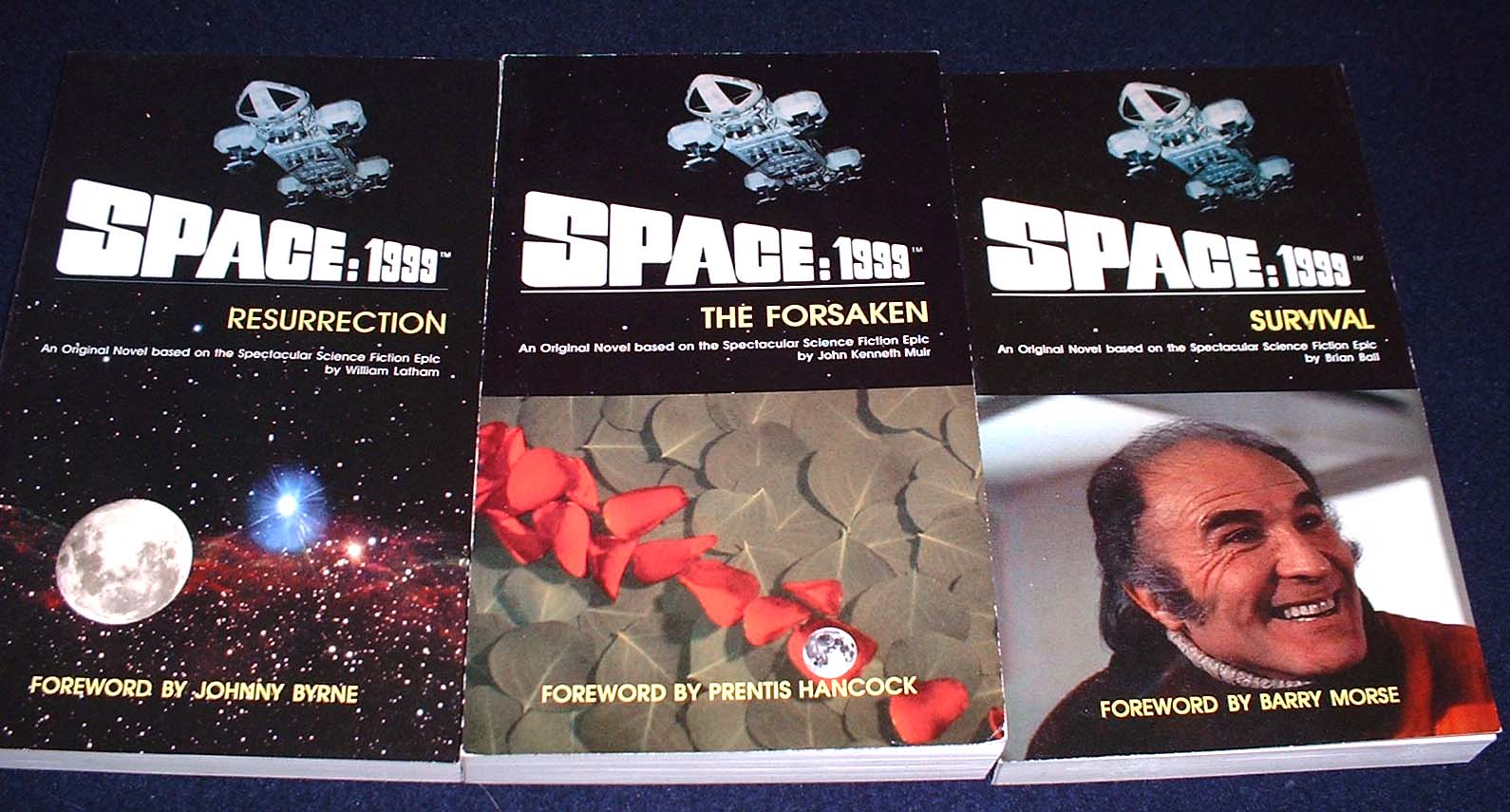
A true resurgence occurred in the late 90s when a company called Carlton obtained the licensing rights to Space: 1999 and actively promoted use of the property. Soon, A&E released all 48 episodes on DVD, and a company called Powys Media set about creating new novels based on the old show. Two of the books provided explanations as to how Season One characters Paul Morrow and Dr. Bergman mysteriously disappeared. The old model kits were reissued, albeit only briefly, and a company specializing in Mego reproductions put out Space: 1999 action figures.

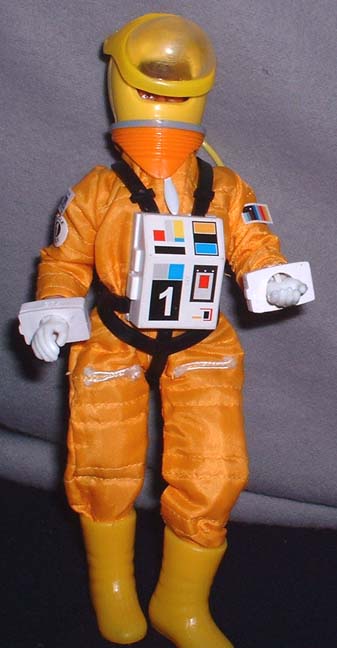
I mentioned in my previous post that, as a boy, I owned a Commander Koenig action figure made by Mattel. The Mattel figures were the only ones sold in the U.S. when the show was on the air. However, Mego produced a separate line of figures sold in Europe through the Palitoy company. While the Mattel figures were slightly larger than the Mego figures and the headsculpts were quite good, the costumes looked nothing like those worn on the show. The Mego/Palitoy figures had decent head sculpts and the uniforms were closer to the ones on the show, but they didn’t have a Helena Russell figure and no laser guns. Maybe the Europeans were worried about promoting violence. The Mattel figures definitely had laser guns along with the commlocks. Anyway, now in the 21st century, Classic T.V. Toys started putting out reproductions of the old Mego figures as well as creating new figures based on other characters from the show like Maya and Tony Verdeshi. They even came up with an Alan Carter figure in a realistically rendered space suit. The one drawback was that Martin Landau would not give permission to use his likeness on a new Commander Koenig doll. C’mon, Marty, cut the fans a break!

Since Classic T.V. Toys couldn’t make one, I was determined that I would create my own custom Koenig. Fortunately, CTVT offers figure parts and clothes, so I bought a standard Space:1999 body complete with the white boots. They also offer a Commander Koenig uniform, although it lacks the black stripe on the right arm and the black, mock turtleneck. I was able to add those to the uniform with some black fabric and fabric glue. All I needed was a head. As luck would have it, Dr. Mego sells an unpainted head that looks strikingly like the original Mego head that adorned their old figure. I purchased the head along with a belt, commlock, and laser gun that he makes for Space: 1999 figures. The gun is especially cool since it looks like it belongs with the old figures even though no laser was originally produced.

After painting the head and assembling the parts, I had my own custom Commander Koenig action figure. A childhood dream fulfilled.

Thursday, February 15, 2007

SPACE: 1999

While my friend Greg was zealously promoting Star Trek on the playground, my other friend Vince was showing equal fervor over Space: 1999 in the cafeteria. I’d sit across from Vince every lunch break while he went on and on about what a great show Space: 1999 was. I listened politely but skeptically. I had watched the premiere episode in September of 1975 and couldn’t make it through the first 15 minutes. What I could discern from that first episode was that Moonbase Alpha was built to monitor a huge nuclear waste dump on the far side of the moon (incorrectly called the “dark side” of the moon on the show). Increased electromagnetic energy caused by the excessive amounts of radioactive material created an enormous nuclear explosion that propelled the moon, and the inhabitants of Alpha, on a one-way journey into deep space. Sounds cooler than it actually looked to me at the time. It reminded me too much of UFO, another Gerry Anderson production, which seemed too slow, too stiff, and too talky to be interesting television.


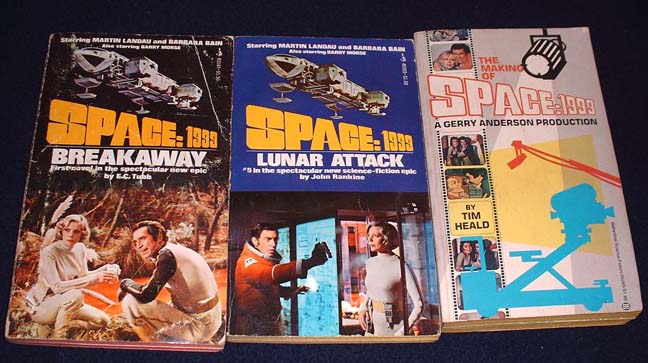
After Vince started his crusade to bring me around, I watched another episode called The Guardian of Piri, which involved the personnel of Moonbase Alpha being lured to a planet where they are basically turned into listless dolts who sit around and stare into space. Not exactly exciting stuff for an 11-year-old, and I was convinced this show was a dud. Finally, I figured I’d give it one more try for Vince’s sake, so I picked up one of the Space:1999 books which novelized four episodes of the show into one sort of cohesive story. Written by veteran science fiction writer E.C. Tubb, I was impressed by the story and I finally understood what I couldn’t seem to grasp by merely watching a random episode here and there.

While Star Trek presented a bright future where outer space was a dynamic and exciting place to explore, Space: 1999 presented a darker vision where man’s inability to control his own technology had thrust a sampling of humanity into the dark, cold, inhospitable void long before they were psychologically ready to face it. The Enterprise crew was made up of smart, courageous people who established relations with alien life forms across the galaxy. The inhabitants of Moonbase Alpha were a more realistic representation of ordinary people who bickered amongst themselves, became wildly stressed by the dangers they were confronting, and sometimes made horrible decisions based on fear and the yearning to find a new home. Captain Kirk was friendly, self-assured, and always had the right answer to any problem. Commander Koenig was overwhelmed by the responsibilities forced on him, short-tempered, and often too quick to respond with a short-sighted decision which put the members of Alpha in jeopardy. In a nutshell, Star Trek stood for the Kennedy-style, right stuff, Peace Corps, Great Society optimism of the 60s which was just beginning to erode by the time the show hit the air. Space: 1999 reflected the more cynical 70s, where leaders could be wrong, foreigners might not be so welcoming to visitors, and new experiences may lead to ambiguous conclusions.

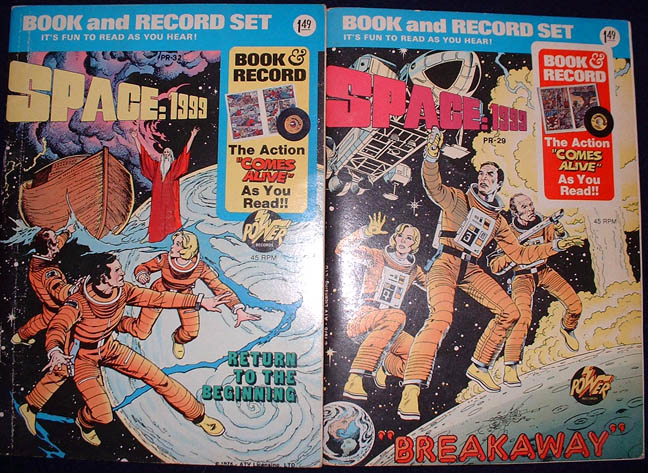
During the spring and summer of 1976, I watched both Star Trek and Space: 1999. They were like two sides of a space opera coin. Star Trek stimulated my desire for adventure and exploration; Space: 1999 compelled me with its sense of loneliness and danger. And just like every kid who’s rabid about a t.v. show, I piled up Space: 1999 toys and memorabilia just as quickly as I did for Star Trek. Peter Pan records put out two Space: 1999 book and record sets, along with an LP of audio stories. I also had the Mattel version of the Commander Koenig action figure, and a cardboard representation of Moonbase Alpha with cardboard people and spaceships.

Also, just like Star Trek, I bought up all the model kits available, including the Eagle and Hawk spaceships, and the Moonbase Alpha diorama. AMT even put out a dune buggy looking thing called The Alien and slapped the Space: 1999 logo on it. Although it had nothing to do with the show, I bought it anyway.

I mentioned the novels earlier, but there were also comic books (great early John Byrne artwork), coloring books, and even a color-by-number poster. If the Space: 1999 logo was on it, I was buying it.

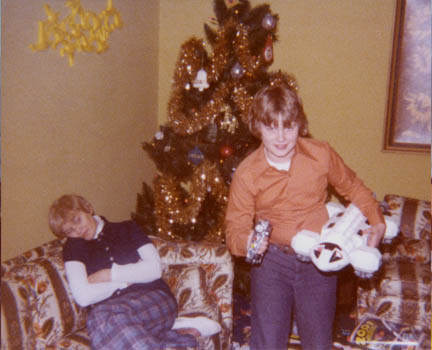
For Christmas 1976, I received the laser gun, complete with flashing lights, and the three-foot Eagle spaceship with little Koenig, Russell, and Bergman figures. They were kinda brittle and posed in a strange, ape-like stance to fit in the cockpit, so I soon abandoned the figures and used my MAC men (more on that in a previous post). These items, like virtually all the Space: 1999 stuff, were based on the characters and look of the first season. In the fall of ’76, Space: 1999 was into its second season and it appeared to be almost a completely different show.

To make the show more “American,” Gerry Anderson brought in t.v. hack Fred Freiberger, who had produced the disastrous third season of Star Trek. To Freiberger’s credit, he did make the show more exciting, hiring writers and directors who could focus on action and pacing. He also allowed the set and costume designers to bring more color and flair to the show’s look. He specifically moved away from the expansive, white sets of the first season in favor of smaller rooms crammed with equipment to enhance tension. Freiberger’s flaw was that he viewed Space: 1999 as another Star Trek, and completely ignored the tone and story lines that made the show unique. Instead of encountering advanced beings and space phenomena that challenged their perception of the universe, Koenig and the gang spent the second season battling the proverbial bug-eyed monsters who were usually bent on stealing Alpha’s “life support core,” whatever the hell that was. He also callously removed characters and replaced them with new ones, never explaining where they went. On Star Trek, you could assume that characters like Yeoman Rand were simply transferred, but characters stranded on a runaway moon had to be explained away. I guess Freiberger assumed we were too stupid to notice.

Which was the essential flaw with the second season: the fans were treated like clods who only wanted spaceships and ray guns. For all its shortcomings, the first season had a point of view. In addition to showing humans at their best and worst under stressful conditions, presenting alternate perceptions of reality, and building suspense through the sheer struggle to survive, there was also an underlying theme that promoted the concept that the Alphans had a destiny. Man had destroyed Earth through wars and pollution and the inhabitants of Moonbase Alpha were flung into the cosmos to provide the human race with a second chance to start over on a new planet. Sometimes they would inexplicably escape certain destruction. The only reason for their survival was that some higher power wanted them to carry on and fulfill their destiny. Pretty heady stuff for 70s t.v.

Of course, as a pre-teen, I only understood these concepts on a subliminal level. Watching the second season, an inexplicable sense of loss grew as each new episode aired. With each new bug-eyed monster, I was certain something special was missing. I couldn’t articulate it, but I yearned to see the first season again. Unlike Star Trek, however, Space: 1999 was in first-run syndication, meaning that the first season shows would not be rerun for some time if at all. The Year Two episodes became steadily worse as the weeks went by and I gave up on the show completely before the run of new episodes was completed. I didn’t even bother to check if there would be a Year Three, the writing on the wall was so clear.

They did syndicate the reruns during the late 70s, but I had moved on. I suppose it was symbolic that I dismantled my Space: 1999 models to make customized spaceships and Vince and I blew up his Moonbase Alpha model with firecrackers. Boys will be boys. It wouldn’t be until the real year 1999 rolled around that my interest in the show would resume.

Thursday, February 08, 2007

EARLY STAR TREK GEEKDOM

I was first sucked into the Star Trek fandom wormhole in the fall of 1975. Although I was aware of the show, I never paid much attention to it until my friend Greg started extolling its virtues to me every day during recess. In those days, Star Trek reruns were shown daily just about everywhere on the planet. I was able to watch them on WDCA Channel 20 in Washington DC. It didn’t take long to cycle through all three seasons of the series and by winter 1976, I was a hard core Trekkie (that was the proper term back then, before some geeks became inexplicably offended by it and decided they must be called Trekkers).

Star Trek filled a necessary void in my life as I transitioned from child to adolescent. Unlike other kids my age who were graduating from action figures and Hot Wheels to guitars and 10-speed bikes, I was having a hard time leaving the escapist fantasies behind. I needed something that would capture my imagination and allow me to live in make-believe, at least for short periods of time. Star Trek was perfect for that, providing a starship populated by charismatic crew members who could transport me to new worlds full of aliens and high adventure. The positive, humanistic sub-text of the show, promoting the good in mankind and our capacity to create a brighter future, was also encouraging to a child dealing with an alcoholic father and bullying classmates on dreary 20th century Earth.

Fortunately for me, this was also the time when Paramount realized that they could cash in big by licensing the hell out of Star Trek to toy makers, publishers, and anyone else who could put out a Star Trek-related trinket. I spent the next year nagging my parents to buy me any number of Star Trek items. I started with the paperbacks novelizing stories from the original series and the later animated one. I moved on to all the model kits and soon filled my room with the Enterprise, the Klingon Battle Cruiser, Romulan Bird of Prey, Galileo Seven, and Space Station K-7. AMT was even ballsy enough to put out a totally made up spaceship under the Star Trek banner, called something like Interplanetary Explorer (my mind’s a little hazy). Although it didn’t look anything like a Star Trek ship, I liked it because it glowed in the dark and it had a hangar with working doors and a little shuttlecraft that lived inside.

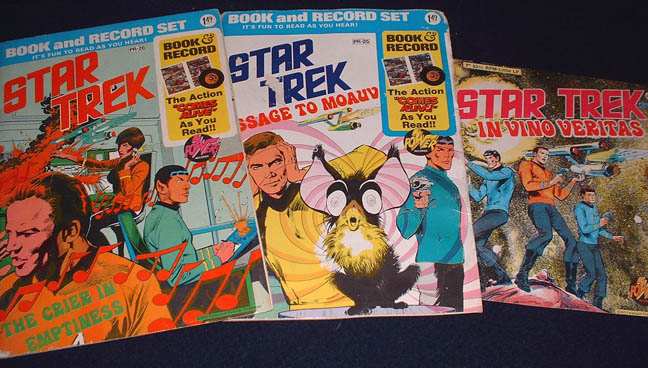
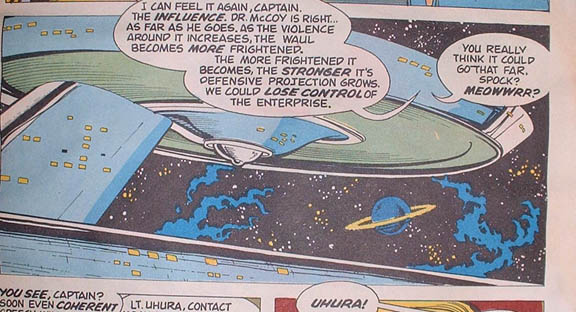
Peter Pan Records, the people who put out kiddie records in the 60s and 70s, released a series of Star Trek records with accompanying comic books so you could read the story as you listened to it. The art work was pretty good (a step up from the amateurish Gold Key Comics of the era) and the stories were in the spirit of Star Trek, although clearly aimed at a younger audience.

The part I found strange about the art work was that, while the renderings of the main characters and the interiors of the Enterprise were quite accurate, the depictions of the Enterprise exterior varied from frame to frame and was often wildly inaccurate, like the artist was never given a clear picture of the ship.


Also, Uhura was a white woman and Sulu was African-American! As far as the recordings went, the voice actors asked to imitate the real stars of the show did an admirable job of invoking the spirit of the characters without resorting to full-on impersonations.

In the spring of 76, someone put out a line of Star Trek shirts for kids. I was still small enough to fit into one, so I got a red shirt like Scotty’s. Most of the kids I knew got the gold Kirk shirts, but I was always more partial to Lt. Commander Scott. To me, Scotty was the true soul of the ship and he alone pulled their bacon out of the fire far more frequently than Kirk or Spock ever did. With my red shirt, and my model kit of the phaser, communicator, and tricorder, I could go off on my own adventures (although I usually did this in my room or in the basement since walking around the neighborhood dressed like Scotty could elicit some unwanted laughs).

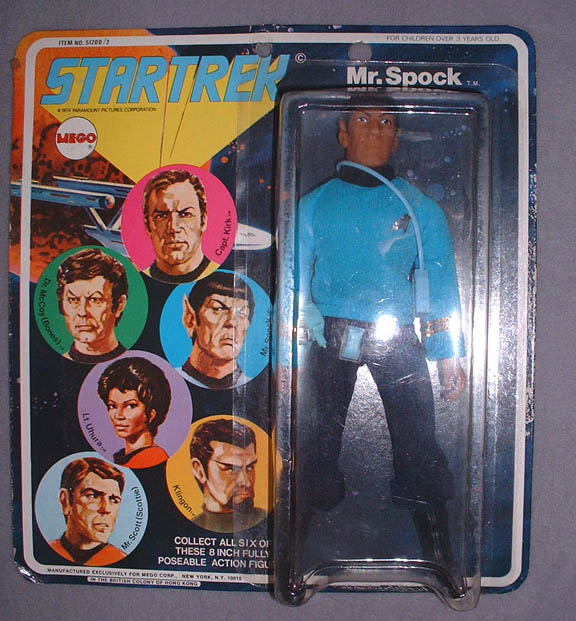
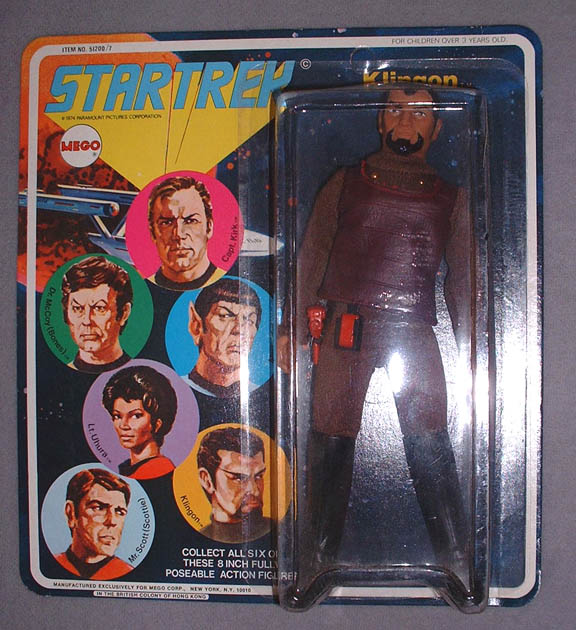
Of course, the big Star Trek collectible of that time for any kid was the Mego action figures. I had the Kirk, Spock, and McCoy figures, then I acquired a Klingon. The likenesses were spot on, but I was always frustrated by Mego’s cheapness when it came to accessories. Spock and McCoy had a communicator, phaser, and tricorder. Kirk only had a phaser and communicator, and the Klingon had the exact same phaser and communicator rather than his own alien weaponry.


Since I was losing interest in action figures around this time anyway, I ended up using my figures in a school project where I created a diorama of the Time Portal from City on the Edge of Forever. I think I got a passing grade on it.


I was really thrilled to find such a treasure trove of fantasy fun as Star Trek, but after watching the same episodes over and over every day, the stories were beginning to lose their luster. I needed to find another diversion. As luck would have it, a new science fiction show was on the air at the same time…

Friday, February 02, 2007

JOHN WAYNE

I don’t know what the occasion is, but they seem to be showing an awful lot of John Wayne movies on AMC lately (or is that a lot of awful John Wayne movies?). As I caught snippets of these films, I was reminded of my lifelong ambivalence toward The Duke. In the 70s, it was fashionable to sneer at the old-fashioned, conservative hawk who, although he played war heroes from every branch of the armed services on the silver screen, actively avoided real-life military service during WW II. Later on, I took sadistic joy in finding a VHS copy of The Conqueror where John Wayne portrays Genghis Khan (!) in bad makeup and the same drawling delivery he used in every other movie. His films from the 60s were particularly bad, looking hastily assembled and existing only to cash in on Wayne’s box-office power. Still, you can’t deny that he had a certain appeal, and I’ve probably had repeat viewings of more of his movies than any other star besides Elvis.


I would have to count his non-western films as my favorites, among them Back to Bataan, Sands of Iwo Jima, The Longest Day, and McQ. The latter film was especially fun with Wayne trying to be an older, stockier version of Dirty Harry. The anti-hero with questionable ethics was a departure for Wayne, and the sight of him mowing down bad guys with an Ingram MAC-10 was pretty cool. I even liked The Hellfighters despite its bad script and awkward directing simply because it exposed me to a world I had never known before. The Green Berets was a missed opportunity, in my opinion. I agreed with its intention to pay tribute to an elite fighting force operating in
a difficult and unpopular war, but the silly story and glaring technical errors only emboldened anti-war protestors who saw it as wildly inaccurate propaganda.

Among his westerns, I loved Rio Bravo, partly because it featured two other favorites of mine, Dean Martin and Ricky Nelson. I also enjoyed Hondo, The Sons of Katie Elder (Dino again!), and The Shootist. I know film critics praise him for other, more accomplished films like Stagecoach and She Wore a Yellow Ribbon, but I’m going purely by my gut reactions which don’t always match with film school criteria.

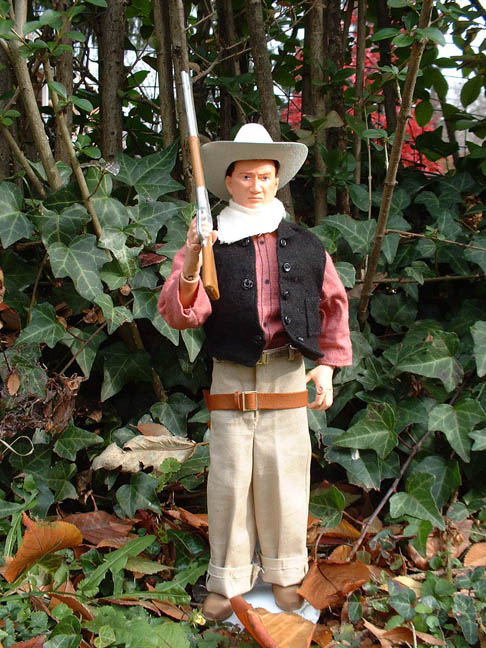
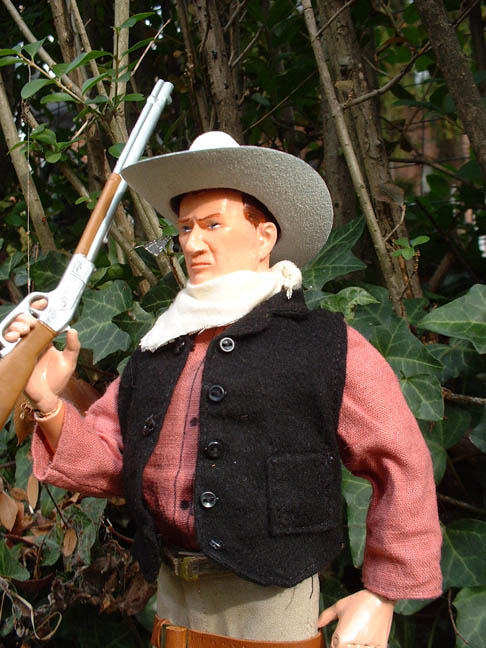
When I discovered that headsculpt master Dale Van Slyke offered a John Wayne head for 1/6th scale action figures, I decided to create a John Wayne figure. I wanted him to look much like the way he appeared in several of his westerns, so I went with tan pants, tan boots, a faded red shirt, vest with lapels, and a soiled white cowboy hat. The boots were the trickiest find. I ultimately settled on a pair of Ken boots and, since Ken has such tiny feet, I was forced to cut the toes off my action figure to make them fit. Not only did he lose his head to a John Wayne resin head, but his toes were lopped off as well! The pants, holster, and vest I ordered from Cotswold Collectibles and Old Joe Infirmary. The shirt came off a Planet of the Apes Dr. Zaius doll with buttons that I drew on. The hat I bought from a crafts store. It was black, so I painted it white with acrylic paint. The black bleeds through, creating the proper soiled look. The neckerchief I made from a piece of cloth.


Overall, I think it’s a pretty nice tribute to The Duke. Saddle up, pilgrim!

Friday, January 26, 2007

ROCKETMAN RE-IMAGINED

Television in the 1970s was a very different animal than it is today. Not only did we not have any means of playing movies or programs on demand like today, we didn’t even have the vast selection of television channels that cable and satellite provide. In Baltimore, as I’m sure was the case in cities around the country, you had three local stations which functioned as the affiliates for the Big Three networks, you had a public television station, and you had one or two local independent stations. With a good antenna, you could pick up the Washington, D.C.-based stations, which had pretty much the same set up. The limited number of stations meant that you had to watch what they had to offer (or go read a book, God forbid!). For the same reason, each station felt an obligation to provide programming that would appeal to all demographic groups, meaning everyone was thrown a small bone but not a big enough one for any single group to get exactly what they wanted. Today, if a child wants to watch cartoons, he or she can turn on a cartoon channel at any time and find cartoons. For a child in the 70s, cartoons would be shown between say 7 and 9 a.m. and 3 and 5 p.m. on weekdays (primarily on the independent stations) and from about 7 to noon on Saturdays (primarily on the network affiliates). If, on some boring summer weekday, I happened to switch the set on at 2 p.m., I would most likely have to sit through the last half of a Clark Gable movie before getting to watch Huckleberry Hound or Ruff ‘N Reddy.

Is there a point to this, you ask? I’m not sure, except to say that I think this arrangement exposed children of my generation to a broader range of entertainment and information than children today who have more choices. These choices allow children to focus on the shows and movies that think they want to see while giving them the ability to tune out material they don’t think they would like. That’s a shame, in my opinion, because some of the greatest pop culture influences in my life came from movies and t.v. shows I discovered when there was nothing else on t.v. to watch. One of those influences was the old movie serials, or cliffhangers if you will.

Cliffhangers were originally shown in Saturday movie matinees from the 30s through the 50s. Somewhere between the Bugs Bunny cartoon and the Roy Rogers western, a 15 or 20-minute chapter would spool out the exploits of a cowboy or G-Man or super hero, ending with the inevitable trap from which the hero couldn’t possibly escape. Of course, in the following week’s chapter, he walks away unscathed, often through some improbable last minute derring-do. These serials were the entertainment of my parents, who didn’t even have the choices I had through television. All they could do was go to the theatre, plunk down their dime, and take their chances.

By the 70s, movie serials were shown on television to fill up large chunks of time, either on Saturday and Sunday afternoons or late at night. I would stumble across these films when I was bored or couldn’t go outside due to inclement weather. Despite the fact that they were old and the technology looked positively prehistoric, I liked the fact that these were stories aimed at kids, but using adult characters. The big trend in 70s children’s programming was to make the main characters kids or teenagers. That was depressing to me because I was either the same age as these characters or close to it, and they were obviously having a much more exciting life than I was. I had no hope of having adventures like them. I much preferred my heroes as adults, because I could always dream that I would some day grown up to be Dick Tracy or The Phantom.

The other appealing aspect to cliffhangers was that they had no pretensions of teaching kids morals or values. The old studio heads knew that kids wanted to see fist fights, car chases, people getting obliterated with ray guns, and any other mayhem they could come up with. Kid shows in the 70s weren’t allowed to have any of that. Instead, we’d sit through a ½ hour of tedium before the Super Friends would look into the camera and say, “So remember kids, you don’t want to be called names, so don’t call other people names.” I was calling them a few names after stealing a half hour of my life! I guess the thinking was that, if we were exposed to non-violent programming when we were young, we would have no desire for such material as adults. Yeah, that worked out well.

So, getting back to my point, here were these funky little films with guys in fedoras driving bulbous, lumbering cars and talking in corny old-movie speak, but I gave them a chance because there was nothing else to watch. And after watching for awhile, I realized that these shows were far more exciting and fun than anything Hanna-Barbara would slap together. I really became obsessed with movie serials as a kid. Trouble was, they didn’t show nearly enough of them. I got books out of the library about the cliffhangers and discovered that there were far more out there than what I was seeing on t.v. I yearned to see more, but it wasn’t until a decade later and the advent of mass produced VHS tapes that I was able to watch more of these gems. Now, many more are being released on DVD, and I’m acquiring them as fast as I can.

Although the serials had their fair share of super heroes, most were lifted directly from comic books. Superman, Batman, and Captain America had their big screen debuts through cliffhangers, although none really did justice to their personas. One of the few super heroes created specifically for the medium was Rocketman, later to become Commando Cody. In either persona, Rocketman was a scientist who developed a jet pack that he could strap to his back and fly around averting trouble. Usually, his adventures involved stopping alien invaders from taking over the earth. The stories were pretty silly, but the concept of a personal flying apparatus was exhilarating to a small boy. The image of Rocketman became iconic, even inspiring the comic book and movie titled The Rocketeer.

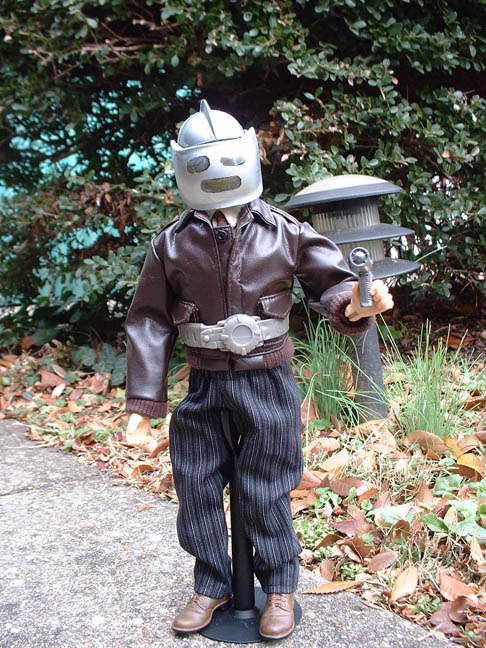
When I got into custom action figures, I knew I wanted to create a Rocketman figure. As I looked at the outfit more carefully, however, I realized that the original rig in the serials wasn’t as impressive as it seemed to me as a child. No wonder comic artist Dave Stevens altered The Rocketeer’s suit to look more majestic. However, while Stevens went art deco, I wanted to create something that was more in keeping with the jet age, the era that Rocketman inhabited in real life. As a result, I crafted my jet pack primarily from parts found in a model kit for an F84E Thunderjet. In addition, I wanted to get rid of the laughable control plate on the chest with highly technical controls like On/Off, Up/Down, and Slow/Fast. Instead, I gave my Rocketman a control belt with undefined buttons.


I also wanted to streamline the helmet while still retaining its basic style, so I coupled a helmet from The Silver Knight figure with a repainted visor from a G.I. Joe jet pilot outfit. In the serial, Rocketman wore a long, bulky leather coat like those worn by German U-boat commanders. I went for a more stylish Bomber jacket. To complete the 50s retro-future look, I created a little ray gun made from a pistol grip and some bits from the airplane model.


Overall I was pretty pleased with it, although I’ll probably revisit again someday. I just can't get enough of that high-flying hero!


Tuesday, January 16, 2007

BATMAN TELEVISION SHOW

In the midst of all my football mania, I forgot a landmark historical date last week. January 12, 2006, marked the fortieth anniversary of the premiere episode of the Batman television show. For a generation of kids born in the 60s, this show had a huge influence and haunts our brains to this day. Although I only have vague memories of watching the show when it originally aired in prime time, Batman was the first super hero I was aware of, and I continued to watch every episode over and over in syndication during the 70s. By the early 70s, I had also learned to read and devoured Batman comic books.


Whether it was a reaction to the camp craze that had run its course or simply a reflection of the changing times, the Batman who appeared in the 70s comics was a very different mammal from the character on tv. Robin was shipped off to college, Bruce Wayne ditched Wayne Manor for a penthouse in the Wayne Foundation Building, and Batman had returned to the dark creature of the night just as he had been in the early days of the comic. The stories had an edgy, pseudo-realism as Batman took on drug dealers and mafia-style crime bosses. Even the old super-villains like the Joker were transformed into disturbing socio-paths. To me, it was like a four-color version of The French Connection, only Popeye Doyle wore tights and pointy ears. While I loved this incarnation of Batman in the comics, I also enjoyed the satirical fun of the old tv show. I never saw the two versions of Batman as an either-or option; they were two interpretations of the same character, merged seamlessly in my childhood mind.

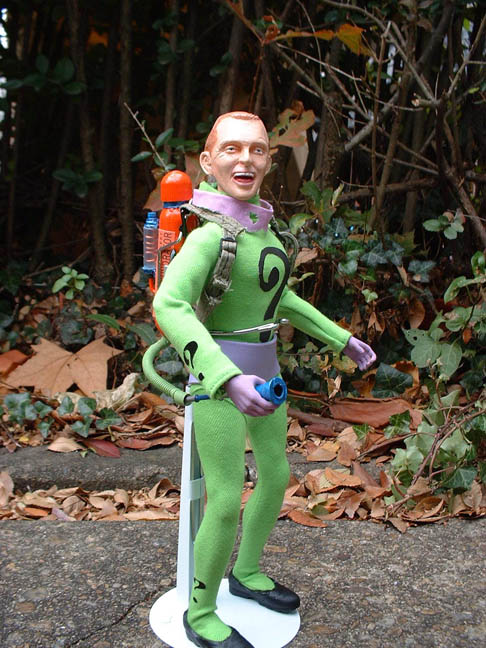
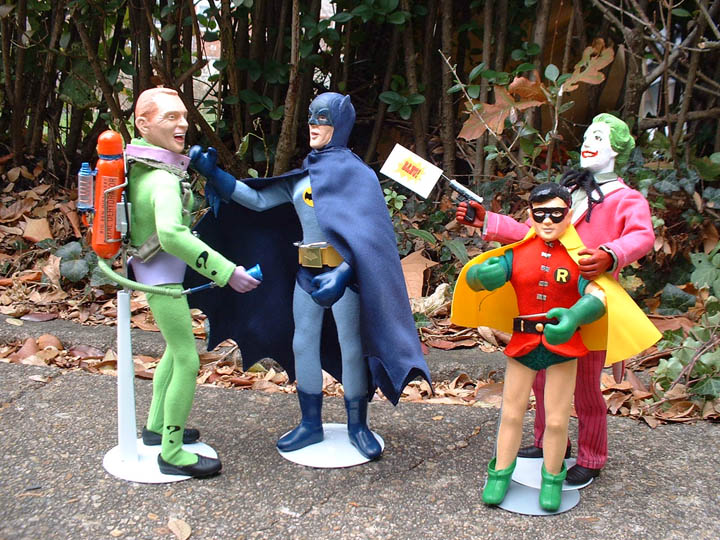
It’s little wonder that I would attempt to create custom action figure versions of the Batman tv show icons later in life. Actually, none of this would’ve come about if Dale Van Slyke hadn’t been selling terrific resin head sculpts of the actors. His 1/6th scale likenesses of Adam West as Batman, Frank Gorshin as The Riddler, and Caesar Romero as The Joker are uncanny. Also, Rauty sells costumes to match Batman and the Riddler, so I was halfway there. My Adam West Batman consists of head, gloves, and boots by Dale, and the outfit and belt by Rauty. All I had to do was lop off the head of an action figure, glue the resin version on the figure, and paint it to look like the television Batman. Voila!

The Riddler followed a similar process, although I had to create the question marks on the suit myself. I used stick-on letters for the question marks on the legs, but in order to get the question mark on his chest to look just like the one on the show, I asked my talented wife to recreate a replica in Photoshop and I printed it out on sticker paper to apply to the costume.


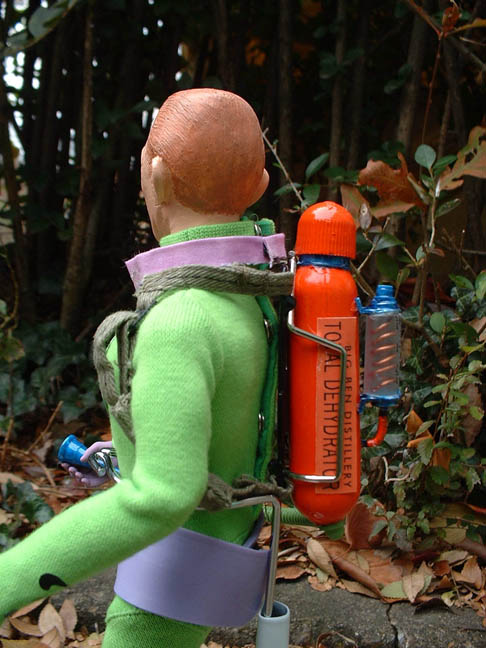
Just for fun, I decided to outfit the Riddler with a Big Ben Distillery Total Dehydrator like the one in the Batman feature film. I started with an oxygen tank from a fireman figure that I had, then fashioned the rest of it from odds and ends including the cap off a lip balm tube, a piece of a syringe, copper wire, and bits cut off of other action figure accessories.


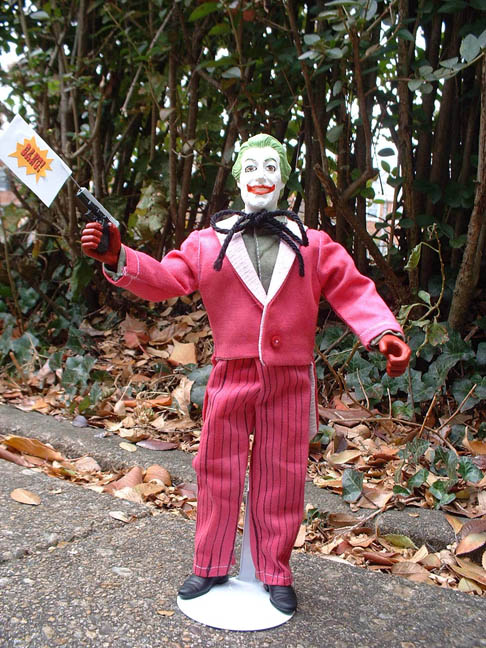
To create the Joker costume, I found on eBay a white tuxedo custom-made for a Ken doll. I dyed the suit a reddish-purple color like the way it appeared on the program and drew the stripes on his pants by hand (the lines were funky and uneven on the show anyway). The lapels aren’t the same as on the show, but it was the best I could do with the material. I also dyed a white shirt to the green color on the show and made a bow tie from yarn.

Robin doesn’t have a resin head, but instead is wearing a Burt Ward-style mask along the lines of the Captain Action masks (again, created by Dale Van Slyke). The suit is a vintage Action Boy Robin outfit, although I created my own belt to more accurately match the one on the show. The belt is black felt with a Velcro fastener on the back, and the gold buckle and capsules were made with a thick gold paint I found at the hobby store which dries in three-dimensional clumps. The gloves, boots, and cape were courtesy of Wes McCue at Classic Plastick. The outfit was originally meant to go on an Action Boy figure, but I found another 8-inch figure in the toy store that was more muscular and looked better squeezed into the stretchy polyester.

So there you have it: My Batman tv show action figures.

Now if they would only clear up the licensing issues and release the old episodes on DVD!


Sunday, January 14, 2007

NO JOY IN MUDDVILLE

The Indianapolis Colts beat the Baltimore Ravens yesterday, 15-6. I guess us Baltimore fans were asking for it given the way we built this game up beyond all reason. What we ended up seeing was how the Ravens have played all season: the defense was dominating, the offense was shaky. The defense did rattle Peyton Manning a bit, creating 2 interceptions, 1 sack, and allowing no touchdowns. That, at least, was satisfying. If only the offense could've delivered some touchdowns. Oh well, there's always next year.

The game was cathartic in a way I hadn't expected. By experiencing the loss, I realized that it really didn't matter much in the vast scheme of things. The Indianapolis Colts are just as alien to me as the New England Patriots or the San Diego Chargers. I was more upset that we weren't going to the Super Bowl than that we lost to the Colts. In some strange mental twist, I no longer saw Baltimore's past in that blue-and-white jersey. They're just another team. I have purple in my veins now.

Football season is essentially over for me. I'm eager to begin devoting my Sunday afternoons to creating new customized action figures, and I will report on my progess in future entries. Stay tuned.
Thursday, January 11, 2007

RAVENS VS. COLTS

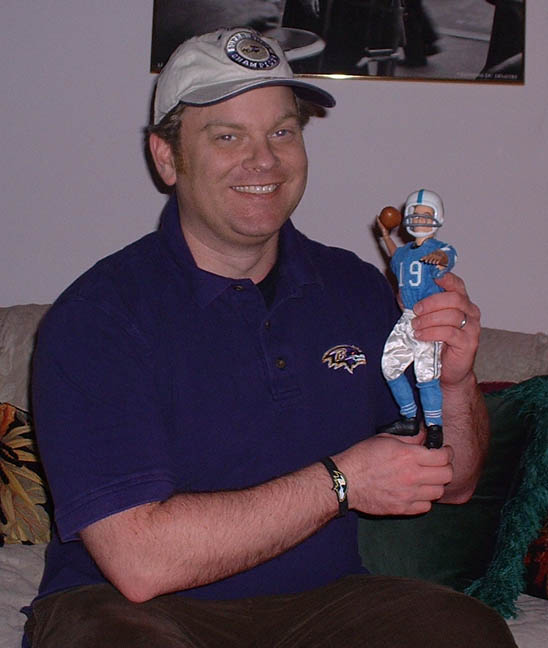
A few months ago, I made a post about my childhood love for the Baltimore Colts and my John Unitas action figure. At the time, I had no idea that the Baltimore Ravens would make it to the playoffs and wind up taking on the Indianapolis Colts for a run at the Super Bowl. Since the game is hosted in Baltimore, the media has been abuzz all week about how this will be payback for Robert Irsay moving the Colts out of Baltimore. I too have been caught up in the frenzy and am now forced to come to grips with my 23-year hatred for the Indianapolis Colts.
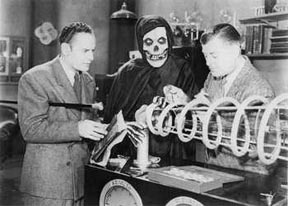
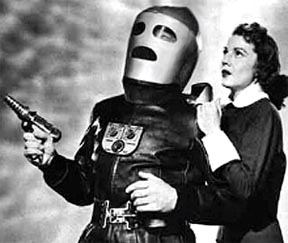
The players on both teams are either too young to remember when the Colts were in Baltimore or not even born when the team snuck out of town on a snowy March night in 1984. They are bewildered by the intensity of this controversy. Even young Ravens fans don’t understand the anger us older fans feel toward Indianapolis and the need for revenge. Frankly, the more I analyze my own feelings, the sillier it seems to me too. I don’t hate the city of Indianapolis, since they simply wanted an NFL team to root for and found an opportunity to get one. I can’t hate Jim Irsay, the current owner of the Colts, who seems like a much nicer guy than his dad was and had no hand in the move to Indianapolis. The only person I can truly hate is the former owner Robert Irsay, and he’s dead.

The ill feelings between Baltimore and Irsay started as soon as he bought the team and escalated to a fevered pitch by the time he left. It’s like if you had a fine, respectable community newspaper that was suddenly bought by an outside publishing firm, which quickly turns the paper into a sleazy tabloid. After awhile, no one wants to read the paper because, not only is it trashy, but it’s an insult to what the paper once was. The circulation declines, so instead of improving the paper, the owners decide to move it to another city. You’re happy to see the sleazy tabloid go, but you wish the newspaper had continued the way it was originally.

Another criticism leveled at us old-Colt-fan-curmudgeons is that Baltimore took away Cleveland’s team much the same way Indianapolis took our team, so we got our payback. There are some holes in that argument, however. First of all, we never wanted another city’s team; in fact, the idea of doing such a thing sickened us. We tried twice to get an expansion team, but were shot down by then-NFL Commissioner Paul Tagliabue (The Emperor to Irsay’s Darth Vader). Tagliabue was blinded by geography and television markets. He couldn’t see why Baltimore would want its own team when the Washington Redskins were 40 miles to our south and the Philadelphia Eagles were 100 miles to our north. We should simply shut up and root for one of those teams. What he couldn’t fathom was that Baltimore was no more like either of those cities than Seattle or Phoenix. We had our own culture, our own traditions, and once had our own team.

After it was made clear that the sneering Tagliabue would not give us a team, we reluctantly brokered the deal to bring Art Modell’s team to Baltimore. However, we did one thing that Robert Irsay was too evil and mean-spirited to do. We let Cleveland keep the name, the colors, and the records of its old team should they ever get a new one (which they did within a few years). We started fresh with a new name, new uniforms, and new legends. If Irsay had extended the same courtesy to us, this whole controversy would be a non-issue. We’d still be rooting for the Colts and they’d be rooting for the Indianapolis Nappers or something.

The bottom line is, us old Colt fans were hurt badly, not only by the team leaving, but by the years of acrimony between Irsay and the city leading up to the departure, and by the NFL’s outward contempt for Baltimore. No matter how much you rationalize, you can’t deny the pain. Just like a bad relationship, the hurt remains regardless of how much time passes or how much better your life gets. Beating the Colts in M&T Bank Stadium on Saturday probably won’t change anything, but it’ll sure be fun to watch!

GO RAVENS!!!!

Tuesday, January 09, 2007

FROM BERT & ERNIE TO HUGO

From age seven to age 11, I had another toy fascination besides action figures. I became obsessed with ventriloquist dolls and hand puppets. My first hand puppets were of Bert and Ernie from Sesame Street fame. I was starting to outgrow the show, but I still loved those two characters and wanted to hang out with them. I know what people would say about that now, but trust me, there was no repressed homosexual fantasies in my seven-year-old brain. I just liked the guys, and found Ernie particularly funny. Having the hand puppets allowed me the opportunity to pretend that I was their friend and could hang out with them all the time. I guess this was the beginning of my interest in bringing an inanimate doll to life and providing it with a personality.


Around the same time, I was watching an awful lot of old movies on t.v. Back in the 70s, local stations filled large chunks of airtime with movies from the 30s and 40s. I especially loved recurring movie characters like Blondie, Andy Hardy, and Laurel & Hardy. Among these films, the ones starring Edgar Bergen with Charlie McCarthy and Mortimer Snerd were way at the top of my list. Although now I can see that Edgar Bergen was not the best ventriloquist, back then I was amazed that he could make it look like Charlie was talking and not him. Plus, I thought it was great that a grown man could interact with what were essentially cartoon characters made of wood and have all kinds of fun adventures. I wanted to be just like Edgar Bergen, and I got my wish, sort of.

For Christmas 1972, my parents got me a Charlie McCarthy ventriloquist doll. His head didn’t turn and his eyes didn’t move like Edgar Bergen’s doll, but his mouth opened and closed via a string in the back of his neck. A booklet came with the doll to instruct me on how to “throw my voice.” I took this very seriously and practiced with my doll in the mirror all the time. I dare say I was better at throwing my voice than Edgar Bergen, even managing to pronounce the letters “p” and “b” with imperceptible mouth movements.

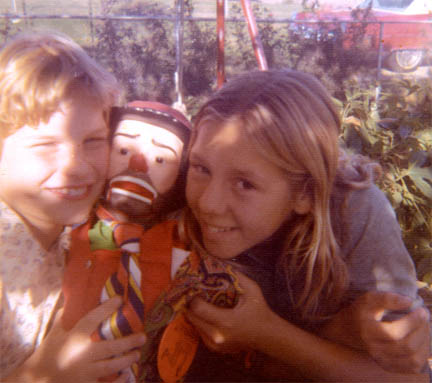
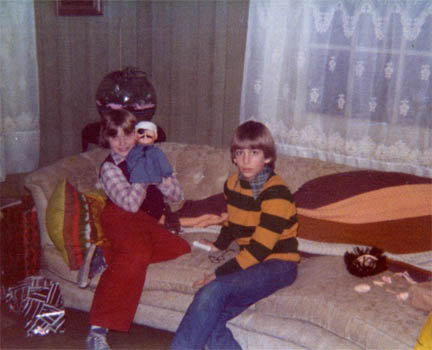
The following Christmas, I received a dummy based on the clown Emmett Kelly. I had no idea who that was, but I liked the looks of him and soon worked out clown-oriented sketches with him (that's me with Emmett and my childhood friend Linda in the photo). By age 10, I also had a dummy that they billed in the catalogues as Will E. Talk. Unlike the other dummies I owned who had established pop culture identities, Will E. Talk was completely generic, so I treated him like a real friend. I chose to call him Chucky Margolis after a character from the old Hudson Brothers’ Saturday morning Razzle Dazzle Show. He had red hair and wore overalls, so I stuck funny pins on him and worked out whole comedy routines like we were the new Willie Tyler and Lester. My parents even sprung for a cool little case to carry him around in.

The madness came to a head when I bragged about my ventriloquist acumen to my beloved fifth grade teacher, Mrs. Schreiber. She, in turn, told our school librarian about it who had just acquired a high-tech new gadget known as a video tape recorder. The rig looked like something from Bob Crane murder scene photos, and recorded on black-and-white videotape. They asked me to put together a sketch using my dummies, so I did an impression of Johnny Carson and I interviewed each doll separately like a talk show. Thankfully, I have no memory of the content of the sketch because I’m sure it was really awful, but the librarian and my teacher were mighty impressed with my creativity. All I do remember was that I kept looking at the monitor to see how the puppets and my mouth movements looked, resulting in me looking like the most disinterested interviewer since Arsenio Hall.

By age 11, the tug of puberty was pulling me away from toys, but I couldn’t resist the draw of Kenner’s Hugo, Man of a Thousand Faces. He was a bland looking hand puppet with a bald head and wearing only a light blue tunic. However, his array of glasses, hair pieces, and facial appliances allowed you to create any number of disguises. All the facial appliances were put on his face with a stick of spirit gum, which had to be cleaned thoroughly off the face and individual pieces or they would get gooey and dirty. Still, he was a lot of fun and I was dying to show him to my cousin Stewart when we got together at my Aunt and Uncle’s house on Christmas 1975. While I was pulling out Hugo and his numerous disguise pieces, Stewart informed me that he had gotten a 20-gauge shotgun and he wanted to take me out to his Dad’s car to show it to me. Suddenly, I felt like a complete loser. Stewart and I were the same age: he got a shotgun and I was still playing with dolls. I felt like I needed to grow up fast before other kids my age started seeing me as a sissy. As a result, Hugo didn’t see much daylight after Christmas Day. Several years later, he was sold to a grateful young girl at one of my mom’s yard sales, so I hope Hugo got the love from her that I so callously denied him.

A little postscript on Hugo: In the early 80s, WOR in New York aired a show called The Uncle Floyd Show. This Soupy Sales-type program featured Hugo sans makeup. During the closing credits, Hugo would be-bop along to the music at the bottom of the screen. His trademark blank expression was completely out of sync with his bobbing dance moves and manically flailing arms. You really had to be there to fully appreciate the humor of it. God, I loved that show!