Friday, September 04, 2009

Lucky Buck is Back!


There seems to be a serious effort to revive the future man of the past, Buck Rogers, judging by this Web site. Just the name "Buck Rogers" remains a catchphrase for all things new and futuristic. Even those who never read the comic strips, watched the old movie serial, or saw the 80's TV show know that there is something bright and positive and forward-thinking in the concept. He lives, after all, in the 25th century and, even though its closer to us now than it was when he was originally conceived in 1928, his time is just far enough away to give us hope that by then we will get it right. Or maybe that's not even a concern anymore, and we just like to speculate about all the cool toys they will have in the far-flung future.

For the uninitiated, Buck Rogers started out as Anthony Rogers in a novel called Armageddon 2419 AD. 20th century man Anthony Rogers becomes trapped in a cave, but a mysterious gas in the cave preserves him until he is reawakened in the year 2419. By this time, the Earth has been divided into general regions and the Mongols (i.e., Asian people) are trying to gain absolute rule over the other regions. Since Rogers is discovered by American resistance fighter Wilma Deering, he becomes a part of their cause and eventually the Mongol forces are defeated.

The novel was quickly turned into a comic strip and it spun off in its own direction, replacing the world war scenario with an outer space battle between Earth and the interplanetary gangster Killer Kane. With a real world war looming in Europe, a futuristic Al Capone, using ray guns instead of machine guns, was probably more palatable to the American readers at the time. Once Rogers, now nicknamed "Buck," was plunged into outer space, the gadgetry of the series really took off. The art style of the strip evolved as well, becoming more cartoonish and providing a real "gee-whiz" quality to this view of the future. In the Depression-era world, no wondered the gleaming rockets and gizmos of Buck Rogers seemed so appealing.

Buck Rogers continued to find an audience even as the world moved into the jet age. The storylines and overall look of the comic strip changed, reflecting the more realistic (but no less optimistic) mood of the 50s where atomic power and rockets pointed to a space age that was right around the corner.

When I was a pre-teen, Buck Rogers held a special place in my heart, although I'm not sure why. There were no comic strips, comic books, TV shows, or movies at the time that would thrust him into my consciousness. The only reference material I had was a coverless book which contained the early run of the comic strip from the 1930s, and a scratchy recording of the first radio show episode. This was enough, however, to trigger my interest in the man with the rocket pack on his back.

In the winter of '79, I dragged my dad into the cold night air to see a new movie version of Buck Rogers. Just like he had done a year earlier with Battlestar Galactica, producer Glen A. Larson made a feature-length TV pilot so he could release the pilot as a theatrical film before people could see it for free on television. I knew it was a rip off, but I so wanted to see what he had done with Buck Rogers. It actually seemed pretty good from my 14-year-old perspective. Gil Gerard's Buck was a flippant, cocky astronaut who reminded me of a macho version of Hawkeye Pierce. There was humor and action and pretty women in revealing outfits: all the stuff a young boy wants in a movie. I was so stoked to see the show when it premiered in the fall. Unfortunately, the series didn't live up to the promise of the movie. The episodes became increasingly more campy and relied too much on the jiggling T&A so prevalent in late 70s/early 80s TV. I didn't even bother with the second season where they traveled in space like a poor man's Star Trek. They even had a poor man's Spock in the form of Hawk, a half-man/half-bird hybrid. That cured me of any Buck Rogers interest after that.


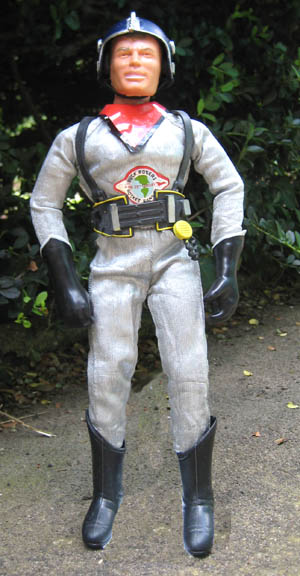
In fact, ol' Buck didn't enter my consciousness again until I started collected Captain Action stuff about 10 years ago. In the mid-60s, when Ideal Toys was licensing every pop culture hero for its Captain Action line, a Buck Rogers suit was created for the good Captain to sport. I assume the suit was based on the way Buck Rogers appeared in the comic strip at the time because he only bears a passing resemblance to the Buck Rogers of the 1930s. The main difference is the silver lame suit. I guess once the NASA Mercury astronauts trotted out their shiny duds, everyone assumed that all space men would wear silver lame. The ubiquitous jet pack is part of the outfit, but it too has an updated, jet-age flair. Buck's helmet in the 1930s looked like a football helmet, but the Captain Action outfit provided a more toned-down head cover. The most interesting part of the suit for me was the gloves and boots. They both sported angled ends that are quite different from anything I have seen before. The boots, especially, have points going up the outer calf rather than in the front. Very forward thinking.


I remember seeing the Buck Rogers costume advertised when Captain Action was in the stores, but I never saw the actual costume in the flesh until my lovely wife bought me a lot of CA odds and ends on eBay, one piece being the Buck Rogers suit and face mask. Thankfully, the chest logo was in good shape, but the silver lame had become dirty and tarnished looking. Some helpful soul on the Yahoo! Captain Action list recommended that I paint the suit with DecoArt metallic silver paint. I was skeptical, but it worked out quite well. Later on, I acquired a pair of boots, but the gloves eluded me, so I ordered a pair of repros from the great Wes McCue at Classic Plastick. The jet pack was gained years later through a heated eBay auction.

I never did find a helmet at a price I wanted to pay, so I made my own version starting with a dark blue helmet from a G.I. Joe set. I removed the visor and covered the ear holes with wheels from a jet airplane model kit. Since the original helmet had little silver balls running up the center, I looked for something that would create the same effect. I never liked how the balls on the original helmet stopped midway up the back for no particular reason, so I had mine run all the way from back to front. They're actually a set of fake pearls from a Disney's Aladdin action figure set which I glued on. After painting over them with a silver stripe, Buck looked ready for action.


The accessories, such as the ray gun and the canteen (?) seldom surface on eBay, but I don't really care. They always seemed like throwaway pieces anyway. The jet pack really made the suit.

I'm hoping that, with all this new interest in Buck Rogers, someone will put together a decent movie or TV series based on the character. Just as Superman is the prototype super hero, Buck Rogers is the prototype science fiction hero. We would never have had Captain Kirk without Buck Rogers, whether Mr. Roddenberry consciously realized it or not. Buck represents what Americans most want to be with a positive eye to the future and no challenge too great to overcome. We could use a revamped Buck Rogers right about now.

Friday, July 24, 2009

Vinyl Impressions Part III

When I presented Jim Six with his custom action figure, one person who was around to witness it was my friend Kate Becker. It was Kate, in fact, who gave me the inspiration for doing the Jim Six figure in the first place when she talked about finding someone online who made custom action figures of people based on photographs. As Jim went into convulsions over his new figure, I could see a glint of envy in Kate's eyes. At that moment, I thought that if I made a figure for anyone else, it should be for Kate. Only thing was, I didn't have any ideas on how to do it.

As I related in my last post, I quickly went on to make a custom action figure for a young boy who was part of an Adopt-A-Family Christmas program. Then I kinda stopped making custom figures for awhile. I still hadn't forgotten about Kate, however, and I flogged my brain to figure out what the theme could be. I knew that she had been a life-long fan of the Baltimore Orioles, so that could be the starting point. Okay, how do I do that?

The answer came to me when I thought back to one of my early customs: a Johnny Unitas figure. The uniform for the legendary Baltimore Colt was found on eBay. Back in the 60s, there was an action figure named Johnny Hero, a rather ordinary 1/6th scale figure who wore a red track suit and matching sneakers. However, the toy line provided uniforms for the figure based on every professional baseball and football team around at the time. After buying the basic figure, you could dress him up as a member of your favorite football or baseball team. Johnny Hero was never as popular as G.I. Joe, but he did hang around for a couple of years during the mid-60s. Anyway, many of these football and baseball costumes were available on eBay, so I regularly scoped out the Johnny Hero uniforms until I found a Colts uniform at the right price. When it came time to make Kate's figure, I knew I should be able to find an Orioles uniform and quickly did.

With the Orioles uniform in hand, I next had to find a female figure to put it on. Female custom figures are difficult to put together simply because there are just not that many female figures out there to choose from. Sure, there are plenty of Barbie dolls, but their bodies are not realistic and there headsculpts are exaggerated. At the other end of the scale, you have figures like the Cy Girls who are basically male fantasy figures best used for super hero customs. I needed a middle ground. Fortunately, Old Joe Infirmary carries a female figure line called Fem'Basix which features average sized figures with different hair and eye colors. I choose a figure which best matched Kate's features and, thankfully, the Orioles uniform fit the figure reasonably well.

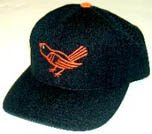
Given the Orioles theme of the project, accessories were not a problem. The Johnny Hero costume already came with a batter's helmet, bat, baseball, and glove. The only trouble was, there was no bird emblem on the cap and the batter's helmet featured the emblem of a different team (must've been a mix-up at the factory in Hong Kong). I decided to do a little research on the Orioles costume and it turned out that this particular uniform was only worn during the 1964 season (the year Johnny Hero was introduced). In addition, the bird emblem on the cap and helmet was distinct to that uniform. I believe the following year, they introduced the cartoon bird which became so familiar to baseball fans for a couple decades. Anyway, after finding a decent graphic of the bird emblem, I shrunk it down to proper size in Photoshop and printed it out on sitcker paper. Once cut out and applied to the cap and helmet, the uniform was official.

Next came the box. This is always a daunting task, especially for my graphic designer wife Kathy who ends up creating the box graphics for me. My technique for mocking up an action figure box is to take an existing box and cover over it with new graphics printed on regular paper, but applied with decoupage glue so that it has a glossy finish. To make our lives as simple as possible, I tried to find an action figure box that was basically rectangular with clean, straight lines. While Kathy and I were outlet shopping on the Eastern Shore of Maryland, I came across a basic military action figure marked down for close-out. Not only did the figure look appealing for a different custom project, the box he came in was a simple rectangle with a rectangular cellophane window on the front. As a bonus, the backing board on which the figure was mounted featured a simple painting of grass and blue skies. Perfect for the baseball theme without the need for any alterations. Once we got it home, Kathy and I set to work.


I have to give Kathy most of the credit for the box design. Although I came up with the back story for the action figure (a fantasy about Kate being the Orioles first bat girl during the 1964 season), Kathy designed everything else. From the All-American colors and font styles to the crisp image of Memorial Stadium on the front, the box screamed baseball americana. After all the cutting and pasting, it looked great.

I presented the gift to Kate one evening after Kathy and Kate had spent the day out together. She was thrilled with the finished product, which gave me no small sense of pride and happiness. I was so glad to be able to pull off one last custom figure based on a person I knew.

Thursday, July 23, 2009

Vinyl Impressions Part II

After creating the custom action figure for Jim Six and seeing what a great reaction it got, I became hooked on the satisfaction of making something that made someone happy. Although I would've loved to make custom figures of all my friends and family, it just wasn't feasible to find figures, clothing, and accessories which would exactly suit everyone. I was a bit lost as to what I should make next.

This was the fall of 2004, and Christmas was fast approaching. As in years past, my wife Kathy was participating in the Adopt a Family program at work where the people in her office buy gifts for one needy family. Kathy showed me the list of family members and the suggested gifts for each person. I noticed that there was a son named Tyrone who was about 6 or 7, I can't recall exactly anymore. Other people at Kathy's office were buying him the toys he requested, but I kept thinking about how I loved my action figures at that age and how I viewed them as adult versions of myself. I kept thinking that I would grow up to become part of G.I. Joe's Adventure Team, digging up mummies in Egypt or braving the jungles of Africa. Action Jackson was another figure through whom I lived vicariously. They could do all the things I couldn't then but maybe could do as an adult. If I had those feelings as a kid, I was sure Tyrone was looking for some kind of hope and inspiration for his future. What if I turned Tyrone into a superhero?


Immediately, the name Tyrone the Cyclone popped into my head. Of course, with "cyclone" in the name, he would have to have super speed. Okay, I had the basic concept, but I needed a costume. With only a few weeks to put the whole thing together, I couldn't afford to poke around on eBay. I had to rely on what I had in my boxes of action figure stuff. I settled on using a Captain Action leotard with the chest emblem removed. Kathy created a wonderful logo for the character using a "T" with a swirling cyclone pattern laid on top. From this logo, I printed a chest emblem on sticker paper and gave it extra gloss with decoupage glue. For boots, I used some flashy silver ones from a Flash Gordon costume, and the mask was made from blue electrical tape cut to shape and applied to his face.

Finally, I needed accessories. One of the disappointments I had as a kid was that both my Batman action figures, whether it be the Batman costume for my Captain Action doll or the Mego Batman doll, did not have functioning utility belts. The Batman costume for Captain Action came with accessories, but they had hooks on them which fit into holes on the belt, so the accessories hung from Batman's utility belt like he was a plumber. Mego, cheapskates that they were, didn't even include accessories with their Batman figure. There would be no half measures for Tyrone. His utility belt would have gadgets and gizmos.

I started with a belt from one of my policeman figures which had numerous pockets on it. I then created various made-up gadgets by splicing together bits and pieces of plastic from my vast collection of action figure do-dads. As I glued these little devices together, I gave each one a specific name: the flying sensor probe, the multi-tasking cosmic wrench, the hi-speed digital camera, the time travel stop watch, and the inter-dimensional communicator. Each little gadget fit neatly into the pockets on the belt. Tyrone the Cyclone was now fully armed and ready for battle.


Of course, that begged the question: Who was he to battle? I had to create an arch-enemy for Tyrone to fight. Since Tyrone the Cyclone's main power was super speed, his villain should be similarly equipped. Like Stan Lee on a deadline, I came up with the name Speed Demon and set about making a new figure.


To start, I had purchased a villainous looking figure a couple years earlier who had just the right mean look to him, but his body was rather slight, so I popped his head off the skinny body and put it on my Van Helsing figure. Not only was the Van Helsing body beefier, but it came already fitted with black gloves. I then put together an all-black outfit for him using a black leotard, funky black boots, and a pleather vest. His belt came from a G.I. Joe set, but I added little rocket jets to it and dubbed it his hover-belt. He also wielded an ornate scepter that I picked up somewhere along the way, and a spinning multi-bladed gizmo that I modified from my Van Helsing action figure. At any rate, he looked pretty bad-ass.


With the figures put together, I felt obligated to concoct a back story for these guys so that, when Tyrone opened the box on Christmas morning, he had some clue as to what the heck these goofy characters were. I wrote up the following story: Tyrone the Cyclone gained his powers when he encountered a sickly old man on a secluded street one night. The man said his name was Galdorn and he was the Supreme Guardian for his people who lived in another dimension. He had just completed his greatest achievement: banishing the worst super-criminal of his race to a nether-region between his dimension and Earth’s. Unfortunately, the super-criminal overpowered him and stole Galdorn’s magic scepter to escape to Earth. Galdorn expended all his energy to chase the super-criminal to Earth, but he was too old and weak to continue the pursuit. With all the energy left in him, Galdorn transferred his remaining powers to Tyrone. Instantly, Tyrone had the ability to travel through time and space at lightning speed. He also possessed the superior technological knowledge of Galdorn, enabling him to create amazing gadgets to hunt down and capture the escaped super-criminal. Calling himself Tyrone the Cyclone, he fashioned himself a costume impervious to the heat and friction of traveling at high speed. He also created a utility belt that carried his useful crime-fighting tools: Flying sensor probe, Multi-tasking cosmic wrench, Hi-speed digital camera, Time travel stop watch, and Inter-dimensional communicator. With his newly found powers, Tyrone the Cyclone scours the Earth to find the super-criminal - now known on Earth as Speed Demon – and return him to his prison beyond our world.

With Kathy's help, the little back story was put on a laminated card with pictures of the figures and fancy graphics. I also needed a box to put the figures in. Because of the time crunch, I couldn't create a mock-up action figure box like I had done with the Jim Six figure. Instead, I found a plain cardboard box that could hold both figures and Kathy helped me create a graphics piece that could be glued onto the front flap. It had all the usual hyperbole that toy boxes usually have and Kathy's graphics were amazing, especially how she designed a cartoon image of the spinning blade weapon that Speed Demon carried.

The whole thing was packaged and ready just in time for the people at Kathy's office to drop off the gifts to the family. I never got a chance to see Tyrone's reaction to his custom-made super hero. I'd like to think that he got a kick out of it, but he may have thought it was the lamest gift ever. I'll never know. I just think every kid should get a chance to feel like a super hero while they are still young enough to believe.
A whole mess of personal changes occurred for me during that Christmas, and I set aside my custom action figures for awhile. Still, there was one idea that kept creeping back into my brain...

Wednesday, July 22, 2009

Vinyl Impressions

Creating custom action figures can be exhilarating or exasperating. Some come together quickly with relative ease; others can take months or years with many fits and starts. The biggest problem comes when you take on more of a challenge than you are prepared to face.

By the winter of 2004, I had several customs under my belt and was eager to expand my horizons. For Christmas, I had made a custom figure of my brother wearing fisherman's gear. I even built a diorama of a wooded lakeside to showcase the figure. Although challenging, the whole project went relatively smoothly, so I convinced myself that I could make a figure of just about anyone. Around this time, my friend Jim Six had talked about how he thought it would be cool to have an action figure in his image. Our friend Kate even found someone online who made custom action figures from people's photographs, but the cost was pretty dear. Feeling rather expansive, I quietly set about to make a Jim Six action figure and spring it on everyone as a surprise once it was completed.

One thing that gave me confidence in the project was that Jim has such a distinctive look. He has a shaved head, sports a graying beard or goatee, wears glasses, and is prone to wear Hawaiian shirts and those khaki vests with all the pockets on them. He also has very specific interests such as writing and playing music on guitar, collecting knifes, and taking photos both professionally and as a hobby. All these elements formed the direction for the project.

Trouble was, where do I get a figure that looks like Jim? Facial hair can be painted on, but most action figures are not bald, and even if I found one that was, the facial features had to be correct. Many customizers make headsculpts from polyvinyl clay, but I was not that advanced. It was a quandary until one day, I was flipping through my Cotswold Collectibles catalog and spotted these figures by DiD. They were edgy looking guys wearing hip-hop clothes and one was bald with a goatee. I thought, "If I put glasses on him and painted his beard gray, he would look just like Jim!" I was off to the races.

Or at least, I was off. The figure came with blue jeans and sneakers, which were perfect for the custom, but I needed to clothe the upper part. I already had a khaki vest left over from my brother's fisherman custom, but I needed a Hawaiian shirt. Not just any Hawaiian shirt, but one that looked like something Jim would wear. Most of the shirts I found on eBay were made for Ken dolls and looked a bit...well, alternative lifestyle, let's say. Not anything I could see Jim wearing. After months of combing eBay, I found a huge lot of Ken clothes with three Hawaiian shirts which were truly exceptional. One in particular was perfect. I bid like crazy on that lot and thought I had it locked down when some woman sniped me at the last second. I was crestfallen, but I wasn't going to give up that easily. I e-mailed the winner and diplomatically asked her if she would be willing to part with those three shirts from the collection. I offered her half what she had paid for the entire lot, and she agreed, thankfully. It turned out, she was bidding on the lot to acquire just a few specific pieces from it herself. Within a couple of weeks, I had those Hawaiian shirts in hand.

Okay, with the figure clothed, the next step was developing the accessories. The eyeglasses were no problem since I had accumulated several different styles from my various action figure purchases. Since Jim was a newspaper man, I included a pencil and notepad that I already had in my stores along with various knives which I had gained from purchasing countless military figures. The guitar was a challenge. I wanted an acoustic guitar like the one Jim owned. While there were plenty of 1/6th scale electric guitars around, I couldn't for the life of me find an acoustic one. Then, just like with the shirts, an acoustic guitar surfaced on eBay amid another big lot of Barbie and Ken stuff. This time I would not be sniped, but I was beginning to wonder what I was going to do with all these pink high-heeled shoes and yellow make-up kits.

The guitar was your standard looking acoustic with a tan wood face and dark brown sides and back. Jim's Johnson guitar was black with white piping, so some careful painting was involved to transform the thing. Once that was done, however, I knew the only accessory left was the digital camera. I assumed his camera was one of those basic silver squares that most people carry around, but my wife Kathy informed me that he had a fancy one. Under the guise of camera shopping, Kathy asked Jim what brand and model camera he had so we could find images of it online. When I finally saw what it looked like, my heart sank. This was a complicated looking piece of equipment which I would have to fabricate from scratch. Breaking the camera down to each physical element, I scoured my collection of toy accessories and model kit extras to find bits of plastic that looked like each piece of the camera. Once I was reasonably satisfied with the pieces, I assembled the camera with model glue. The finished product was basically a caricature of the actual camera, as if it had morphed into a beefier, more stylized version of itself. Anyway, it had to do.


The final element was the box to put it in. Some customizers can fabricate original boxes that look just like the real thing but, again, I don't have the talent or the resources. Instead, I decided to create the original panels for the box on the computer, print them out on paper, and then glue the paper over an existing action figure box like decoupage. To save time and effort, I had to find an action figure box which was big enough to nicely display the figure and the accessories, but simple enough so that I didn't have to create complicated shapes to cover the dye cut of the box. I settled on a box containing Hugh Jackman as Van Helsing. To create the panels, I enlisted the help of my graphic designer wife. After describing my concept for the design and the text I wanted on the box, she set about creating the images in Photoshop.

I wanted the box to mimic the style of the G.I. Joe boxes of the time. Each member of the Joe team had some hokey origin on the back of the box, so I had to come up with a similar back story for Jim. Jim's origin said that he was found as an infant on the doorstep of a Tibetan monastery and raised by a renegade sect of monks, Jim Six learned their discipline that practiced universal harmony through music and a rare form of martial arts built around knife skills. As a teenager, the monastery was destroyed by Red Chinese soldiers. Barely escaping with his guitar and his knife collection, he ventured west to start a new life. He adopted a name based on the tag found around his neck as a child that only read "SIX." Now, as a mild-mannered columnist for a great metropolitan newspaper, he waged a private war against evil.


We had to carefully scale the panels to fit precisely over the existing box. Once everything was designed and printed out, I had to cut out the pieces and glue them on the box with decoupage glue. To provide a gloss finish to the whole box, several more layers of decoupage glue had to be painted on. The box alone took weeks to put together.

Once all the elements were finished, I had to secure the figure and the accessories in the box. I used twist ties to mount the figure to the backing board, but I wanted to create a retro feel as well by securing most of the accessories to the board with good old needle and thread. I knew, however, that the camera would never hold with just thread, so that was secured with velcro. My wife added an additional touch by creating a tiny CD case using the logo of Jim's old band.


The project was so complicated, it took far longer than I had expected. I had planned to give the figure to Jim during one of his annual music parties, but the darn thing was just not finished in time. I knew we were going to visit Jim and his wife again the following weekend, so I took a day off during the week just to assemble the finished product. By the time I was ready to present it to him, I was worried that the odd project would be met with bewilderment. When he saw it, however, he exploded with laughter and joy. He became so excited, in fact, that he began to turn purple and I feared that I would be responsible for his premature death. When Jim started breathing again, so did I. All the time and effort had indeed paid off.

Although the Jim Six action figure was a big success, I swore I never wanted to tackle another personalized action figure again. However, things changed...

Tuesday, July 14, 2009

Captain Stargood

I really like this! Kinda like if Gerry Anderson and Seth Green had a love child:

Friday, July 10, 2009

The Ghost Who Walks!


"The Ghost Who Walks!" If that tag line doesn't capture the imagination of a six year old, I don't know what will. Just as I discovered Batman at a young age because he was conveniently beamed to the TV screen in my living room, I found the Phantom conveniently in the pages of our daily newspaper. As soon as I was able to read, I started reading the comic strips, and The Phantom was there along with Steve Canyon and Beetle Bailey. Since he wasn't as highly exposed as Batman or Superman, I wasn't hooked on him the same way, but he definitely caught my interest.

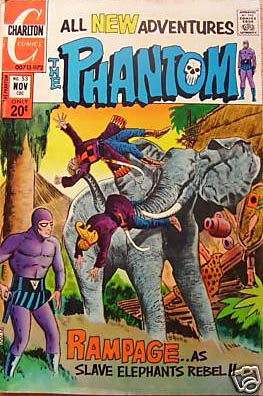
In fact, one of the frustrations I had with comic strips in general was that you only got two or three panels per day. For a kid with a short attention span, having a story unfold at such a snail's pace was maddening. Fortunately, during the early 70s, Charlton Comics was publishing The Phantom in comic book form on a regular basis. I much preferred reading the comic books over the strip, even though I liked the artwork on the strip better. At least with the comic book, I got a complete story in one issue. If there had been a live-action or cartoon show based on The Phantom as well, I probably would have been a bigger fan, but alas, it was not to be back then.

The Phantom's lack of media exposure has always remained a mystery to me. Making his debut in 1936, he is one of the most enduring super heroes in pop culture history, beating out Superman and Batman by two and three years, respectively. He was also the first hero to wear a brightly colored leotard with the briefs on the outside and to sport a mask with the eyes whited out for a spooky effect. He was, for all intents and purposes, the prototype for the modern super hero. The Phantom has never gone away, with the daily strip still running in newspapers along with appearances in various comic books around the world. Currently, Moonstone Comics publishes The Phantom in comic book and graphic novel form, and separate comics have been produced in places like Scandinavia, Australia, and India. Actually, he's more popular abroad than in the States, which has always baffled me. He is, after all, a wealthy American coming to a third world country to protect them. A rather unpopular sentiment in today's world, but somehow he is still appealing.

In a nutshell, The Phantom is Kit Walker, who carries on the family business as the 21st Phantom to roam the jungles of Bengalla. Back in the 1500s, one of Kit's ancestors, Christopher Walker, was serving on his father's ship when it was attacked by pirates of the Singh Brotherhood off the coast of Bengalla. Christopher Walker saw his father murdered before he was swept off the boat. He washed ashore and was nursed back to health by a tribe of pygmies. When he sees the body of the pirate who killed his father on the shore, he swears to fight greed, cruelty, and injustice. From that point on, a Walker has defended the jungle tribes of Bengalla in the disguise of The Phantom. Since the job is past down through the generations, The Phantom never dies and is thus known as "The Ghost Who Walks." Kit assumes the mantle of the super hero when his father dies from a knife wound. Up to that point, Kit had been raised in the States and was set to marry his college sweetheart when he is called to the jungle to serve his duty.

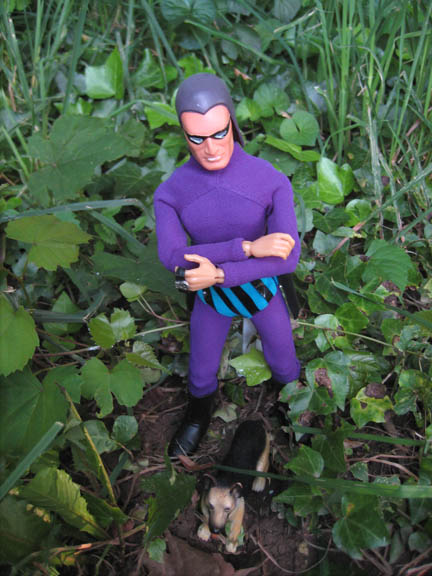
I never thought about it as a kid, but I think the reason why I liked The Phantom was because he was so much like Batman. He was a wealthy man without powers who is devoted to fighting crime and injustice because of a family trauma involving the death of a father. Without the benefit of gadgets, The Phantom was even more resourceful than Batman, using only a pair of .45 automatics and the help of his horse Hero and his wolf called Devil. Occasionally, he would also get an assist from the pygmy tribe who knows his true identity.

The jungle setting of The Phantom was always a bit confusing to me. In the comic strip, he was surrounded by African tribes people, but in other comics and stories that I read, there were Indian references like the Singh Brotherhood. I later discovered that the location of Bengalla was moved from India to Africa in the strip during the 1960s. The movie serial made in the 1940s showed a really muddled picture of the jungle environment with people of all nationalities made up in tribe makeup that didn't indicate any particular race or nationality. I guess the producers figured the kids wouldn't know any difference.

Another thing that confused me was why the strip continued to use Kit Walker as The Phantom over all those decades. Unlike other comic characters where they must remain the same age year after year, The Phantom had its own built in excuse for aging the character and having future generations take over. During the run of the strip, The Phantom did marry and have two children, but Kit remained roughly the same age and continued as the 21st Phantom right up to today. At some point, Lee Falk or the subsequent writers could have had Kit's son take over and aged him as well. I always thought that was a missed opportunity to bring a level of realism to the strip.


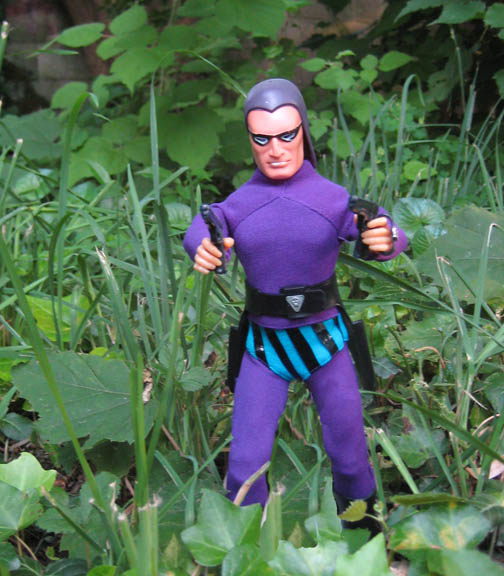
When Captain Action came out in 1966, Ideal secured the license to make costumes based on many of the King Features properties, including The Phantom. I never had a Phantom costume for my Captain Action as a kid, but I definitely snapped one up when Playing Mantis came out with their reproduction versions in the late 90s. Later on, I managed to find some original costumes on eBay, but not all of the accessories. The version pictured in this blog is a mixed assortment of vintage and reproduction pieces. One of the main differences between the old and new costumes is that, on the vintage costume, the black stripes on The Phantom's briefs were created with sewn-on strips of vinyl. Playing Mantis wisely silk-screened the stripes on for the reproduction. Also, Ideal made the mask as a two-piece arrangement with the face part separate from the cowl. Playing Mantis came up with a one-piece mask that's easier to put on. The version pictured here has the vintage leotard and mask. The holster, boots, belt, and knuckle band are all reproductions, which mirror the original accessories almost exactly.


After paying little attention to The Phantom for many years, I read a couple of the Moonstone comics and was quite impressed. I also hear that a new movie is in the works (the Billy Zane film didn't do so well). While he doesn't get the same sort of press as Batman, it looks like The Phantom will continue to live on in pop culture like the character himself lives forever in the jungles of Bengalla.

Monday, July 06, 2009

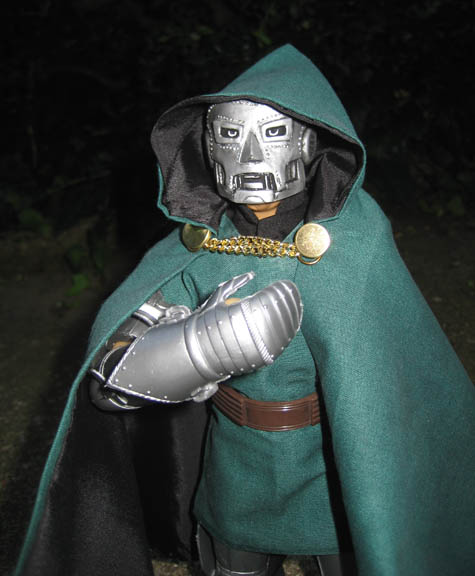
Meet Doctor Doom!


Shortly after Playing Mantis released its reproductions of Captain Action and some of his old costumes, it seemed as though a mini-cottage industry (dollhouse industry?) popped up with enthusiasts creating reproductions of old Captain Action accessories and new masks and costumes for super hero outfits never before offered by Ideal or Playing Mantis. One such entity was 2GFX which made custom masks such as Red Skull, Nick Fury, Captain America's sidekick Bucky, and Doctor Doom. I managed to buy a Red Skull and Doctor Doom mask before 2GFX disappeared into the ether.

The reason why I wanted to make a custom figure of Doctor Doom was because, unlike so many of the other Marvel villains, Doctor Doom seemed genuinely dangerous. I know I'm more of a DC guy and Marvel fans would probably wonder where I come off with a statement like that, but so many of the Marvel villains seemed more goofy than threatening, from my perspective. Mole Man and Green Goblin and The Lizard looked more cute than scary when I was a kid. On the other hand, Doctor Doom was a guy who wore armor and ruled a Balkan country and dabbled in the occult. He had brains like Lex Luthor, but he also had the power and influence of a national ruler. This was Saddam Hussein to the nth power. That was truly frightening to me.

Although I didn't read many Marvel comics when I was young, I was a regular follower of The Fantastic Four, and I was always thrilled when Doc Doom came to ruin the FF's day. As comic fans know, Victor Von Doom had once been a college friend of Reed Richards (a.k.a. Mr. Fantastic) and, when a dangerous experiment permanently damages Von Doom's face, he forever blames Richards for the accident and launches a decades long crusade for revenge. His capers were ingenious, and his status as a dictator made him difficult to touch. Still, the Fantastic Four (and whatever other Marvel heroes he battled) always found a way to put him in check...until the next time.

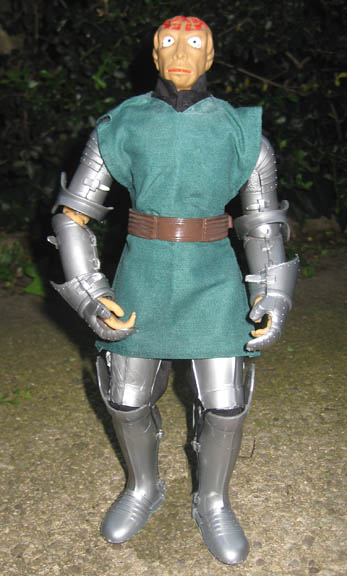
When I set out to make a custom figure of Doc Doom, I was of course first inspired by the mask 2GFX was offering. I was also working under the notion, at the time, that all my customs should be designed specifically for Captain Action or Dr. Evil figures. Since Dr. Doom was a villain, the costume had to be on a Dr. Evil figure, but I didn't want to use the standard blue Dr. Evil figure since he was...well, blue. Fortunately, Playing Mantis produced a tan colored Dr. Evil for its Ming the Merciless costume, so I managed to land a couple of the tan-colored figures on eBay. With a figure in hand, I first gave him a pair of black pants, black boots, and a black shirt to cover the bulk of his body. Over that, I created Doom's green tunic by making a rectangular piece of fabric with a hole in the center for his head and seamed it with fabric glue. When first put on the figure, it resembled a sandwich board, but by gathering the fabric at the waist with a belt I snagged from my Star Wars Count Dooku figure, it created the illusion of a tunic.


For the armor covering his arms and legs, I used the pieces from the Marx Toys Silver Knight character. At the time, a revised version of Marx Toys was putting out a reproduction Silver Knight figure, so I bought it. I later realized that I probably could have purchased original Silver Knight accessories on eBay for the same amount of money or maybe less. I was living and learning the game of action figure customizing. Anyway, the armor pieces worked perfectly even if they were a struggle to put on. Of course, I already had to the mask, so the only piece missing was Doc Doom's iconic hooded cape.

To make the cape, I used the same green fabric I used to make the tunic (most likely purchased from a scrap bin at Jo-Ann Fabrics). I found online a pattern for a Renaissance Fair type of costume which employed a hooded cape, so I scaled the measurements down to 1/6th scale. I didn't have a sewing machine at the time, so I feebly attempted to sew a black lining into the green fabric that I had cut to size. Taking pity on me, my wife took over the sewing chore and did a wonderful job with the finished cape. The finishing touch had to be the gold chain fastener that joins Dr. Doom's cape across his neck. In most of the later drawings of Doom, the chain is connected by two large, flat gold discs. After searching various fabric and craft stores for awhile, I finally found a chain that perfectly matched what I was looking for.


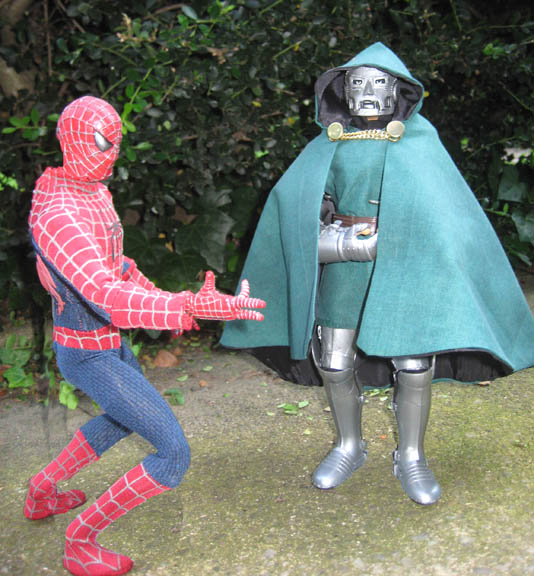
Even now, with all the other custom figures under my belt, I still think this early attempt is one of my best. Of course, the mask looks great, but the Silver Knight armor and that terrific cape by my wife really sets the whole thing off. He looks just as menacing as the guy in the comics.

Wednesday, July 01, 2009

Wonder Woman


Since comic book readership has traditionally been predominantly male, female super heroes were often a tough sell. Not that there weren't several attempts made, but characters like Lady Luck are largely forgotten today. As the median age of comic book readers began to rise in the 1970s, it was easier for the comic book companies to cultivate popular female superheroes since adolescent boys were only too happy to see a curvy, buxom woman in spandex kicking butt. The one female who beat the odds and remained popular from the golden age to modern day was Wonder Woman.

As a kid, I was aware of her name, but I didn't really know anything about Wonder Woman until I read her origin story reprinted in Jules Feiffer's wonderful book on comic history, The Great Comic Book Heroes. In a sense, I was experiencing Wonder Woman for the first time the same way the rest of America experienced her for the first time in 1941. The origin takes place just before the beginning of World War II when Army Intelligence officer Steve Trevor uncovers the leaders of a spy ring and goes on a dangerous mission to capture them. Along the way, his plane runs out of fuel and crash lands on Paradise Island, home of the Amazons. While Trevor is nursed back to health, Princess Diana falls in love with the man and fights to win the honor of taking Trevor back to America so he can finish the job he started. Her mother, Queen Hippolyte, fashions a special costume for her that incorporates elements of the U.S. flag and the golden eagle. Thus, Princess Diana adopts the U.S. as her new home and fights to protect her.

Plenty has been written about what Wonder Woman represents to young girls and to American society in general. I think her biggest contribution was to bring a female perspective and influence to the male dominated machismo of the super hero world. Shortly after her introduction, she was given membership into the all-boys club Justice Society of America. By the time the Justice League of America was formed in the Silver Age, Wonder Woman was part of DC's top three heroes (Superman and Batman being the other two, of course) who had run uninterrupted in comics up to that time. She also established the precedent of there being at least one female in every comic hero team.

Other than that origin story, I have to say I never read a Wonder Woman comic. I only saw her as part of the Justice League, or in the Super Friends cartoon show. There was also this bizarre TV movie from the early 70s:


Gotta love the wakka-cha wakka-cha theme songs back then!

I also watched the Lynda Carter version, at least for a season or so. As much as I liked Wonder Woman, I couldn't bring myself to read a comic featuring a woman. My guess is that most boys had the same reaction, which is why action figures based on female heroes were not as popular in those days. Ideal put out a line of female hero dolls in the 60s to compliment their Captain Action line, but they sold poorly and are quite rare today. Called the Super Queens, the four dolls were Batgirl, Supergirl, Aquaman's wife Mera, and Wonder Woman. I never tried to collect them because, in addition to being expensive, I didn't think they looked all that good. While Captain Action was muscled and articulated to look and pose like a hero, the Super Queens were slight and had limited articulation. They also possessed extremely girly faces not befitting of a super hero.

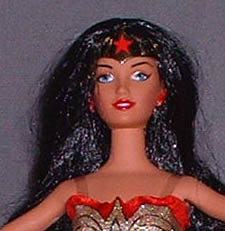
Still, I wanted a Wonder Woman doll to put amongst my other DC figures. Several years back, Mattel put out a series of Barbie dolls dressed like DC's female heroes. The costumes were great, but I've never been a fan of the Barbie doll in general. Again, it's too slight, the articulation is wonky, and the faces are way too soft and pretty. They are dolls for girls, after all. I bought a Wonder Woman Barbie and slipped it in with my Superman and Batman and Aquaman, but I wasn't happy about it.

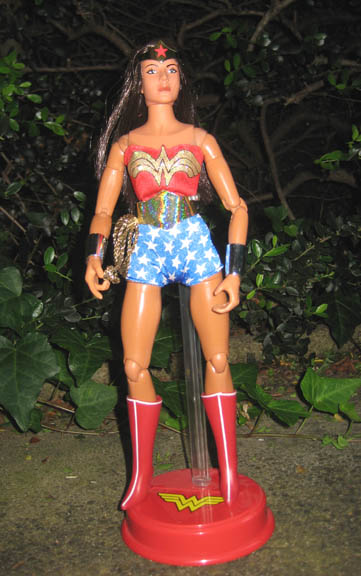
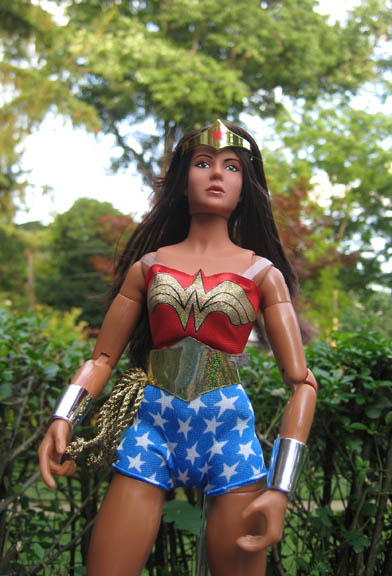
Then, last Christmas, my wonder woman wife bought me some Cy Girl action figures for customizing purposes. These female figures are articulated like male action figures and are more curvacious than Barbies, looking very much like the way women are drawn in comic books. They are also provided with two different chest pieces, one featuring smallish breasts and one with larger breasts, depending on what type of effect you want to create. Although my brunette Cy Girl had bigger hips than the Barbie, I figured she could probably slip into the Wonder Woman costume with some encouragement. Happily, I was correct. Of course, I had to use the smaller chest piece since the big boobs simply would not fit in the costume, but I think a smaller chest is better suited to an athletic woman anyhow.


The finished product appears to me as a modern, realistic interpretation of Wonder Woman rather than her iconic image, but I like it. She's also much easier to pose.
Sunday, June 28, 2009

Golden Age and Silver Age Green Lantern


Just like the Silver Age Flash, I first discovered Silver Age Green Lantern not in comic books but on the Aquaman cartoon show where he appeared in both his own solo back-up stories and as part of the Justice League of America. The thing that fascinated me about Green Lantern was that he belonged to a larger intergalactic organization designed to police all the planets in space. That imbued him with a greater calling than these other super heroes who simply got hit by radiation or fell into a pile of chemicals and gained super powers. Hal Jordan was blessed with his powers, or at least given a ring and lantern that contained powers, by a far superior group of aliens. If Superman was a veiled representation of Jesus Christ, the Green Lantern was something like a prophet.

I first learned Green Lantern's origin in one of the cartoon installments. Test pilot Hal Jordan is suddenly transported to a desert area where a UFO has crash landed. The alien belongs to the Guardians of the Universe and, now that the alien is dying, he has chosen Jordan to pass on his membership to because he is a good man without fear. The alien gives Jordan a green ring and a green device that looks like a lantern. The lantern charges the ring every 24 hours and, whitgh the ring, he can create just about anything he wishes. Its only weakness is that the ring is powerless against the color yellow. This was one of those bullshit twists that I always hated in comic books, like Superman's kryptonite. These guardians are so powerful, but all you have to do is paint your gun yellow and they're screwed. Oh well...

I discovered that there had been a Golden Age Green Lantern when DC Comics started publishing old reprints in the back pages of their comics in the early 70s. While Silver Age Green Lantern's origin was pure atomic age sci-fi, the Golden Age version had an origin borrowing more from magic, which was pretty common with those early super heroes. Alan Scott stumbles across a magic lantern made of green metal which has mysterious powers. Scott creates a ring that, when he touches it to the lantern every 24 hours, gives him great powers. While Hal Jordan's ring could not affect anything yellow, Scott's ring was defenseless against items made of wood. I think Hal Jordan had the better advantage here.

Like The Flash, Green Lantern was one of the top five super heroes of DC's powerful stable who had his own magazine in addition to appearing regularly in an anthology title (All-American) and as part of the Justice Society of America in All-Star Comics. Also like The Flash, Green Lantern faded away in the early 50s as super hero comics fell out of favor. Once The Flash was successfully resurrected in a new form in 1956, Green Lantern got his aforementioned face lift in 1959 and the Silver Age was off and running.

I wasn't a regular reader of the Green Lantern comics, but he was always a big part of my childhood through his appearances on the Aquaman show and, of course, the Super Friends. When I renewed my interest in the old Captain Action toy during the late 90s, I found there was a lot of fans online who wished Ideal had made a Silver Age Green Lantern costume for Captain Action. Indeed, had the toy line been more successful, I have no doubt that The Flash and Green Lantern would've been turned into costume sets for the trans-super hero. Of course, I had to make a costume for my own Captain Action.

The elements for the costume came from the usual suspects. The gloves and boots were courtesy of Wes McCue at Classic Plastick. To simulate the green ring, I cut out a ring shape from green electrical tape and stuck it on the right glove hand. The costume was made by Rauty, which cleverly consists of a full black leotard over which you put on the green one-piece bathing suit type of garment. The chest emblem was made by finding a copy of the logo online, adjusting it to size in Photoshop, and then printing the logo on sitcker paper.

The mask went through two versions. First, I used the mask that came with Playing Mantis's second generation Green Hornet costume over which I placed a green mask cut out of electrical tape. I had cut out the eye holes because Green Lantern was sometimes drawn with his eyes exposed. However, the Green Hornet face mask had bug eyes similar in look to Eagle Eye G.I Joe, and the hair style was all wrong. The finished mask didn't look anything like Hal Jordan.

After awhile, it occurred to me that Hal Jordan had a pile of curly hair similar to Aquaman. Since Ideal had made an Aquaman costume set for Captain Action, maybe I could repaint an Aquaman mask. One finally came on eBay for a price I was willing to pay, and I repainted Aquaman's golden locks brown. I used the same electrical tape technique for the green mask, but decided to paint the eye holes plain white. With this new face mask, I was reasonably pleased with my Silver Age Green Lantern.


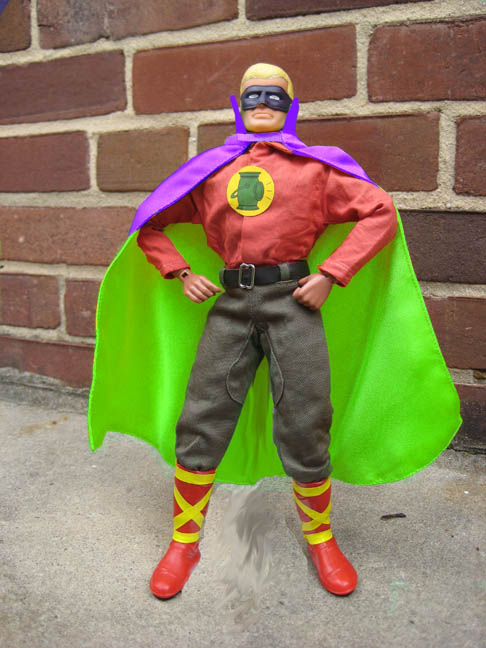
A few years later, when I was making custom figures of all the Justice Society of America characters, I took on the daunting task of recreating Golden Age Green Lantern. His was one of the more audacious costumes from the era, featuring a red shirt, green pants, red boots with yellow criss-cross striping, a purple mask, and a high-collared cape with purple on the outside and chartreuse on the inner lining. In today's vernacular, he was a hot tranny mess!

Although I was no longer making costumes specifically for Captain Action figures, I decided to repaint a spare Lone Ranger face mask to use for Alan Scott's head because of the similarity. His hair went from black to yellow and his mask went from black to purple. To mitigate the extreme color pallate, I dyed a white shirt in a soft red tone and I used some olive drab pants instead of bright green tights. The chest emblem was created in the same process mentioned above. On the red boots, courtesy of Wes McCue, I created the striping pattern with yellow electrical tape. I wanted to make the cape, but I could never find the material in the right colors. For the sake of this post, I mocked up a cape with a little photoshoppery. This is a reasonable representation of what I want my finished Green Lantern to look like when I get the right cape material.


The Flash and Green Lantern survived through the 20th century by going through radical makeovers, but DC's other three big stars, Superman, Batman, and Wonder Woman, remained relatively unchanged throughout their careers. I'll talk about my Wonder Woman action figure next time.

Friday, June 19, 2009

A Tale of Two Flashes

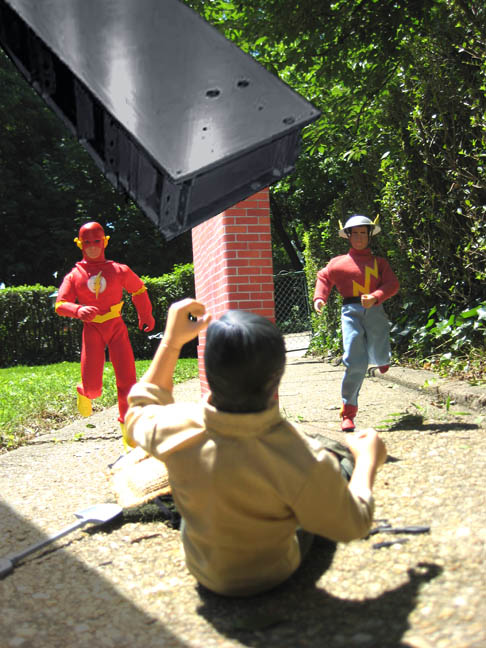
Going through my old posts, I realized that I neglected to talk about some of my earliest custom action figures. Although they lack some of the attention to detail that I brought to my later customs, I'm still pretty happy with them and thought it might be fun to share them. The Flash seems to be the best place to start since he was the first super hero to cross over from the Golden Age of Comics to the Silver Age in a completely new incarnation. Also, I just so happen to have created custom versions of each character.

Like many people born in the 60s, my first exposure to The Flash came not from the comics but from the Aquaman TV show where The Flash was featured in solo back-up stories as well as in The Justice League of America adventures. The Flash was the first "unitasker" hero I had ever seen. Unlike Superman who could do anything, or Batman who had no superpowers and relied mainly on his belt full of gadgets and gizmos, The Flash could do one thing well which was run like crazy. As a result, all his adventures were tailored to showcase his particular talent. The budding writer in me was fascinated by the contrived nature of these stories. I would think, "Boy, it's a good thing he doesn't have to lift up a train or set something on fire with laser vision. He just has to run across the country in time to defuse a bomb."

A few years later, I was able to read about The Flash's origin in the reprint comic title Secret Origins #1. In the story, police scientist Barry Allen leaves some jars of chemicals near an open window during a thunderstorm (why the window is open during a storm is not explained). Lightning jumps through the window, strikes the apparently conductive chemicals, and the resulting mixture splashes all over Barry Allen. Soon he discovers that he can move at super fast speed like a comic book character he remembered from his youth, the one we now refer to as Golden Age Flash. Since he already works for the police, Allen decides to become a new version of his comic book hero, fashioning a bright red costume for himself and fighting crime as The Flash.

I loved that story, not only because of the great Carmine Infantino artwork, but because the origin referenced an earlier DC creation. Barry Allen was inspired by a comic character who actually existed years earlier. This was the first time I learned of Golden Age Flash, but I was soon able to read his early stories thanks to DC's habit at the time of filling the back pages of its comics with Golden Age stories. Of course, this Flash was a completely different character. In this version, college student Jay Garrick has a lab accident (like Barry Allen) and he inhales fumes that make him super fast. Immediately, he puts together a costume modeled after the Greek god Hermes and starts fighting crime. His motivation for fighting crime is less clear than Allen's, but the stories were still a lot of fun.

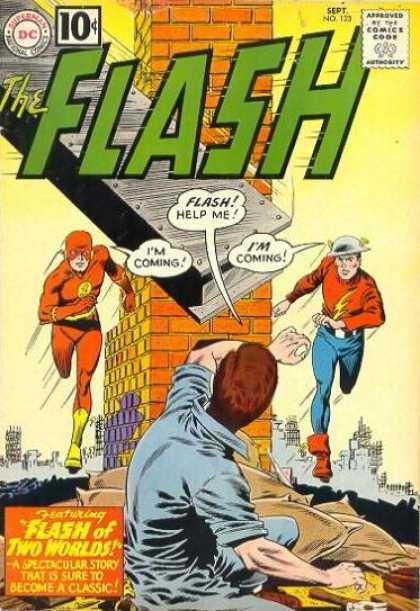
As I grew older and became a full-fledged comic book geek, I learned that the creation of two versions of The Flash led to a major change in the DC universe. In 1961, The Flash #123 featured a story where the old and new Flash meet. It seems Golden Age Flash was not merely a comic book character, but a flesh and blood hero on an alternate world known as Earth 2. In fact, all the Golden Age super heroes lived there including older versions of Superman and Batman. This opened up a long series of cross over stories featuring the old and new characters.

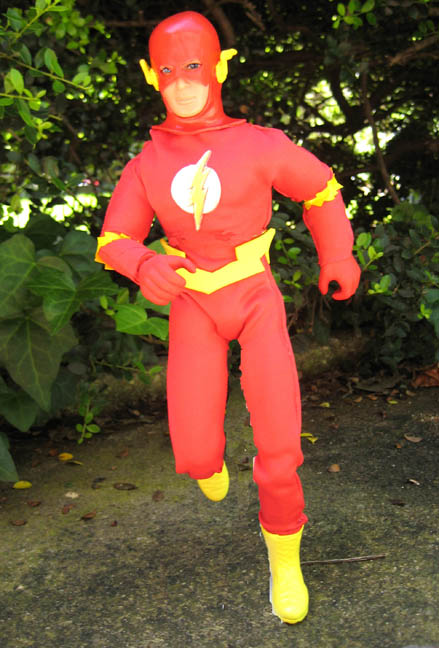
Jumping ahead to the 12st century, I found myself increasingly fascinated with the idea of creating 12" custom action figures based on the super heroes I loved as a kid. More specifically, I was inspired by the old Captain Action line where you could dress Captain Action up in various super hero costumes. Unfortunately, the short run of the toy line prevented Ideal from creating certain super hero costumes that were no brainers, like The Flash and Green Lantern. I decided to create a Flash costume when I found a great Flash mask on eBay, created by Dale Van Slyke. I then purchased a red unitard from the Dr. Mego Web site. I have to admit that, although Dr. Mego makes great Mego parts, the unitard was of really poor quality. However, I liked that it was slightly baggy the way Carmine Infantino used to draw The Flash's costume, so I made some repairs and used it. I made the yellow lightning bolts around the elbows with electrical tape, and for the chest emblem, I took an emblem from the Internet, photoshopped it to size, and printed it on sticker paper. Once cut out and applied to the chest, the unitard was complete.


Since The Flash's boots had tread, I used a pair of army boots that I painted yellow. My original figure also wore red gloves which I bought from Classic Plastick, but I didn't like the way the mask fit on the figure, so I used a beefier action figure with a bigger head. Problem was, the gloves didn't fit his beefy hands, so I just painted his hands red. The yellow belt came from a uniform set sold by a Captain Action fan known as Rauty. His red unitard was better than the Dr. Mego one, but I used his for a different custom project.


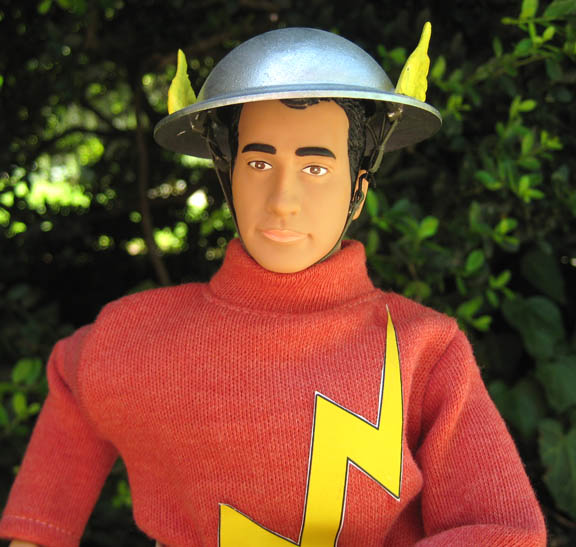
The Golden Age Flash figure was created later when I got it into my head to make my own version of the Justice Society of America. I discussed the creation of this figure in an earlier post. Unlike my Silver Age Flash, which was originally devised to be a costume I could put on a Captain Action figure, the Golden Age figure was devised as a stand alone custom. After awhile, I liked the idea of just having figures on display that were meant to be solely one thing rather than making costume sets that could work on different action figures. That's why I chose a figure from ERTL's Fisherman set. I thought the headsculpt closely resembled Golden Age Flash's face.


After creating a Silver Age Flash action figure, my next logical project had to be the other super hero who got a Silver Age makeover: Green Lantern. A look at Silver Age and Golden Age Green Lantern next time!

Wednesday, June 17, 2009

Saturday Afternoon Matinee

If my calculations are correct, it was on this day 31 years ago when the summer vacation between my 8th and 9th grade school years began. The summer of 1978 was an especially wondrous time for me when my imagination came into full blossom, and I cherished every mundane aspect of life as if it were priceless. I remember that first day especially well because my friend Vince and I went to a matinee double feature at the Northpoint Plaza Theatre (now a dreary Wall-Mart).

In the time before home video, double features were a great way of coaxing people to see a not-so-great new release by pairing it with a slightly better film that had been released a couple years earlier. Movie-goers who liked the older film and wanted to see it again, or those who hadn't had a chance to see it when it was originally released, might be lured in to see the new film. In this case, the double bill was Warlords of Atlantis and Sinbad and the Eye of the Tiger.

It was a Saturday and, as with every Saturday from May to October, I had to mow my neighbor's lawn. The woman I knew as Miss Peggy was a widow with a house on the corner, so her lawn was much larger than the rest of the houses on the block, encompassing not only the front and back of her house, but also a large section on the side by the intersection and the long strips of grass between the sidewalk and the street. For the handsome sum of $7 per week, I would mow and trim that huge lawn with her Toro gas-powered mower and my father's cheesy Black & Decker weed whacker. To make matters worse, Miss Peggy had her lawn chemically treated, so it grew just as fast as I could cut it and those chemicals wreaked havoc with my sinuses. Still, in a day when comic books cost 30 cents and a matinee was only $2, making $7 a week in addition to my newspaper delivery boy salary was good money.

I finished mowing the lawn around noon, took a quick shower, and then called Vince to make sure he was ready to go. My dad drove us to the theatre as he so often did. Looking back, I would've thought it a pain in the ass to drive us all over town, but he liked to drive. My mom said he should've been a bus driver.

Anyway, the first film to be shown was Warlords of Atlantis, the new release. This was the fourth Amicus release to feature Doug McClure as a turn-of-the-century explorer who stumbles into some forgotten world of monsters and lost tribes. The first three films were based on Edgar Rice Burroughs books, but this one was original. I guess the film-makers thought they could save some money by writing their own story but swiping the formula. In this movie, McClure takes a bathysphere down to the ocean's depths and is swept into a strange underwater world. I had never seen a bathysphere before, so I was completely captivated by the concept. Here's the segment of the film that fascinated me the most:


Aw, up your bathysphere with an ancient golden statue!

Did you catch Cliffie as one of the crew members? Someone has uploaded the entire film on YouTube if you care to watch it. Once they reach the underwater world, I think the story kinda bogs down. To a 13 year old, though, it was pretty exciting.

Next up was the much better Sinbad and the Eye of the Tiger, featuring the incredible special effects of Ray Harryhausen. It star's John's son Patrick Wayne as Sinbad and Tyrone Power's daughter Taryn. A very young Jane Seymour and Doctor Who #2 Patrick Troughton are also in the movie. There was only one scene that stayed with me all these decades, and someone just so happened to put it on YouTube. You'll discover fairly quickly why it burned itself so vividly into my adolescent brain:


More than the stories themselves, I became completely lost in these depictions of fantasy worlds from a bygone era. Having already had my fill of space opera like Star Trek, Space:1999, and Star Wars, I was ready for some new fantasy legends. In between the countless comic books I read that summer, I poured over books by Edgar Rice Burroughs, the stories of Sinbad, and even tales from The Arabian Nights. All that lawn and newspaper money went straight to the comic book/used book store in my neighborhood. So lost was I in these fantasy tales that I doubt my parents were even aware of my existence until I showed up for dinner.

To this day, I remember that summer as a dream-like blend of fantasy and reality. While mowing the lawn, I was a giant slaughtering hordes of soldiers with my swirling blades of death. Wandering the sun-baked sidewalks of my neighborhood delivering newspapers, my mind was underground in the hidden world of Pellucidar helping David Innes defeat the evil Mahars. It was the last summer when I had no worries and could afford to completely block out the harsh realities that were looming on the horizon. During those sultry, hot days in 1978, I was purely a kid for the last time.

Thursday, June 11, 2009

Men Into Spa-aaa-ace!

Although I read comics from the time before I could read, I didn't seriously collect comics until I was about 12 years old. Among my early obsessions were the Dell/Gold Key comics from the 50s and 60s. Dell was the comic book arm of the Western Printing and Lithograph Co., which held the licensing rights to numerous pop culture properties from comic strips, movies, and television. Instead of having regular titles with monthly or bi-monthly publishing schedules, Dell primarily put out an anthology series known to collectors as Four Color Comics featuring an array of properties including Buck Rogers, Mr. Ed, the Three Stooges, and Leave it to Beaver. The quirky line-up of pop culture icons, coupled with the unique covers using either paintings or photo-collages, really jumped out at me as a collector. Also, they were way cheaper for me to buy than old Marvel or DC comics. This was important on my newspaper delivery boy/lawn mower salary.

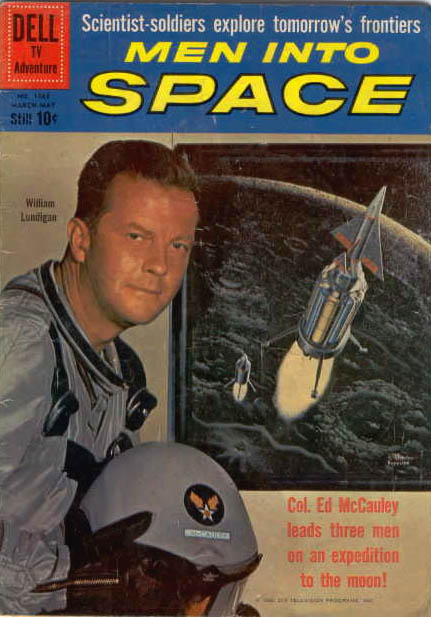
One of my favorite Four Color Comics was the issue featuring the Men Into Space TV series. At the time, I had never heard of the show, but I was intrigued by the grim-faced astronaut on the cover with the cool helmet sitting next to the Chesley Bonestell painting. I later discovered that Men Into Space was a half-hour, syndicated series about the United States Air Force's attempts to explore space. Led by Colonel Edward McCauley (played by William Lundigan), these space explorers dealt with the hazards of space travel as they built space stations, moon bases, and planned trips to Mars. Although the stories were supposed to take place in some vaguely defined near future, everything looked like 1959.

Of course, I only had the comic to go by when I was 12, and it seemed pretty exciting to me. While I knew that the science presented in this 1960 comic bore no resemblance to the realities of the Apollo missions, I enjoyed experiencing this "what if" view of the future that seemed so much more elegant than the truth. The frustrating part about the comic book was that the story ended with a cliffhanger. During one of their moon missions, one of the crew is injured. Also, they do not have enough fuel to get back in their rocket ship, so the injured man and another astronaut are sent home in a makeshift rescue craft, leaving McCauley and another astronaut stranded on the moon waiting for help. I spent decades trying to find the second issue of this comic so I could read the conclusion of the story. It wasn't until a few years ago, with the help of the Internet, that I discovered Dell never published that second issue. I don't know whether the series' cancellation or poor comic sales were to blame, but Col. McCauley was never rescued from the moon.

I always wanted to see some episodes of the show, but the only way I could see them was to buy the entire set of 38 episodes on DVD for about $40. I wasn't prepared to invest that much money on a show I had never seen before, so I never bought them. Now, some generous person has posted one of the episodes on YouTube, so I'd like to share it with you. As I suspected, it's kinda like "Sea Hunt in Outer Space." The budget is low, there's a heavy reliance on stock footage, and the story is rather uneventful. Still, I wish I could have seen it in syndication when I was a kid. I think I would've enjoyed it. This episode features a young Robert Vaughn as guest star, who is clearly the best actor in this episode. Anyway, here it is:


Monday, March 23, 2009

Forty Winks: The Perils of Pandora

In the waning years of the previous century, I found myself in the midst of a group of highly creative individuals who wished to take comic books beyond the worn out parameters of super heroes and the dreary pretensions of Frank Miller garbage to a universe where any type of story was possible and commercial considerations were not an issue. These people were part of an independent, small press movement. Brave souls who put their time, energy, and money into producing comic books for the sheer joy of creating something that had never existed before.

The comic that I was involved with was called Forty Winks (you can still find copies on eBay for cheap). It told the story of a 10-year-old girl named Pandora who lived with her widowed father. She was an ordinary girl except that she was an "active dreamer," that is, someone who didn't just float passively through her dreams, but could actually control her actions within the Dreamscape. When a mysterious monster begins attacking her in her dreams, she sets out to discover who this monster is and how he can be stopped. Along the way, she enlists the help of a scrappy gang of urchins known as the Smith Street Gang and a Dream Guide named Sam, who shows her how to navigate the tricky and treacherous world of dreams.

The initial adventure of Pandora and the gang ran over four issues beginning in September 1997 and ending in June 1998. A Christmas special and a TV parody issue followed. Forty Winks proved so popular that she appeared in another company's comic book titled, Comics Library International, where she appeared in five issues. The story, known as The Perils of Pandora, followed on the events in FW #1-4 where Pandora is put on trial in the Dreamscape for breaking several dream laws during her previous adventure. As punishment, she is sent on a mission to explore various aspects of the dream world and gather knowledge about how it works. By the time this new storyline started, however, our little group splintered apart and the producers of Comics Library International took over Pandora's story. The last two segments were written and drawn completely without the participation of her original creators. It was an unfortunate end to a promising story.

Almost 10 years later, the world of indy comics is a very different place, thanks to the World Wide Web. Now comics can be produced and presented to a global audience without the expense of printing paper copies and distributing them to whomever will take notice. Forty Winks artist John Peters has been a steady presence in this world of Internet comics for many years now, and he has returned to the story which ended prematurely. Forty Winks: The Perils of Pandora is being serialized on Web Comics Nation. You can take a look at it here.

Since the storyline in CLI was not fully realized as it was originally intended, John is recreating much of the comic and constructing a new ending. John is an amazing artist with a wildly creative mind. Please check it out. I, for one, am certainly looking forward to seeing where he takes little Pandora on this new, old adventure.

Monday, March 09, 2009

Custom Action Figure - Daniel Craig as James Bond


When it was announced that Daniel Craig was the new James Bond, I couldn't understand what all the fuss was about. It seemed like every time a new actor was assigned the role, there was always some kind of buzz in the media about how this person is not right for the part. As a fan of both the novels and the movies, I can't see how anyone can truly claim any expertise on knowing who is or isn't the right person to portray the character.

Many think that Sean Connery is and always shall be the quintessential Bond, probably because he was the first to play the role on film and that's the first impression many have of who Bond was supposed to be. At the time, however, Ian Fleming was extremely disappointed in the choice, and anyone who's read the novels can understand why. In Casino Royale, the first Bond story, Fleming described Bond's features this way:

His grey-blue eyes looked calmly back with a hint of ironical inquiry and the short lock of black hair which would never stay in place subsided to form a thick comma above his right eyebrow. With the thin vertical scar down his right cheek the general effect was faintly piratical.

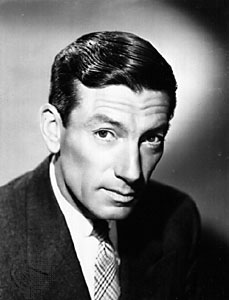
In the same story, he writes that Bond had "a cruel mouth" and Vesper Lyn mentions that Bond looks a little like Hoagy Carmichael. That's an obscure reference for most of us today, so here's what the singer/songwriter looked like:


Not exactly Sean Connery, I would say. After the first movie came out, Fleming grew to like Connery in the role and even gave Bond a Scottish background in the penultimate Fleming-penned Bond novel, You Only Live Twice. When Roger Moore took over the role, some said that Moore embodied the proper British gentleman aspect of Bond's character, but Bond never struck me that way in the books. Although he could turn on the British charm when he had to, and he did have a certain code of fair play in his otherwise dirty line of work, he was generally a pretty coarse character. I think Timothy Dalton was also a bit too refined for the role, but I didn't really have a problem with the way he played the character.

Of course, Pierce Brosnan was likely the most popular next to Connery. He had that combination of gentlemanly refinement and rugged strength that fan came to expect from the cinematic Bond, but again, not really the literary Bond. So when Daniel Craig took over, I really had no feelings about the choice one way or the other.

"A blond Bond?" many scoffed.

Well, why not. Hair color or eye color really shouldn't be a determining factor. Instead, what I was looking for was whether or not he might be able to bring back some of the coarse manliness of Bond, especially since his first outing as the MI-6 spy was in a movie adaptation of the first novel. Once Casino Royale was in the theatres, all the fuss quickly blew away and the general public loved the new Bond.

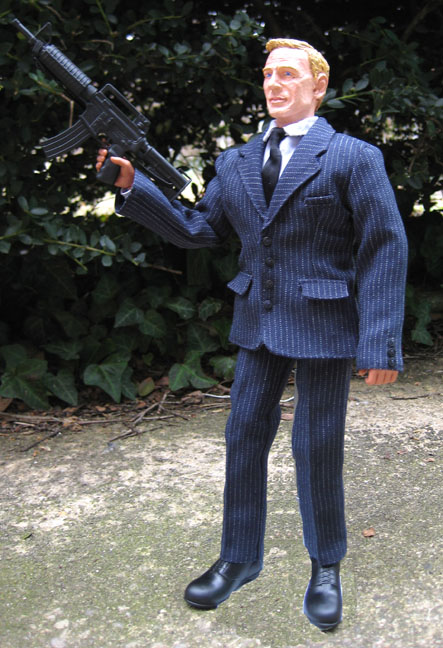
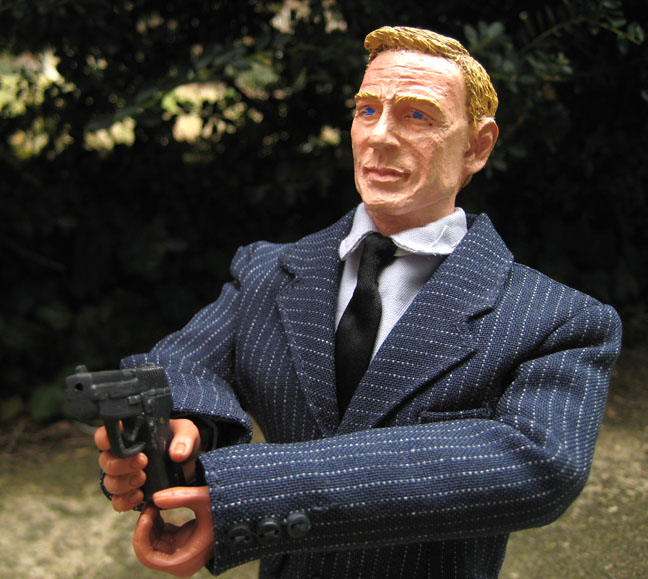
My wife and I have gone to see Casino Royale and Quantum of Solace on her respective birthdays, and have enjoyed each movie quite a bit. We're hoping that they keep releasing Bond movies in mid-November so we can keep the birthday tradition going. That's why it was such a kick when, this past Christmas, she presented me with a 1/6ht scale resin headsculpt of Daniel Craig, made by Dale Van Slyke who sells numerous celebrity headsculpts on eBay. I finally got around to creating my Daniel Craig custom figure this weekend.

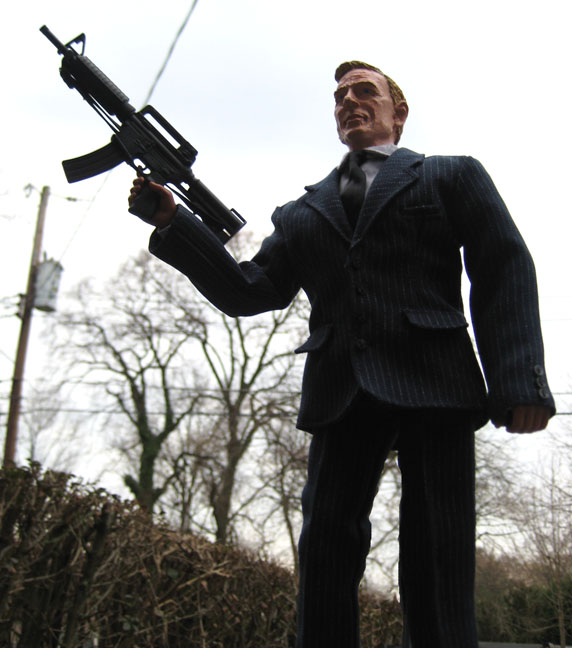
As per the usual process, I lopped off the head from one of my 12-inch action figures and glued the resin head onto the neck stalk using model glue. Once the glue was dry, I painted the head, occasionally glancing at a picture of Craig on the computer for reference. The sculpt is not a perfect likeness, but just as good as, if not better than, the other Daniel Craig action figures I've seen online. It's a lot cheaper to make your own as well.

After painting the head, I dressed him in a blue pin-striped suit that I bought from Old Joe Infirmary many moons ago. The light grey shirt is also from Old Joe Infirmary, and the black tie came from the old Playing Mantis Green Hornet set made for Captain Action. All my dress shoes were currently being used on other figures, so I found some G.I. Joe boots that, when tucked underneath the pant legs, could pass for black, lace-up shoes.


Without any armaments, my action figure just looks like Fred the insurance salesman, so I tried to find an assault rifle like the one Craig is holding in the poster for Quantum of Solace. I didn't have one that was exactly the same, but I think the one in my photos is fairly close. I also took some shots of him holding a pistol. I could've gone with a Walther PPK, but I think that's so overdone. Frankly, I'm not sure what kind of automatic he's holding here, but it's chunky and cool looking.


Now I have to figure out what I'm going to do with the Christian Bale headsculpt my wife also got me for Christmas. Maybe I can stage a diorama where he's attacking a cinematographer!