Tuesday, August 21, 2007

IT'S MY BIRTHDAY! IT'S MY BIRTHDAY!

Okay, no cabbage-patching. It's so 90s!


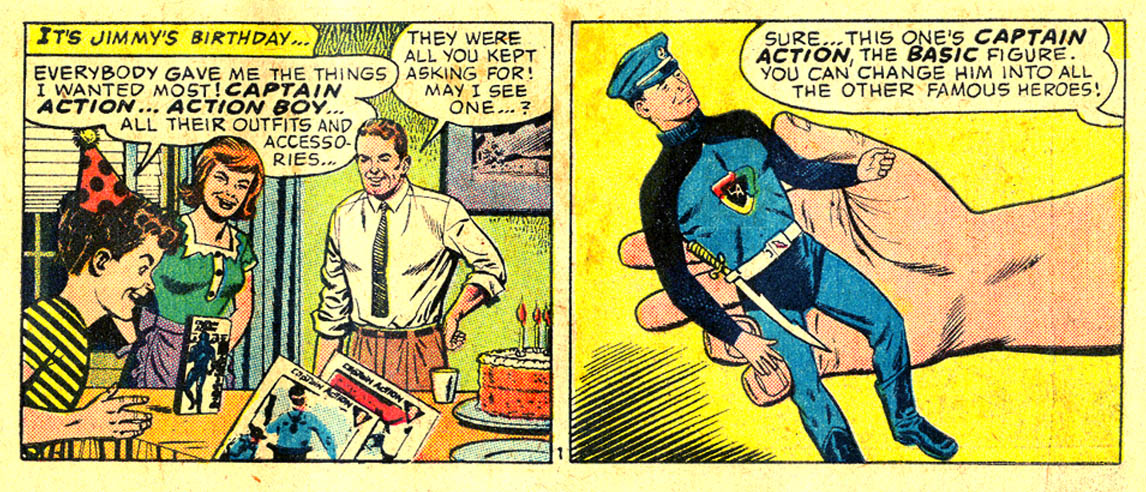
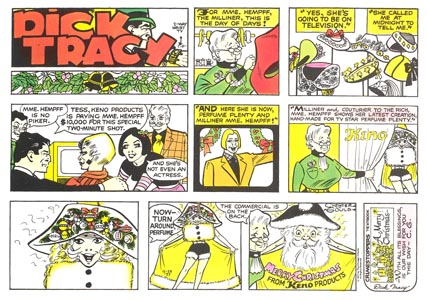
The comic page above came from a promotional comic book that was included with my Captain Action figure (click on the image for a larger view if you can't read it). When I was a kid, I hated little Jimmy. I was pretty happy with my Captain Action and his Batman and Captain America costumes, but Jimmy got "Captain Action...Action Boy...all their outfits and accessories!" Little bastard. This comic scarred me for life. Do you know how many hundreds of dollars I've spent trying to acquire what Jimmy had, and I'm still not even close! Ideal really knew how to mess with a kid's head.

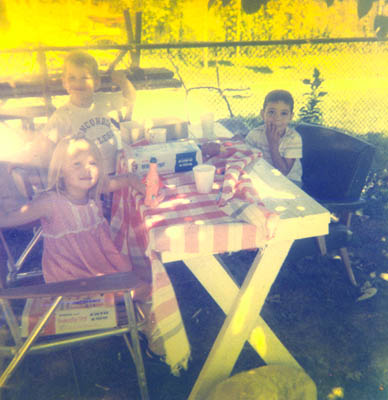
To be honest, I don't remember too much about my childhood birthdays. I vaguely remember the one pictured below, primarily because I have a photo of it. I believe it's my fourth birthday:


That's my friends Kimmie and Nick (I'm the chubby kid standing on his chair and waving). I'm playing with my Mr. Potato Head which I just received from Kimmie. She had a variation that used an orange soda bottle rather than a potato for a head. And no, there hadn't been a nuclear accident that morning. The color in the photo has gotten funky with age.

Birthday's were always bittersweet growing up. My birthday meant that the summer would soon be over and I would have to go back to school. It was Birthday - Jerry Lewis Telethon - Back to School. I still get a twinge in my stomach when I hear Jerry sing Never Walk Alone, although that may not be because of the school thing.

Anyway, I don't have much to say about birthdays, except it's kinda nice to acknowledge that you've made it through another year. It's a mile marker to show how far you've come and that you can still go farther. I guess that's pretty good.

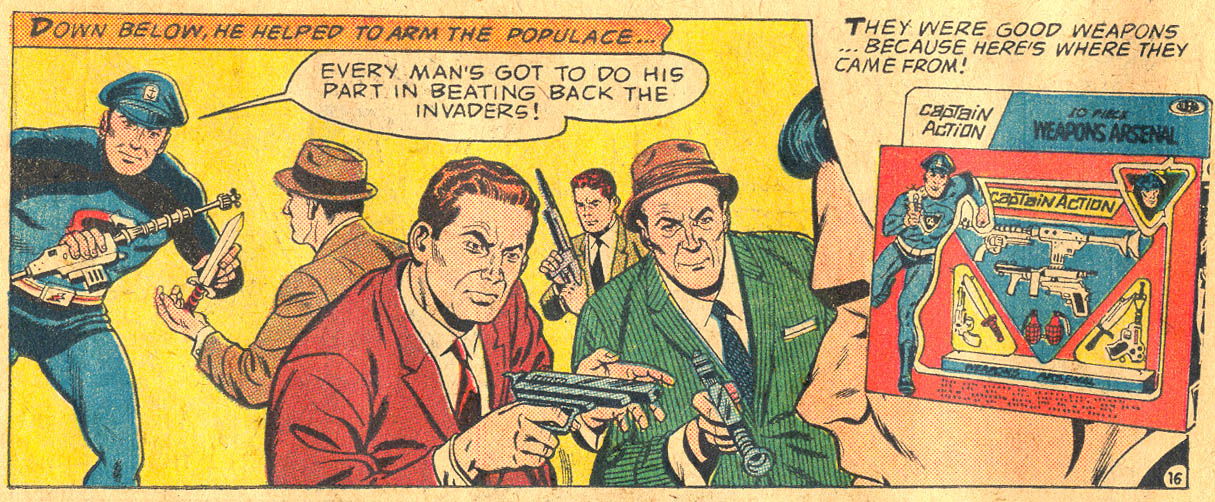
I have to show you another panel from that Captain Action comic:


Can you imagine any toy company including a panel like that in any promotional material nowadays?!! All I can say to Captain Action is, stay away from Baltimore! Our murder rate is high enough without you handing out weapons on the street corners!!

Friday, August 17, 2007

CAPTAIN AMERICA AND THE SUMMER OF ‘72

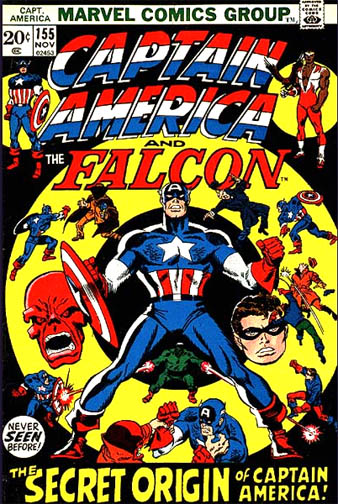
With all the recent hoopla about Marvel killing off Captain America (like they won’t revive him in another year or two), I got to thinking about my very first Captain America comic. It was Captain America #155, which also featured his then partner The Falcon. I didn't know at the that this issue was part of a very special story arc in the Captain’s Bronze Age history.


You see, Steve Englehart had taken over the writing duties for Captain America a few issues earlier, and his first assignment was to figure out a way to explain those Captain America comics that had come out during the 50s. According to Stan Lee’s revised history, Captain America had been put in suspended animation shortly before the end of World War II and revived in the 60s. However, comic fans knew that Captain America had also appeared in several issues of Young Men comics in the 50s. Who was that guy if Cap was on ice at the time? Mr. Englehart explained that another man and his teenaged student were transformed into a new Captain America and Bucky to fight the Communist menace. They were later put into suspended animation in the mid-50s, but then revived in the 70s and these two were giving the real Cap a bad reputation. The real Captain America, a.k.a. Steve Rogers, puts this bogus Captain America out of action, but the bad guy was brought back once again as The Grand Director. It’s all very complicated, so let’s get back to my seven-year-old mind and Issue #155 and the summer of 1972.

I think I grabbed this issue off the spinner rack because of the unusual cover. Instead of a standard picture of Cap beating up a bad guy, #155 had this abstract, “bullseye” design with Captain America in the center and all kinds of little things going on in the corners. Another interesting feature was that it proclaimed to reveal “The Secret Origin of Captain America.” Pretty nice way to start off your virgin reading experience with a new superhero! In fact, the flashback section of the book where Steve Rogers is injected with the super strength serum looked just like the old Jack Kirby/Joe Simon artwork. Since I’m writing from memory, I’m not sure whether it was the real artwork or an artist mimicking the style, but either way, the effect of changing styles back and forth to suggest a different era was fascinating to me. I was beginning to sense how comic books had a history and a continuity.

This became one of my favorite comic books of that summer (I was reading quite a few during those sultry months), and I re-read the book several times. I always associate that comic with the Summer Olympics in Munich, Germany. Although the games officially ran from August 26th to September 11th, they seemed to go on forever. I remember perusing my Captain America comic when Mark Spitz was racking up his seven swimming gold medals, or studying that cool flashback segment when Olga Korbut was showing that some Russian women could be cute and perky. I also remember reading Issue #155 when it was announced that eight Palestinian terrorists had taken 11 Israeli athletes hostage, killing two in their apartment right away.

I didn’t know anything about the Israeli-Palestinian conflict at that time, and I still didn’t understand it after the hostage situation ended in a bloody massacre. All I knew was that the Olympic Games were supposed to be about friendly competition amongst the world’s best athletes. There was no place for such brutality at a fun event like this. I equated the terrorists with the bullies at school who would interrupt a friendly game by pushing kids around and starting trouble. That was kid’s stuff, though, and I was consoled with the notion that things got better when you grew up. After those Summer Olympics, I knew that some people never lost their need to inflict violence and mayhem no matter how many more people desired peace. When I saw a shaken Jim McKay solemnly report that "they're all gone,” I was assured that things never really got better.

I could falsely concoct some story that I had secretly wished for Captain America to come and save the hostages, but no such thought occurred to me. Like most normal seven-year-olds, I knew the Captain was a fantasy created to fulfill our collective yearning for swift justice. I knew superheroes were not real and never could be. The only connection I made was that comic books were more fun than real life, and I retreated into comics for most of my young life. I even re-read my Issue #155 on Labor Day while Jerry Lewis, strung out on Percodan, was chastising me for not sending in money for his “kids.” Just like the Captain’s arch enemy Red Skull, that greasy-haired man in the tuxedo was repulsive and fascinating at the same time.

Thursday, August 09, 2007

NICK FURY - AGENT OF S.H.I.E.L.D.

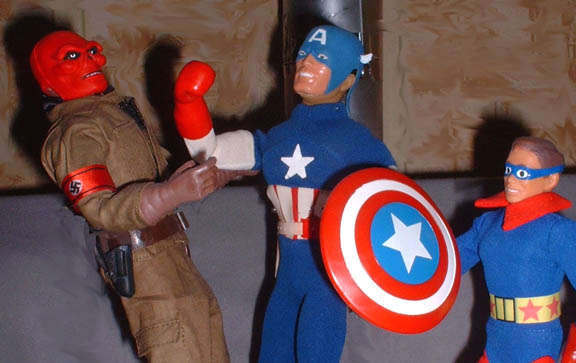
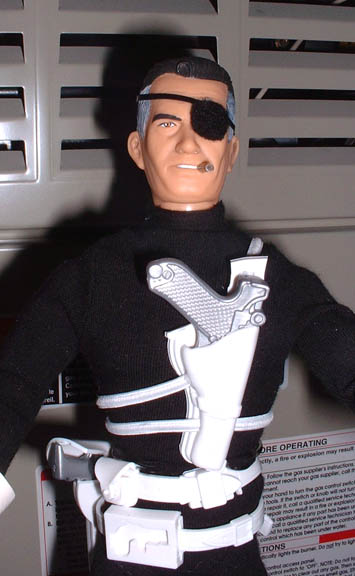
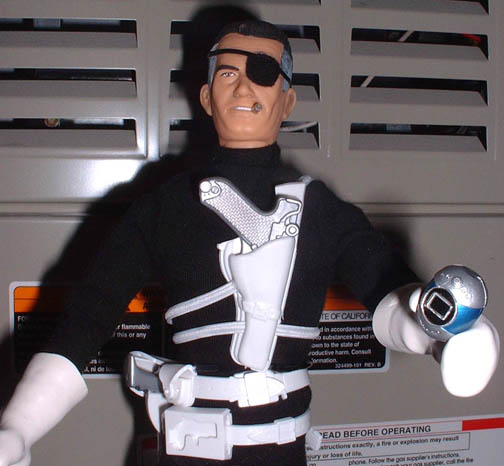
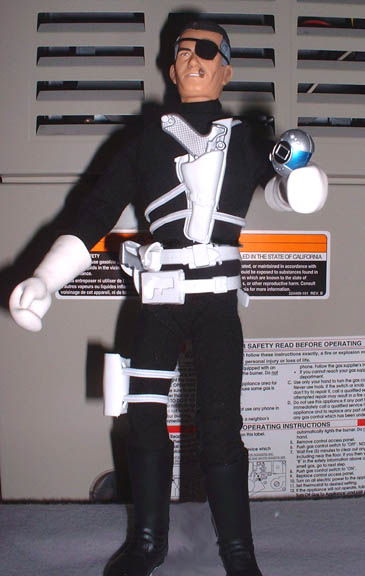
I started working on a Nick Fury action figure after I found this interesting figure on Old Joe Infirmary that had a very Nick Fury–like face, right down to the cigar in his mouth. It seemed like a relatively easy costume to create, and I always had a soft-spot for the old soldier in the futuristic paramilitary organization. I guess I also have a fondness for him because he got me through a rather harrowing night as a child.

I knew from as far back as I could remember that my father had a drinking problem. Until I was eight years old, however, the concept was completely abstract, like saying the neighbor down the street is a water skier. His behavior when drunk did not affect me as a very small child, except when my parents would fight, which was as confusing as it was disturbing. Then, one Saturday afternoon in the fall of ’72, I finally understood the seriousness of my father’s alcoholism. My mom had been a stay-at-home mom most of the time that I was little, but with inflation rearing its ugly head, she decided to take a part-time job at a catalog clearance center to make extra money during the holiday shopping season. This meant that she had to work some Saturdays, and my dad had to watch my brother and me. My dad pretended that his pride was hurt by my mom going to work and showing the world that he was not a big enough bread winner to support his family, and he chose to take it out on her (and, unthinkingly, on my brother and I as well) by getting rip-roaring drunk during the day that he was supposed to be watching us. Of course, I later realized that any excuse, like the sky was blue for example, was a good enough excuse if my dad chose to get drunk. But this was my first, full-blown awareness of my dad being drunk.

He seemed fine in the morning, and was quite happy to give me a few bucks to go off to a kids movie festival at my elementary school. My friend Linda and I spent the afternoon eating candy and watching cartoons and poorly dubbed children’s movies from Sweden or someplace, all spooling through a crappy 16-millimeter projector that would periodically eat the film and have to be re-threaded. Anyway, Linda and I had a reasonably fun time, and we wandered back to my house shortly before dinner time. As soon as I walked in the door, there was a palpable tension in the air. I can’t explain it, but I would feel it for the rest of my childhood, every time I walked into the house when my father was drinking. I recall my dad and my brother were doing some project out in the back yard, and my dad looked crazed. His fiery red hair was sticking up on end, and his normally ruddy face was completely red. He looked like the Heat Miser from The Year Without a Santa Claus, although that cultural reference was not available to me in 1972. My brother, six years older and more aware, just looked frustrated and a bit scared.

My dad came into the house ranting and raving to no one in particular, but with a gravelly, slurring voice which made it feel personal. I told Linda to go home and tried to make myself scarce until my mom returned from work. Maybe she could deal with the demon that had possessed my father. Of course, her arrival only made matters worse as he unleashed his full venom on her and this wicked job that was keeping her away from her true duty of watching the kids. Somehow, Mom kept her cool as my father kept up his non-stop rant for the entire evening. She made us dinner, washed the dishes, ran a bath for me, and put me into my pajamas while the entire time my dad spewed forth his nonsensical verbal venom. Being that this was the first time I connected the drinking with my father’s yelling, I truly tried to follow what exactly his grievances were. No matter how closely I listened, however, nothing really made sense. Sometimes he wouldn’t even finish sentences, but start a completely new line of thought just as irrational as the last. This was my first survival lesson for living with an alcoholic: they make no sense, so it’s best to not pay any attention to what they are saying, lest you lose your own sanity trying to understand them.

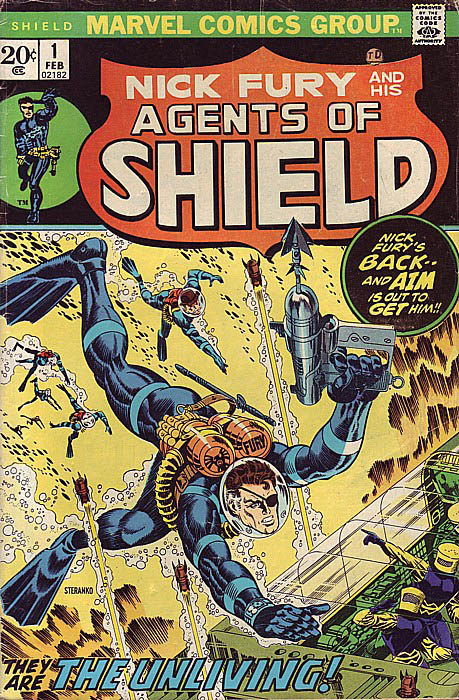
I’m not sure where my brother was in all of this, but my mom most likely told him to go to a friend’s house. By about 9:30, my father had completely exhausted himself and passed out on the bed. A little while later, he grumbled to my mom to go to the store and get him some cigarettes (that’s back when smoking was good for you). Willing to do anything to keep him quiet, my mom put some pants and shoes on me and we drove to the 7-11 store. Given what we had been through, I guess Mom felt I deserved a comic book and an ice cream. I quickly scanned the spinner rack of comics to settle on a choice (I didn’t need to aggravate my mom with indecisiveness). I stumbled onto something called Nick Fury and his Agents of S.H.I.E.L.D. (for you comic fans, this was the first reprint issue featuring old stories from Strange Tales). Now I had read Sgt. Fury comics before, but this was something new. It definitely was set in present day and not World War II, and this Nick Fury looked a little different from the Howling Commando Leader. I was confused, but the fancy gadgets and spy-movie feel sucked me in. I grabbed it.

When we got home, I eagerly started reading my new comic. Then the haunted, slurring voice called from upstairs, “Neal!” Cautiously, l pulled myself up the stairs and walked into the darkened bedroom. My dad remained prone on the bed. From the faint light in the hallway, I could only see my father’s eyes, and they appeared to glow.

“Where’d you and your mother go?” he croaked out, suspicion hanging on each syllable.

“We went to the 7-11 to get you cigarettes,” I replied, incredulous that he would even ask.

“Are you sure?” he groaned, like some ambulance-chasing lawyer.

I nodded, feeling guilty for no apparent reason.

“No place else?” my father added, accusingly.

“Yes, just to the 7-11,” I said, feeling more and more creeped out by the minute.

I don’t know exactly how long this interrogation went on, but he eventually let me go. Some years later, I realized that my father, in his twisted, alcoholic haze, was setting a trap for my mom. Thinking that she was having an affair, he gave her an excuse to leave the house so she could meet with the non-existent boyfriend. I guess I was supposed to tattle on her transgression, which only occurred in his sick, clouded head. Truly mindbending!

Once back downstairs, I continued to read about the adventures of Nick Fury. So intent was I to leave my current time and space that I poured myself into those pages. I was right alongside Nick Fury on whatever escapade he was having. I welcomed the challenge, for no villain could be any scarier than my own father at that point.

The next morning, I read through the comic again. I was thrilled to discover that this was, in fact, the same Nick Fury from WW II, only a little older and with cooler weapons. My dad eventually came downstairs, hung over and full of self-reproach. My parents’ whispers in the kitchen barely contained the seething tension underneath, eventually ebbing to a simmer of conciliatory repartee. I tried to block it out, focusing only on Nick Fury. It was the second survival technique I learned in so many days.

Friday, July 27, 2007

HARRY POTTER, LORD OF THE RINGS, AND ALL THIS PRECIOUS BRITISH NONSENSE

My lovely wife, like so many others around the world, became obsessed last weekend with reading all 759 pages of Harry Potter and The Deathly Hallows before anyone of her friends let loose with revealing tidbits or she saw any spoilers on the Internet. Despite all the activities around our house during the weekend, she managed to finish the book by Monday, a pretty amazing feat from my perspective when it takes me a week or more to plow through a 250-page novel. I admired her dedication to the cult of Potter, but I have never understood it.

Ever since this whole phenomenon started, I’ve had countless people stare at me aghast when I proclaim that I haven’t read any of the Potter books. I suppose because I’m into some other nerdy things like Star Trek and comic books, people assume that I would be climbing right on the back of the Potter buckboard, but in fact, I have a real aversion to what I would call British Preciousness. You know, all the cute and fuzzy fantasy characters with their goofy names and their quaint powers which come into play at just the right time so the writer can easily pull the character’s butt out of the fire without thinking of a plausible solution.
As an adolescent, I had the same visceral disgust for all the quaint and cute fantasy elements of J.R.R. Tolkien’s Middle Earth. Whenever someone started talking about gnomes and elves and magic rings and started throwing around cuddly names like Frodo and Bilbo Baggins, I just shuttered. Back then, people also assumed that I would lap up this otherworldly crap, but I had no interest and was annoyed with those who tried to convince me that I should like it. I was a science fiction person, and although some people are into both, I saw a real difference in speculating about our own future and delving into a completely made up world that never did and never will exist.

First of all, I can’t relate to it. If I have to train myself to understand who all the creatures are and what all their powers are, then figure out how their fantasy world is laid out and where they’re going, you’ve already lost me. I don’t want to do that much homework. Let’s at least deal with real humans. I know what they look like and what their not-so-special powers are.

I thought I had left such nonsense in the 80s with Boy George and docksiders, but along came Harry Potter and the return of precious fantasy goobledegook. It doesn’t help that obliging Potter cultists try to explain all of the ins and outs of Potter’s world to me. “You see, Blunderbutt can fart questions out his ass, but Harry had his sense of smell taken away by Soursox the cat, so he couldn’t answer Blunderbutt, but then Proctoplesse used his driller of doom…” At this point, I’m thinking about whether or not Jonathon Ogden’s toe will be healed by the time of the Raven’s season opener.

I thought perhaps watching the movies would make it easier to get into the Potter spirit. After all, a movie only requires that I sit and watch and listen. Little did I know how difficult such tasks would be. Now, I’ve sat through the most boring, putrid, insipid, and mind-bending movies ever filmed. I have tremendous endurance when it comes to annoying cinema. And to be fair, the Potter films are all well-made, big-budget epics with strong casts. Nevertheless, when those wizardly rugrats start rattling off ensorcelled exposition on spinning staircases while the wall hangings go about their ghostly gabbing, I feel like I’ve shown up at the wrong party and somebody’s spiked my drink. I keep wishing I can catch the next flying train back to London and see if James Bond is doing something cool.

Don’t get me wrong, if you are into it, that’s perfectly fine. I’ve certainly given up trying to explain to my wife why The Band Wagon is the greatest movie musical ever made or why Kurt Vonnegut was an amazing writer. I’m clearly in the minority with this Harry Potter thing anyway. I’m just glad that the last book is finally out and I won’t have to be subjected to anymore hype…at least until the next movie comes out or J.K. Rowlings assaults us with another phonebook-sized tome of British Preciousness.

Friday, July 20, 2007

HAWAII FIVE-O

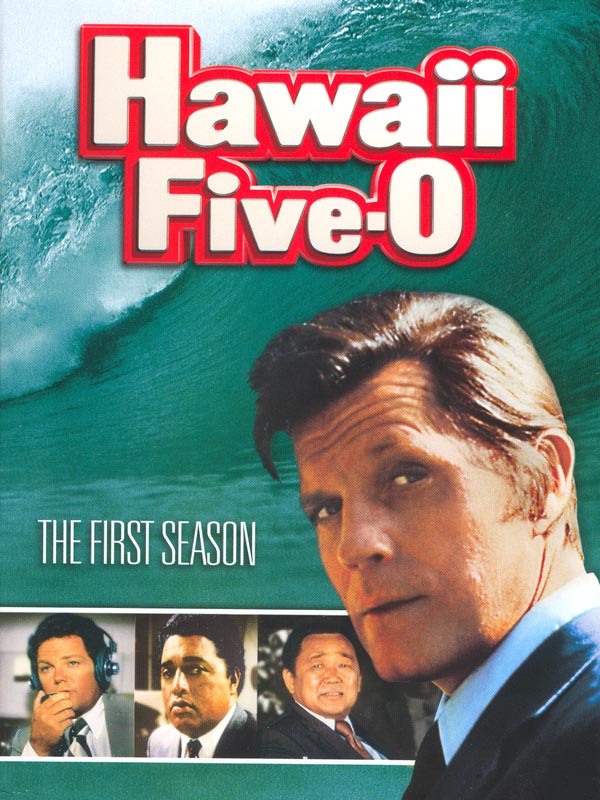
DVDs have become a wonderful way to relive childhood memories. As my lovely wife and I work our way through season one of Hawaii Five-O, it’s as if my life is flashing before my eyes, in a pop culture sort of way. For about 30 years, this show followed me from pre-schooler to working drone, and my admiration for it grew steadily along the way.

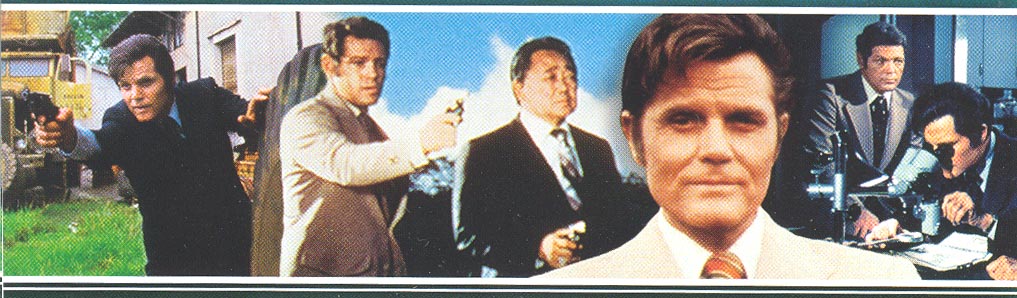
Hawaii Five-O was one of those television juggernauts, much like Law & Order is today. Beginning in 1968, the show ran for 12 seasons, holding a steady and loyal audience through the 70s. My grandmother was one of its devoted fans since it provided the kind of detective stories she loved. Just like Perry Mason and Burke’s Law before, Hawaii Five-O showed dedicated professionals piecing together clues in a methodical way until they found their perpetrator. There was really no mystery for the audience, since we usually knew whodunit before the catchy opening credit sequence began. The joy of the show was watching Steve McGarrett, Danny "Danno" Williams, Chin Ho Kelly, and Kono put together the clues and zero in on the criminal before he or she flies the coop (or the island as the case may be).

A typical episode went something like this: A creepy, sweaty villain commits a crime. Cue snazzy opening credits sequence featuring waves, hula dancers, and Jack Lord’s hair. McGarrett and the team show up at the scene of the crime and scope the place. McGarrett simmers with controlled contempt for the villain, then sends Danno out on some useless fact-finding mission; e.g., “Locate every person on the island who purchased a grape soda in the last 48 hours.” Ever the faithful bottom, Danno rushes off with a clip board. Chin Ho goes out and talks to the Chinese locals and Kono tails somebody. Meanwhile, the villain commits another crime in an even more heinous and sweaty way. McGarrett gets pissed and pounds his desk. The guys rush in and rattle off a bunch of factoids which McGarrett writes on his chalkboard. They all puzzle and stew until Che comes up from the crime lab and lays out the whole case based on fingerprints and carpet fibers. The gang rushes over to the villain’s clapboard house just as he’s about to commit another crime. They pull their .38 Specials on the sweaty bad guy and McGarrett utters the immortal line, “Book ‘em, Danno.” Big wave crashes and the music swells. The end.

Once in awhile, they would shake things up by doing an episode with Chinese superspy, Wo Fat. He was McGarrett’s arch enemy and, like Sherlock Holmes’s Moriarty, the one villain who always eluded him. I can’t say I shared my grandmother’s enthusiasm for the show while it was in its original run. Jack Lord seemed way too square for me. I preferred cool, maverick cops like Baretta and Starsky & Hutch. I thought Five-O was dull and stilted. In fact, everyone in my family couldn’t understand grandmom’s fascination for the show. We often joked about it. My grandfather, who was forced to watch every episode, just thought it was a bunch of noise and violence. He would often joke with us, “Well, I have to go home now and clean the blood out from under the TV.”

In the summer of '79, while my family was having a cook-out in honor of my grandfather’s birthday, my Aunt Kay was reading an article from the newspaper about changes they were making to Hawaii Five-O to help its flagging ratings. I was shocked. I didn’t know the show was still on the air. The article described how Danno and the boys had been replaced by younger, hipper detectives including one female cop. My grandmother seemed confident that the show would remain successful, but I was TV-savvy enough to know that any major overhaul to a series meant the end was near. That was the last season of Hawaii Five-O.

A few years later, my parents had divorced and my mom and I ended up moving into a house two doors down from my grandparents. Hawaii Five-O was shown every day at 4 p.m. in Baltimore, and since I was usually home from classes by that time, I started watching it. I became fascinated by the exotic locale, comfortable with the predictable formula, and admiring of the detectives' earnest pursuit of justice. One summer, when my grandfather was in England visiting relatives and my grandmother wasn’t up for the trip, I spent many an afternoon watching the show with her. It was the only bonding experience I ever had with my grandmother. We found something we both liked. I became obsessed with Hawaii Five-O. Then it disappeared from my local stations.

I had nearly forgotten about the show until The Family Channel decided to air the reruns during the summer of 1997. I was overcome with excitement and annoyed my co-workers to no end with my constant prattling about how great the show was. Every night at 9 o’clock, I was parked in front of the TV watching Hawaii Five-O for that entire summer. Then, once again, it abruptly disappeared. In January of 1998, Jack Lord died. I was genuinely saddened. I announced the news to my co-workers, one of whom replied, “Yeah, I hear they’re holding Wo Fat for questioning.”

Five years ago, Dreamworks announced that they were going to produce a movie version of the crime drama, but like any Dreamworks project that doesn’t have the work “Shrek” in it, they never got it off the ground. I’m still hoping to see that crashing wave on the big screen, with an updated version of the theme song blaring in surround sound. Just don’t do anything stupid like cast Ben Affleck as McGarrett.

Tuesday, July 10, 2007

WHAT HAPPENED TO THE OATERS?

I was born right when Hollywood’s western fetish was reaching its orgiastic climax. Most of the westerns which dominated television during the 50s and early 60s were losing audience and quietly going to cancellationland. The diehards, like Bonanza and Gunsmoke, lingered into the 70s, but most were pushed out for hard-bitten crime dramas and spy thrillers. The same was true for movies, where the only westerns that could generate decent box-office were helmed by the cowboy icon John Wayne or stylized to present an alternative view of the West like the Sergio Leone films.

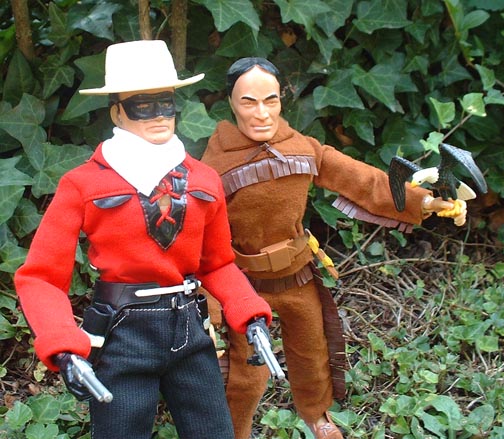
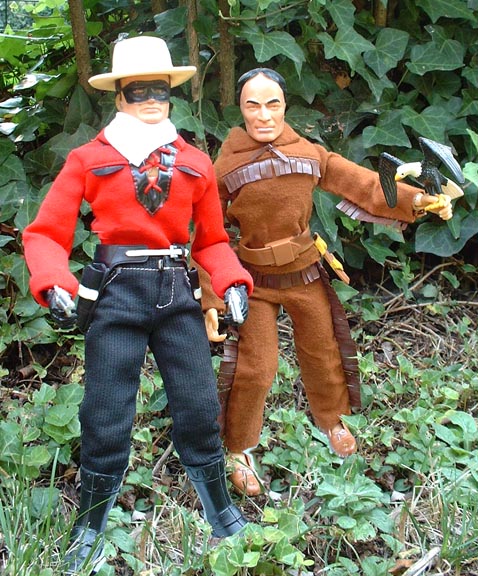
I past through the vapor trail of this fading phenomenon, playing Cowboys ‘n Indians with my friends as a virtual reflex, a boyhood tradition past down from my older brother and, quite likely, my father before him. I doubt, however, that I shared their enthusiasm for the milieu. My aunt and uncle owned a horse farm when I was young, so I did have first-hand experience with saddling horses, riding horses, and even cleaning out their stalls. Still didn’t make me a cowboy at heart. The closest I came to feeling like a western hero was when my dad got me a Lone Ranger outfit for my seventh birthday. What a thrill to wear the white hat and strap that silver cap-gun to my hip. Oh yeah, and inhaling the smoke from the barrel after the gun was fired (actually, it was a nasty little high which usually nauseated me. Don’t try this at home, kids).

My earliest western memory is watching The Lone Ranger cartoon in the late 60s. Clearly, The Wild, Wild West was the inspiration for this animated take on the radio show character since the art style reflects the look of TWWW’s opening credit sequences. Also, this Lone Ranger couldn’t be bothered with mundane issues like stagecoach robbers and cattle rustlers, instead taking on magical sorceresses, aliens, and villains in submarines. Even then, animators knew it would take more than the usual western clichés to hold the interests of early Gen-Xers.

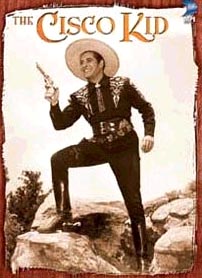
I still could enjoy some of the fast-paced half-hour western shows from the 50s which were aired in syndication, like The Lone Ranger, Hopalong Cassidy, and The Cisco Kid. I especially enjoyed The Cisco Kid, although it was a bit of a challenge to catch it since it aired in my hometown at 6 a.m. on Saturday mornings. I would struggle to pull myself out of bed, sneak down to the living room, and turn the t.v. on at a barely audible volume so as not to disturb my family. There was something irresistible about the show, however. Duncan Reynaldo as The Kid and Leo Carillo as Pancho made an amiable pair, and the stories were lightning fast, perfect for my equally fleeting attention span.

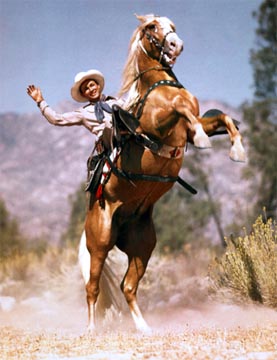
By the time I was 11, our local independent station, WBFF-TV Channel 45, started airing what amounted to an old-fashioned Saturday afternoon at the movies. Between 1 and 4 p.m. every Saturday, they would show a chapter from a cliffhanger, a short subject like Laurel & Hardy, and a western. For about two or three years in the mid-70s, I was given a crash course in early horse operas. I have to say I preferred Roy Rogers over all the rest. He had a certain sincere quality and humble demeanor that defined what an American hero should be. Most of the others, like William Boyd or Randolph Scott, had that tough talking, wise guy thing which always rubbed me the wrong way. Sometimes it felt like the good guy was ruder than the villain. Not so with Roy Rogers. He was always soft spoken, earnest, and polite, even when he was pointing a six-shooter at a cattle rustler’s abdomen. As for Gene Autry, give me a break. He looked like the pharmacist from the corner drugstore.

Aside from a revival of The Lone Ranger cartoon in the early 80s, the western motif faded from the childhood lexicon of fantasy. By then, Star Wars had taken hold of everyone’s imagination. Of course, Han Solo and the border town of Mos Eisley borrowed heavily from the iconic western images. More recently, the t.v. show Firefly and its movie sequel Serenity mixed an obvious cocktail of science fiction and western, but it never grew beyond a cult audience. Perhaps the overarching western theme, that of total freedom in a wide open land where an individual enforces his own brand of justice and forges his own destiny, is just a little too hard to swallow in our overcrowded, constantly connected, hi-def, Big Brother world. Forty years ago, people could still dream of returning to that simpler time. Maybe now it’s just too far gone to even contemplate.

Wednesday, June 27, 2007

JOHN CARTER OF MARS - THE ACTION FIGURE

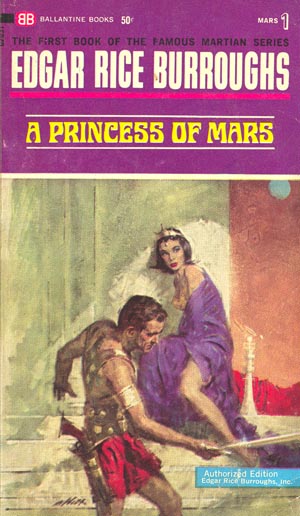
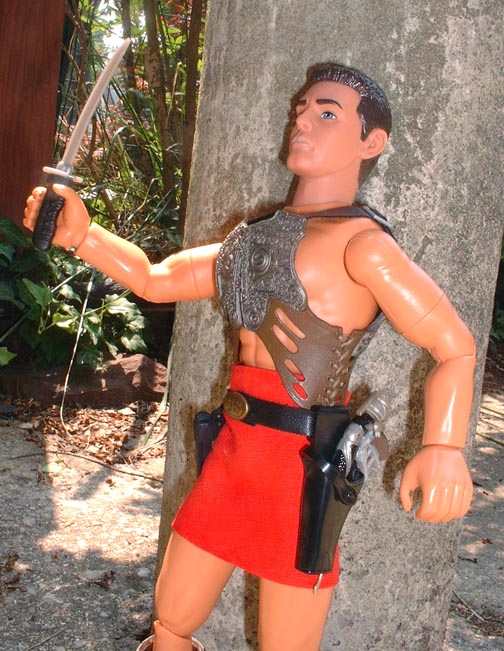
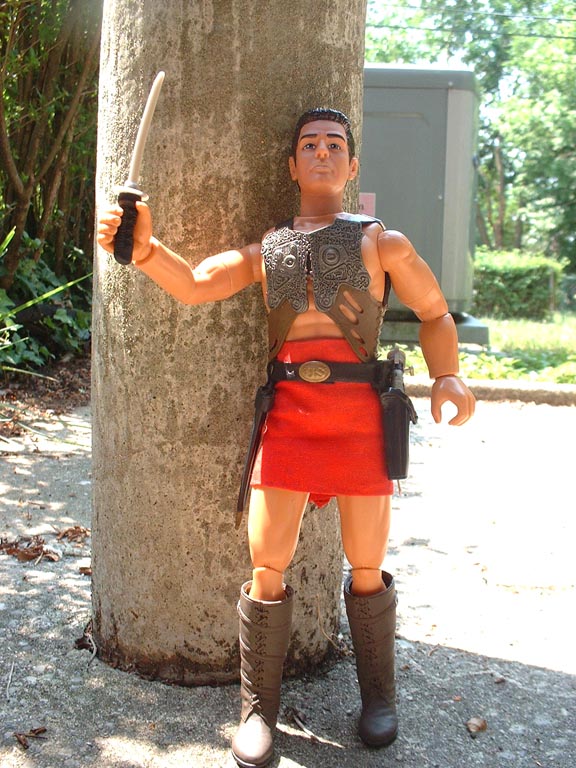
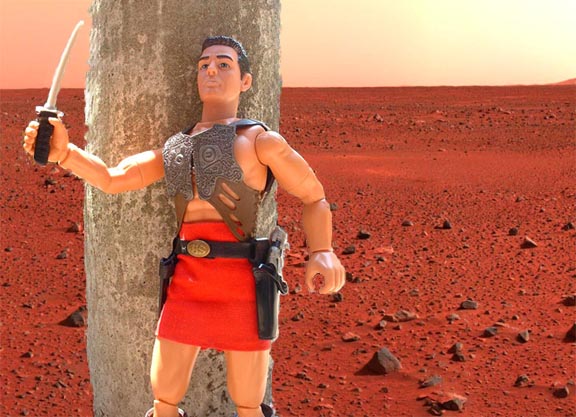
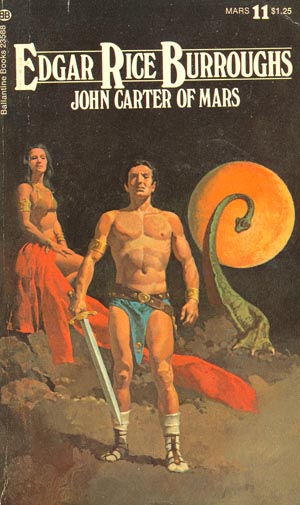
A few weeks back, I blogged about how the books of Edgar Rice Burroughs (and the related movies and comic books) had a great influence on my imagination in my early adolescence. I hesitated writing the posts since I had no toys or custom action figures to talk about, and I've tried to stick mostly to toy and action figure commentary in this blog. However, ERB was a huge part of my teenage years and still provides inspiration in my writing, so I plunged ahead and wrote what was on my mind at the time. Then I got to thinking about maybe creating a custom action figure based on the classic ERB hero, John Carter of Mars. I didn't want to go overboard and buy any new materials for the custom, but I wanted to do something that would provide at least a vague resemblance to the John Carter renderings which appeared on the old paperbacks. The artists who illustrated those covers gave John Carter a slightly gladiator look, except he carried a radium gun along with his sword. And the radium gun was usually depicted as sort of a musket/ray gun like Alex Raymond may have envisioned it. So I dug through my bins of leftover action figure accessories, old dolls, and fabric remnants. Without too much effort, I came up with what I think is a pretty serviceable figure.


I started with an old action figure I bought as part of a lot sale on eBay. He's too brawny to fit in most of the clothes I have, but looks pretty manly in gladiator-type apparel. His chest plate was left over from a Hellboy action figure, and his boots are from a Van Helsing action figure (remember that movie?). The belt came from a Civil War costume, including the scabbard (John Carter did fight in the Civil War, after all). The holster for the radium gun is of more modern design, swiped from a G.I. Joe belt. The radium gun itself was pieced together: the barrel section was the hilt from Count Dooku's light saber, and the handle came from some oddball weapon that the Van Helsing doll had. The sword was from a G.I. Joe.


For the kilt, I found some red fabric, cut it to size, hemmed it with fabric glue, and added a Velcro attachment on the back. These are the kinds of projects that are often the most fun, where everything can be pieced together from extra bits lying around. I'm rather happy with it.

Tuesday, June 12, 2007

DICK TRACY - PART TWO

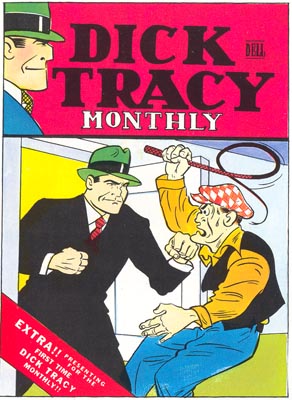
During the 80s, Dick Tracy faded from my consciousness like so many heroes of my youth. As a child, I wanted to be a cartoonist like Chester Gould, both writing and drawing the stories. By adolescence, I realized that my drawing abilities would never rise above accomplished doodler, so I focused on writing and buried dreams of being a comic book auteur. Still, I continued to collect comics through high school and college, and if I came across one of the old Dick Tracy comics put out by Harvey or Dell, I would buy it and try to rekindle my old excitement for the character. The nostalgia was fleeting, however.


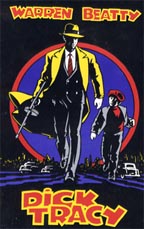
Then came the Dick Tracy movie in 1990. After the gargantuan success of the first Batman movie the year before, Disney tried to recreate the same sort of hype around their comic movie. What they didn’t understand was that, while the Batman movie was a new take on an ever-evolving comic book icon, the Dick Tracy movie was a fond homage to a character whose glory days were long past. From an artistic standpoint, I could agree with Warren Beatty’s decision to set the movie in a colorful, stylized facsimile of 1930s Gangland Chicago. Along with the Depression-era cars and furnishings, the quaint gadgets which would’ve passed for high-tech in the 30s, like the two-way wrist radio and the wire recording device, added a wonderful sense of place. Beatty chose older, veteran actors to play the famous villains, none of whom would draw much interest from a younger crowd. Madonna was the only star the kids could get excited about, but she was far from the Material Girl as she sang retro-30s inspired songs by Stephen Sondheim. All this added up to a quasi-musical aimed at an over-30 audience. While I enjoyed it, I knew this was not going to draw the same kind of lightning that the Batman movie did, and I was correct.

Given the interest in action movies at the time, I think Disney would’ve fared better had they used a more modern approach. Set the movie in present day, utilizing some of the fancy gadgets Dick Tracy was already using, like a wrist communicator/computer and the flying air cars. As a cross between Die Hard’s John McClane and James Bond, Dick Tracy could’ve gotten a new lease with a young audience. Also, Madonna would have worked better as a stripper-with-a-heart-of-gold doing video-style production numbers in slinky lingerie. Now that could’ve been a franchise for the 90s. Instead, the movie did adequate business, then disappeared without much fanfare. Only the licensed toys, books, and do-dads, languishing in bargain bins for years, provided any lasting reminder of the film.

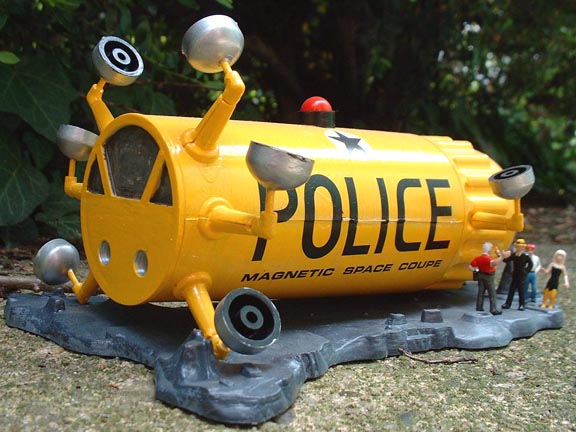
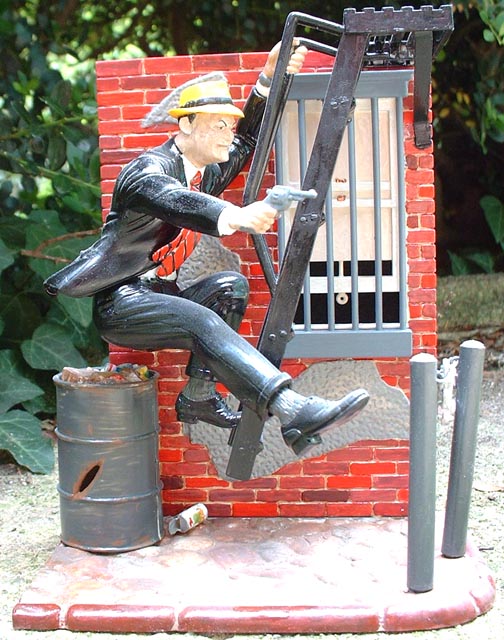
A decade later, Dick Tracy entered my consciousness again when Polar Lights, the model-making subsidiary of Playing Mantis, put out reproductions of the Dick Tracy model kits that Aurora produced in the 1960s. One kit was a really nice diorama showing Tracy jumping off a fire escape in a dirty alleyway, his gun leveled on some unseen perpetrator. The other kit was a scene on the moon featuring the magnetic Space Coupe. I had just gotten back into model building as therapy to quit smoking, so I was thrilled to work on these detailed dioramas, from painting each individual brick in the apartment building wall to putting fine touches on the teeny figures standing next to the Space Coupe.

At the same time that Polar Lights was releasing these models, parent company Playing Mantis had released a reproduction of the old Captain Action figure. In addition to recreating some of the old hero costumes that Captain Action once wore, like the Green Hornet and Lone Ranger, PM put out new outfits like Ming the Merciless and Kato. Since PM apparently had the license to release Dick Tracy models, I was hoping they would put out a Dick Tracy outfit for Captain Action. Sadly, the Captain Action line didn’t catch on and was dropped after only a few years. I’m pretty certain they would’ve gotten around to making one had the new Captain Action been a success. At any rate, it got me thinking about making my own custom Dick Tracy figure.

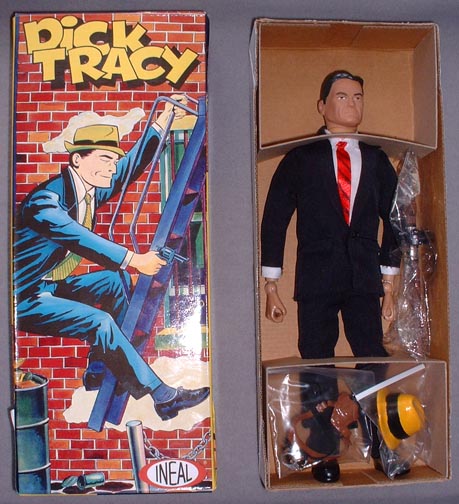
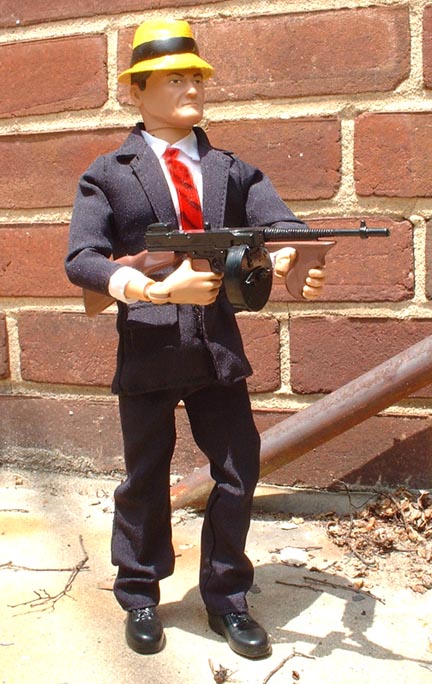
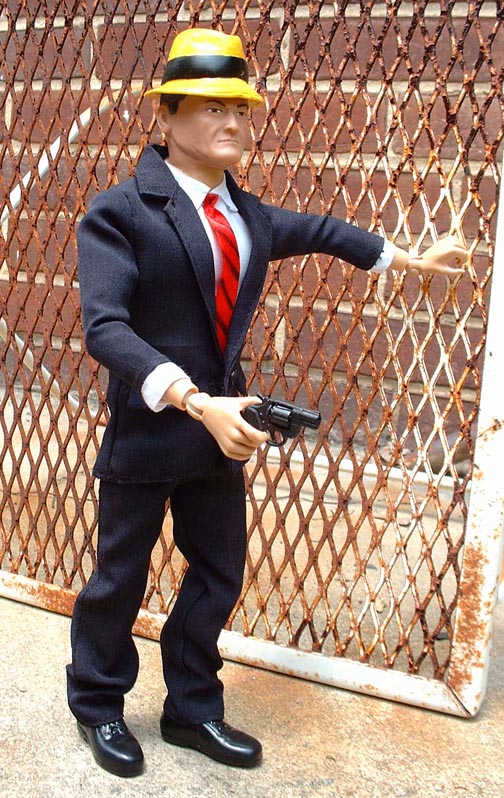
The outfit itself was simple enough, since Dick Tracy always wore a black suit, white shirt, and red and black striped tie. The suit came off one of those Presidents of the U.S. dolls, and the shirt and tie are from a Ken doll (I drew the black stripes on the tie with a Sharpee). I made a yellow hat for him by repainting a leftover hat from one of the Green Hornet outfits I had bought. Tracy was also known for his yellow overcoat, but that was a garment mostly seen in his pre-60s incarnation, so I didn’t feel obligated to recreate one. As for accessories, I bought a detective outfit from Old Joe Infirmary which contained a badge, gun, holster, pager, and handcuffs. For the two-way wrist t.v., I found a jazzy watch in a scuba diver set that fit the bill.


I also picked up a tommy gun separately should Tracy need more serious fire power.

The tough part was finding an action figure that resembled Tracy’s unique features. I couldn’t find one with exactly the right nose, but Cotswold Collectibles offered a headsculpt which suggested Tracy’s grim expression pretty well. After assembling my custom figure, I thought it might be fun to give him a 60s style box. Although I’m not clever enough to print boxes like some other customizers, I thought the box which contained my Dick Tracy model kit looked an awful lot like one of those old “coffin” boxes that G.I. Joe and Captain Action came in. For the outside of the box, I did some minor alterations to the graphics. On the inside, I swiped the figure stays from a Playing Mantis Captain Action box and recut them to fit inside the model box. With these changes, I had my own box for Dick Tracy.


I think kids in the 60s would’ve gone ape for an action figure like this.

Thursday, June 07, 2007

DICK TRACY PART ONE

As someone born in the 1960s, I often feel like I lived the first half of my 40-odd years in one era and the other half in a different era. The pivot point, in my mind, was the proliferation of the personal computer in the 1980s. Just as Henry Ford’s Tin Lizzy fundamentally changed the way Americans (and much of the world) conducted their daily lives, PCs and Macs have dramatically changed both our personal and professional routines beyond all recognition. For young adults who were born in the 80s, I don’t think they can fully appreciate how different things used to be, just as I could hardly imagine my parent's world before television.


One of the major changes since the 1980s is the eroding influence of newspapers. Of course, newspapers still exist, but there are far fewer than when I was a kid, and virtually all newspaper organizations now have a strong Internet presence which I would wager gets far more attention than their printed version. Cable and satellite news channels have also become the go-to outlets for instant news and information, relegating newspapers to a portable information product used when accessing a computer, Blackberry, cellphone with web access, or a television is not feasible. Information rushes at us from so many different sources, I don’t believe anyone seeks out one primary source any longer.

During my childhood, when the Internet was unheard of and television news was squeezed in between afternoon cartoons and the prime-time line-up, newspapers represented the main source of in-depth information and analysis, and most major cities had at least two newspapers fighting for your daily attention. Since the news was pretty much the same in both papers, they had to lure you with unique features. One such competitive feature was the comic strip page. Believe it or not, many people chose their source of news based on which paper had the best collection of comic strips. As a result, a popular comic strip was extremely important to newspapers and could be quite lucrative for both the syndication outfit and the comic strip producer.

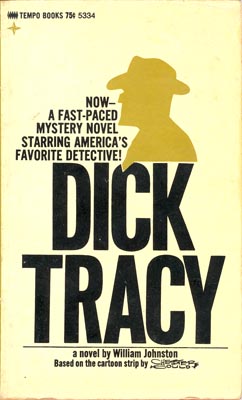
A handful of these popular strips have gone on to become cultural icons, like Dick Tracy. This gumshoe with the squared-off nose was a comic strip titan, drawing millions of readers every day for decades. Long before I came along, Dick Tracy’s popularity in newspapers spawned media spin-offs including movies, television shows, toys, comic books, and Big Little Books. The hard-boiled crime fighter, born in an era when G-Men were rounding up Depression-era gangsters, served as a cathartic outlet for those who felt anxious and helpless in an uncertain world. Once raised to the top of the entertainment heap, Dick Tracy retained his popular status into the 60s, before his creator Chester Gould made some inexplicable changes to the strip and snatched defeat from the jaws of victory.

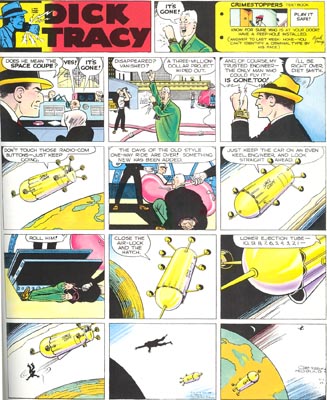
Given the strong interest in the space program, Chester Gould decided to give Dick Tracy a sci-fi angle with the introduction of the Space Coup. Soon, Tracy was taking frequent trips into space and hooking up with people on the Moon. Of course, by 1969 we landed on the Moon and confirmed that no one lived there, killing a vital element to the 1960s Dick Tracy world. Also, Tracy was known for his violent methods in dealing with criminals. After the assassinations of Martin Luther King and Robert Kennedy, people were beginning to re-think our prurient fascination with violent entertainment. Dick Tracy was becoming a sad anachronism just as I reached reading age. This didn’t stop me from loving the strip, though.

In my hometown, Dick Tracy appeared in The Baltimore Evening Sun. Again, no CNN or all-day Internet access, so many newspapers ran morning and evening editions. The other Baltimore paper, The News American, ran once a day in the afternoon. My parents subscribed to The News American because it had all the Hearst syndicate features. However, my Dad would usually pick up a Sunday edition of The Sun Papers when he went to the convenience store for smokes on Saturday night. The Sunday edition featured two separate comic sections in full color. That’s where I discovered Dick Tracy.

In the 1970s, Dick Tracy was returning to his more gritty, police procedural formula, although he still had some futuristic gadgets like his two-way wrist t.v. and the hovering air cars in which the detective could zip around the city. At first, I didn’t realize that the strip ran daily, so I was confused why I couldn’t follow the plots simply by reading the Sunday edition. Once I figured out that we needed to receive the Evening Sun every day, I begged and pleaded with my parents to switch papers, but to no avail. Actually, I wanted them to receive both papers so I could continue to read Steve Canyon and The Phantom in The News American, but I digress.

The day before I got my Sunday comics fix, I would watch Archie’s Famous Funnies, where popular comic strip characters were presented in short cartoon segments. Dick Tracy had a regular segment on the show, but it was entirely too short to develop any real plot. All it did was tease me with the desire for a full half-hour devoted only to Tracy and the gang. Weekday afternoons, the local stations would run an old Dick Tracy cartoon series from the 60s, but this series was played for laughs with Tracy sending out a goofy array of bumbling assistants to do the actual crime fighting. Pretty unsatisfying offerings, but I took what I could get.

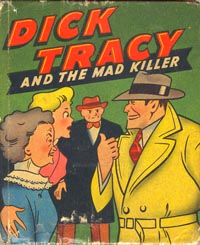
Slightly more interesting was a Big Little Book I got at the time called Dick Tracy Encounters Facey. I loved Big Little Books and this one dealt with a villain who could mold his face to look like other people including Tracy himself. I was so inspired by the book, I stapled together strips of paper about the same size as the Big Little Book and wrote my own adventure story in the same format. You remember: text on each left-hand page and an illustration on each right-hand page. I don’t recall the exact story, but the hero and heroine were named Rudy and Roxanne. Give me a break; I was eight years old.

What really cemented my interest in the super cop was when my Dad brought home a big coffee-table type hardcover from the library which compiled all the daily and Sunday Tracy strips from the beginning in 1931 all the way into the 1940s.This was the detective in his prime and, after spending hours pouring over this huge collection, I felt like I really understood what Dick Tracy was all about. The wild, grotesque villains, the sadistic torture tests Tracy was regularly subjected to, and the violent retribution Tracy would exact from these devious thugs. Many would die tragically by their own hand, showing how a life of crime in itself would lead to one's own downfall. Probably a little over the top for today’s audiences, but wonderfully moving for a child.

I continued to follow Tracy’s adventures throughout the 70s, reading the color strip every Sunday, then befriending kids in the neighborhood who received The Evening Sun and scanning the comic page in between playing with our G.I. Joes. Then on December 25, 1977, creator Chester Gould drew his final Dick Tracy strip. Just a silly gag strip for the holiday, I paid little attention to it and had no idea at the time that this would be Gould’s farewell. The strip continued the very next day, but the artwork looked slightly different now that Gould’s inker Rick Fletcher took over. The stories themselves actually improved as mystery writer Max Allen Collins helmed the writing, but somehow I didn’t enjoy it anymore. I felt a bond with Chester Gould’s quirky style, and this more mature Dick Tracy wasn’t working for me. I lost complete interest when Dick Locher assumed the drawing duties, as his style was far too cartoonish for me.

When the Dick Tracy movie came out in the summer of 1990, I decided to check back with my old detective friend. The News American had folded a few years prior, and The Sunpapers only published one edition in the morning. Dick Tracy had survived the comic strip layoffs and was appearing in the new morning edition. Art reflecting life, the story line during that summer dealt with Hollywood making a movie based on Dick Tracy’s life. I thought the whole thing pretty lame and stopped reading before the arc was completed. I imagine many other readers felt the same way, because The Sunpapers dropped Tracy’s strip shortly afterward. The Dick Tracy strip still continues solely under Dick Locher’s guidance, but now I would have to read it on the Internet. From the looks of it, I can’t really see the point.

Thursday, May 31, 2007

JOHN CARTER OF MARS

Although Tarzan is by far Edgar Rice Burroughs’s most famous creation, John Carter of Mars was his first and, for my money, his most interesting. In the novel A Princess of Mars (originally titled Under the Moons of Mars), we are introduced to Virginia Civil War Captain John Carter who, while entering a lonely cave, is consumed by a mysterious vapor which renders him unconscious. When he awakes, he finds that he is on the planet Mars. Naked and completely vulnerable, he happens upon a nest of giant eggs. Turns out these are the incubating offspring of the Tharks. Soon, he is attacked by a group of 15-feet-tall, green creatures with four arms and tusks jutting from their protruding jaws. While unarmed, Carter is able to avoid injury by leaping great distances and exhibiting tremendous strength, thanks to the lighter gravity on Mars. The leader of the Thark group, Tars Tarkus, finds Carter a novelty and decides to take him back to his village. Here Carter meets the other Tharks and learns the language of Mars, or Barsoom as it is called in the native tongue.

Carter becomes a welcome honorary member of the Tharks until an airship crashes near the village and red-skinned humanoids are rousted from the craft by the Tharks. It turns out they are from Helium on a scientific expedition, but the Tharks don’t buy their story, having been at war with the Heliumites for years. The expedition is led by the raven-haired Princess Dejah Thoris and, being that she looks like the hot chicks back home, Carter instantly falls for her. When one of the Tharks tries to kill the Heliumites, Carter kills the Thark, suddenly putting him on the outs with his adopted people. Soon, Carter and Dejah Thoris are on the run. Eventually, Tars Tarkus defies his own people and befriends Carter. From this point, Carter bounces from one battle to another, one adventure to another, and wins the hand of Dejah Thoris. However, he dies on Mars and returns to Earth. After living a successful life on Earth, he dies a natural death, but returns to Mars as his younger self to continue his adventures. There’s a lot more, but that’s the basic gist.

My first exposure to John Carter was not from the original novels, but through comic books. In the late 70s, Marvel ran a comic series based on the hero. The artwork was handled by various artists over the years, but the books were all top quality. Since I was heavily into comic book collecting at the time, I also found the John Carter stories which appeared in DC Comics title, Weird Worlds. Incidentally, the back-up feature in Weird Worlds was my old friend David Innes from Pellucidar. Finally, I landed copies of Gold Key’s John Carter comic from the 60s. Although the artwork was simplistic, I loved the straight forward nature of the story telling. I later learned that these were reprints of Dell comics from the 50s and were closely based on the early Burroughs novels. That convinced me that I needed to read those books.

I have to be honest; I only read the first book and a few others. By the time I got around to the John Carter series, I was entering high school and my attention was slipping to other interests. Still, I was intrigued by the concept of such a civilization, so strange and yet so close to our own planet. The fact that Carter’s experiences happened in the 1800s set up a plausible time line, at least in my teenage mind. Burroughs made it clear that the inhabitants of Barsoom were hanging on by a thread on this desert planet, using an “atmosphere factory” to maintain a breathable climate. The Viking mission of 1976 led us to believe that Mars was essentially a barren rock. To me, this meant that the races of Barsoom, torn by arrogance and hostility, fought and argued while their fragile environment wasted away. Carter experienced the final years of their civilization, before they were choked by the feeble atmosphere and buried in the sands of Mars. Unlike the uncharted islands or underground worlds of Burroughs's other stories, the Mars premise seemed almost plausible. I wanted to believe that perhaps this world did once exist.

For the past few years, a movie project based on John Carter has been kicked around. Currently, it looks like the Warlord of Mars is in the hands of Disney and the Pixar people. God help us! All I can say is, I hope they don’t screw it up. Just like Jules Verne and H.G. Wells before him, Edgar Rice Burroughs invented a new type of story telling which formed a pillar in the genre wing known as science fiction. Without Burroughs, there is no Buck Rogers, Flash Gordon, or even Star Wars. His blending of swashbuckling and planet hopping, swords and ray guns, Arabian-style kingdoms and weird aliens, created a style we have loved for decades. Disney must understand that they are dealing with the original article, and they must treat Captain Carter with a great deal of respect.

Wednesday, May 23, 2007

EDGAR RICE BURROUGHS

I recently read that Gordon Scott, the actor who portrayed Tarzan through the second half of the 50s, died in my hometown of Baltimore while being treated for a heart ailment at Johns Hopkins Hospital. Forget about Johnny Weismuller; Mr. Scott was the best Tarzan for my money. He was handsome, well-built, and he played Tarzan as an educated person, like in the books. None of this “You Jane, me Tarzan,” garbage. The Tarzan movies from that era were also slick productions, in full color with strong performances (catch Sean Connery as a baddie in Tarzan’s Greatest Adventure). Yessir, Gordon Scott was the Tarzan for me, and the fact that he spent his remaining years so close to where I live seemed like an interesting coincidence.

Tarzan, of course, was Edgar Rice Burroughs most well known creation, but he was the least interesting to me as a child. Tarzan movies from all eras, from the 30s to the 60s, were a ubiquitous part of weekend television when I was a child, so I watched them regularly, but I don’t think I was ever able to finish a whole Tarzan book. Jungle stories just didn’t excite me that much. I was more of a science fiction guy, and I had no idea that Burroughs wrote primarily sci-fi until I went to see The Land that Time Forgot.

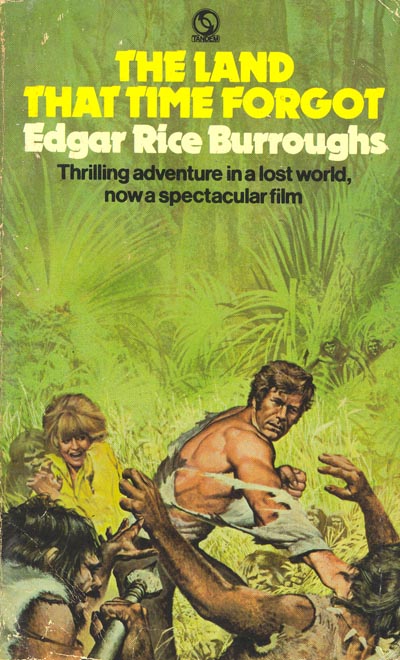
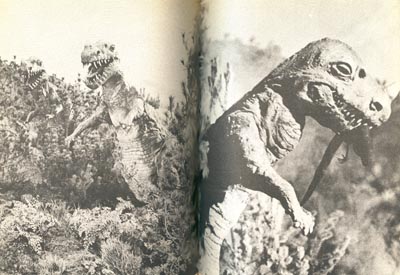
Released in 1974, The Land that Time Forgot was a modestly budgeted movie starring aging t.v. star Doug McClure and produced by the British company Amicus Productions, known primarily for modestly budgeted horror films like The House That Dripped Blood. In a nutshell, McClure is an American traveling on an ocean liner in the Atlantic during WW I when it is torpedoed by a German U-Boat. Stranded in the water, McClure and his fellow castaways launch an improbable attack on the U-Boat and take it over. They then end up lost and find an uncharted island hidden from the world by a perpetual fog. Once ashore, the international crew discover a volatile world of volcanoes, dinosaurs, and cavemen. Since this was 1974, the dinosaurs are rubber, the caveman makeup is laughable, and the volcano special effects are crude. But for a 10-year-old in the 70s, this was really exciting stuff.


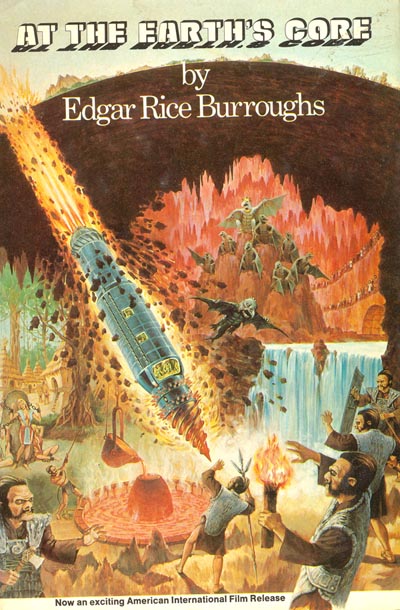
Amicius quickly followed up with a movie based on another Burroughs book, At The Earth’s Core. Also starring Doug McClure as David Innes, this time he’s teamed with horror legend Peter Cushing as two intrepid explorers (they were all intrepid back then) who traveled to the center of the Earth in a turn-of-the-century machine which looked like a cross between a tank and a gi-normous drill. The Earth turns out to be a hollow ball with a tiny sun in the center. A whole civilization lives on the inner surface of the Earth, bathed in eternal daylight. Of course, we don’t have much time to ponder the science since the set-up is just an excuse to fight rubber dinosaurs, primitive humans, and a race of bird-like bad guys (i.e., men in rubber suits). After seeing this second movie, I was convinced there was more to this Burroughs guy than just stories about guys in loincloths.

Around this same time, I was becoming a rabid reader, and I begged my dad constantly to visit the Waldens Books at the local mall. My favorite section to browse was Science Fiction, and there I discovered shelf after shelf of Edgar Rice Burroughs books. I was stunned at the number and diversity of his work. My first purchases were the books I had seen adapted on the screen. To my surprise and pleasure, the books were much better than the movies. There’s a certain special exhilaration one feels when one discovers a writer with whom one can’t get enough of, and given Burroughs library, I knew there was plenty for me to feast on for quite awhile.

After reading TLTTF and At the Earth’s Core, I moved on to their sequels, The People that Time Forgot and Pellucidar. The former was also made into a movie starring Patrick Wayne (John’s son). It was on par with the earlier movies and featured a cameo by perennial Doug McClure, but the movies just couldn’t live up to the source material.

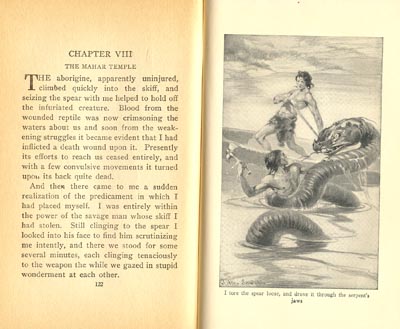
This was my pre-teen/early teen period, when I was also a big comic book collector. The cool thing about comic collecting back then was that comic people also tended to be mad science fiction buffs, so there was a cross-over of collecting comics and second-hand books. While I was buying old comics, including old comics based on Edgar Rice Burroughs stories, I also came across first editions of Burroughs books. Those musty hardcovers with the painted illustrations inside made the reading experience even more exciting, as if I were making a direct connection with the era when these stories were first written. I spent those sultry summers in the late 70s sitting on my back porch reading those books until the sun light faded from the evening sky. I would always burn a citronella candle next to me to keep away the mosquitoes. I don’t think it ever worked based on the number of bites I received, but the smell of the stuff brings me back to those days when I was alongside David Innes fighting wild creatures on Pellucidar.


For those who are avid Burroughs fans, it might surprise some that I started with these lesser known books. I actually took awhile to work my way to what is probably Burroughs’s second greatest creation next to Tarzan. That is, of course, John Carter of Mars. More on him next time…

Tuesday, May 15, 2007

JSA SERIES - HAWKMAN

As a child, I never liked Hawkman. I think it was because of the hawk mask and the ultra-realistic wings. I couldn’t tell whether he was man or bird or both. The whole costume was just a little too creepy for me. That probably explains why he was never a big mover of comic books: kids were just creeped out by him. As an adult, however, I was impressed with his elaborate garb.

Physically, Golden Age Hawkman and Silver Age Hawkman looked pretty much the same. Of course, as was the case with the reintroduction of these old characters in the 50s and 60s, their origins were quite different. While the Silver Age origin is pure science fiction, Hawkman’s Golden Age origin is rooted in ancient mythology. Carter Hall believes himself to be the reincarnation of Egyptian Prince Khufu. His girlfriend Shiera Sanders also thinks she has an Egyptian soul in her, and the two become Hawkman and Hawkgirl to defeat the reincarnation of ancient priest Hath-Set. Using something called “Ninth Metal,” they make anti-gravity costumes with cool hawk wings. The ensuing stories take on an unusual air of romance and ancient mysticism.

Like his colleague the Flash, Hawkman did his regular duty in Flash Comics as well as functioning as a member of the Justice Society of America. Somewhere along the way, for reasons I’ve never been able to uncover, Hawkman’s giant hawk mask was replaced with a simple yellow cowl which made him look like a Mexican wrestler. Although he was less scary looking with the cowl, he lost a great deal of his mystique. The issue was moot, since all the old super heroes got the boot in the early 50s. When Hawkman was resurrected during the Silver Age, his big hawk mask was brought back.

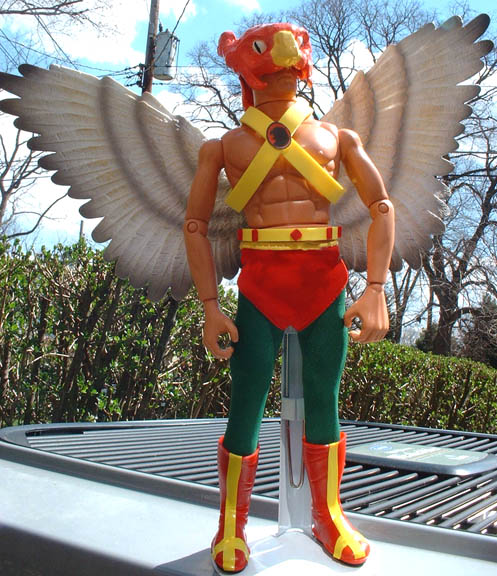
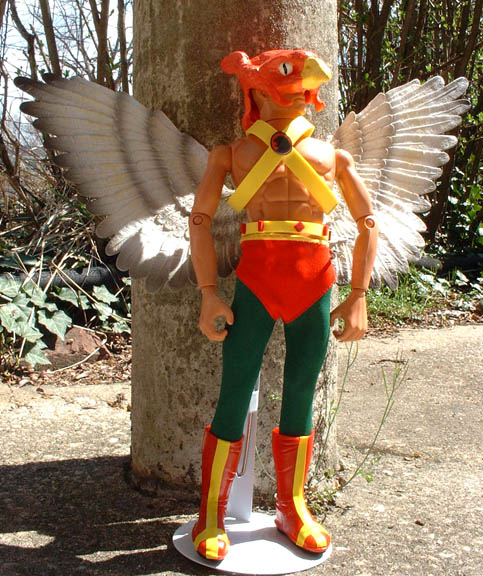
My custom Hawkman took a re-eeaa-lly long time to put together. Rauty’s Toy Store offered the basic Hawkman costume, which consisted of the tights, belt, and criss-cross chest thingee. The big issue was the hawk mask and the wings. I bought the costume years earlier, but it took a long time to figure out how to make the wings. Finally, I read in the Yahoo! Captain Action forum that a fellow customizer used the wings from an X-Men Angel figure. Although the Angel figure was several inches smaller than my 12-inch figures, the wings were oversized and, therefore, worked perfectly for my Hawkman. After snagging an Angel figure on eBay, I chopped off the wings and the back attachment from the Angel figure and re-attached the whole assembly on a standard G.I. Joe figure with screws and model glue. It’s not very pretty from the back, but the effect is great from the front.

The next big issue was the mask. Dale Van Slyke once sold a rubber Hawkman mask on eBay, but I didn’t think it was quite what I was looking for. I swallowed hard and attempted to create a mask with Sculpey. To my surprise, my clay modeling skills weren’t too bad and the mask did look something like a hawk head. Unfortunately, the Sculpey was too thick and the mask looked way oversized on poor Joe’s head. The second attempt looked better, although I had to give the wings on the sides of the helmet a swept-back look so that the mask would not be so unwieldy. Now that I’ve become more proficient with Sculpey, I may take another shot at the mask with wings that stand up on top more. The boots were standard red boots sold by Classic Plastick, but I used yellow electrical tape to fashion the talon-like stripes.

Anyway, here is the final product. Probably one of my most difficult custom jobs, but highly satisfying.


Wednesday, May 02, 2007

JSA SERIES - GOLDEN AGE FLASH

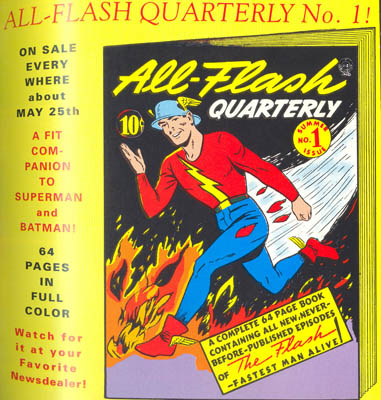
When I first laid eyes on the Golden Age version of the Flash, I could understand why DC Comics made such a radical upgrade for the Silver Age incarnation. Instead of the unitard, which was standard apparel for Silver Age heroes, Golden Age Flash wore light-blue chinos and a red, long-sleeved t-shirt with a yellow lightning bolt racing out of his trousers. Footwear consisted of red, ankle-high booties with little yellow wings on the sides. But the worst fashion choice was the helmet. Capes may be cumbersome for a super hero, but hats and helmets are downright silly (sorry Magneto, but it had to be said). In an attempt to suggest the mythological god Mercury, Golden Age Flash wore a silver head covering which resembled a World War I doughboy helmet, adorned with yellow wings similar to those on his feet. The whole effect was to suggest an utterly fabulous utility worker rather than a courageous crimefighter.


This older version of Flash had an origin about as silly as his outfit. College chemistry major Jay Garrick has one of those chemical accidents so common in comic books. He inhales the fumes of his concoction and develops the ability to run at super fast speeds. Instead of entering the Olympics, Jay decides that his powers are best served fighting crime, so he throws together the aforementioned costume and sets out to be a super hero.

The Flash followed the career path of many similar Golden Age heroes, making his debut in late 1939 in Flash Comics (not named after the character, but perhaps the character was named after the book title). He joined the Justice Society of America, then left the group once he got his own comic (called All-Flash to distinguish it from the regular Flash title). After World War II, his popularity, like those of his costumed colleagues, faded and the comic titles he appeared in were systematically dropped. Once he lost his own title, he returned to the Justice Society, but that group would also fade from existence in the early 50s with the cancellation of All-Star Comics. In 1956, a new version of The Flash was introduced, with a better costume, better origin, and better artwork. This is when many comic fans say the Silver Age began, and I won’t argue that assessment.

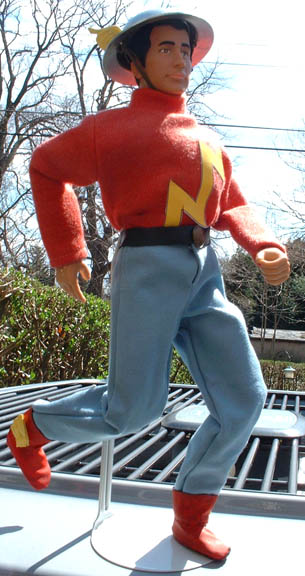
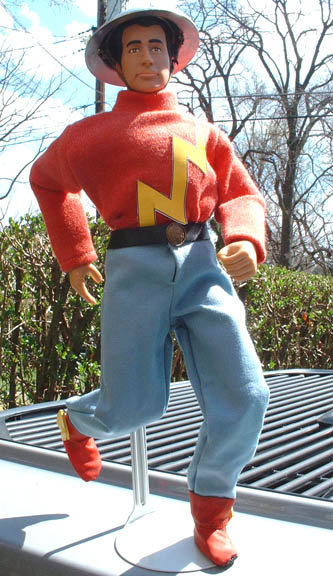
It took me a long time to figure out how to create a custom action figure based on Golden Age Flash. I couldn’t find a long-sleeved t-shirt in 1/6th scale, so I took one of my many white turtlenecks and dyed it red. The light-blue pants and belt were courtesy of a Civil War uniform. For the helmet, I started with a World War I helmet which I painted silver. By carefully cutting out sections of wing from a rubber eagle I bought at a crafts store, I had the wings for the sides, which I simply painted yellow and glued to the helmet.

The odd booties took some thinking. I ended up using the boots from an Aladdin action figure, which I painted red. For the wings, I cut yellow pieces of foam rubber into wing shapes. Not my best work, but fairly effective. For the figure itself, I needed one with a headsculpt that would suggest the way Jay Garrick was drawn in the comic since he didn’t wear a mask to disguise his face. I settled on a figure that came in ERTL’s Outdoor Fisherman set.

Keep ‘em flying, Flash!